
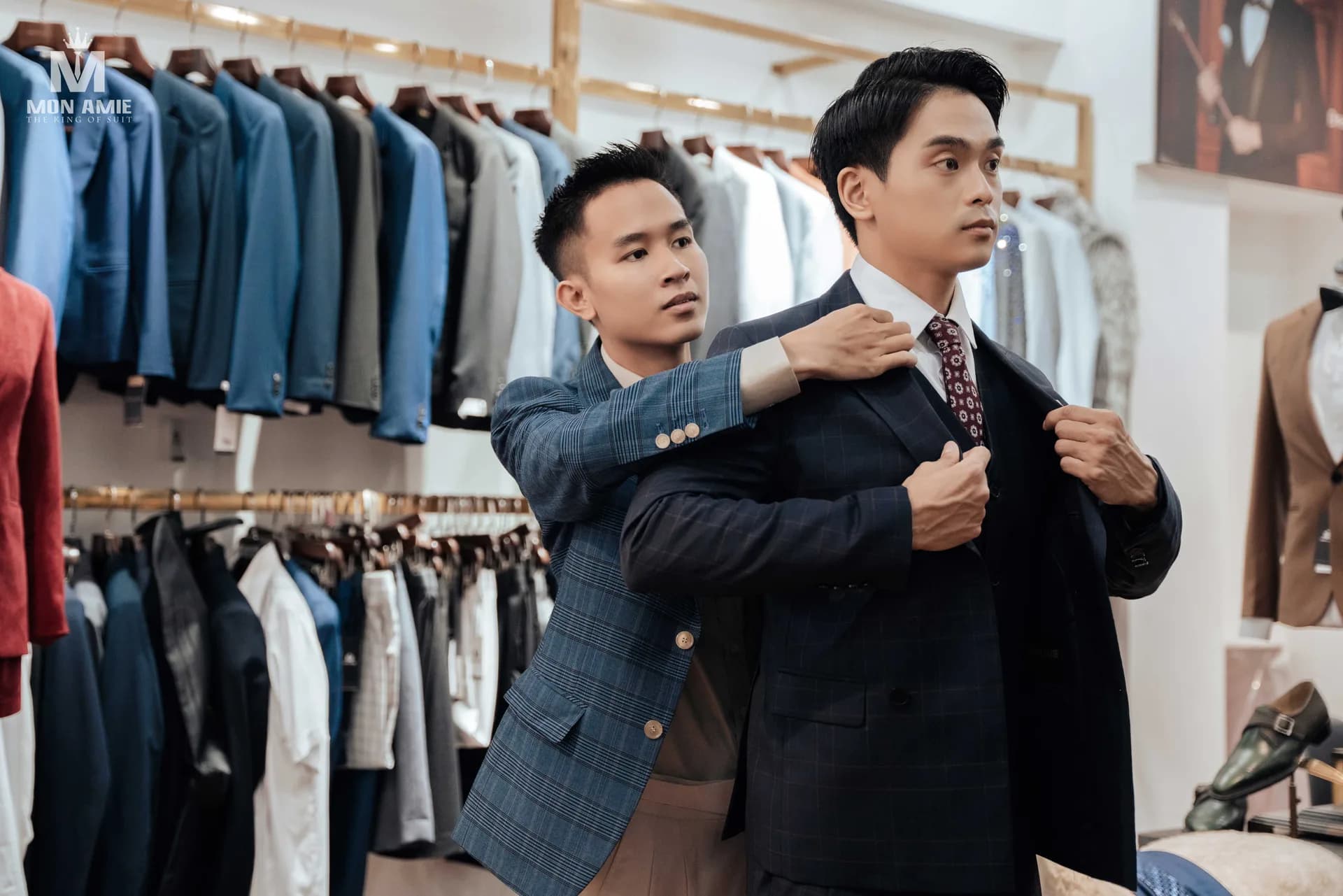
Pick up a suit in front of a mirror and most customers look at the colour and the price. A master tailor looks at the shoulder. It is not a trade habit kept for show: the shoulder is the one part of a jacket that can almost never be altered, while nearly every other flaw can be rescued. That is also the opening principle of how to choose a men's suit, which we would like to share with you here.
The short answer
Choose a men's suit in this order: shoulders, chest and collar, waist, jacket length, sleeves, trousers, then the canvas inside. The shoulders must fit exactly because they cannot be altered; the other parts can be adjusted. When you try a suit on, wear a real shirt and real shoes, put your usual items in the pockets, then raise your arms, sit down and bend over.
How to choose a men's suit in seven steps, from fit to detail
Step 1: The shoulders, the part that cannot be altered
The shoulder seam must sit exactly at the tip of your shoulder bone. If it sticks out past your arm, the jacket sags off the shoulder; if it falls inside, the jacket is tight and creases around the armhole. Seen from behind, the shoulders should lie smooth, not ripple into folds. If the shoulders are wrong, set price and colour aside and try another suit. The article on the shoulder line in a suit explains why in detail.
Step 2: Chest and collar
Fasten one button (on a two-button jacket, fasten the top button and leave the bottom one open) and let your arms hang naturally. The front of the jacket should lie flat. If you see an X-shaped crease around the button, the jacket is tight across the chest. The jacket collar should hug the shirt collar and not pull away at the back of your neck, and the lapels should lie flat on the chest.
Step 3: Waist
The waist line of the jacket should sit at your natural waist, where your torso is narrowest. The back should hang straight, with no horizontal creases. A slightly suppressed waist gives a clean silhouette, but too much suppression pulls the front panels open and makes them flare.
Step 4: Jacket length
The hem usually covers the seat completely. A familiar check: let your arms hang straight with your hands slightly curled, and the hem should almost touch your knuckles. A jacket that is too short makes your legs look shorter; one that is too long makes the torso look heavy.
Step 5: Sleeves
The sleeve ends at the wrist bone, showing about 1 to 1.5 cm of shirt cuff. The sleeve head (where it joins the shoulder) must not show twisting or horizontal creases, since these are a sign the sleeve has been set with a twist. A sleeve can only be shortened a little, so it has to be right from the start.
Step 6: Trousers
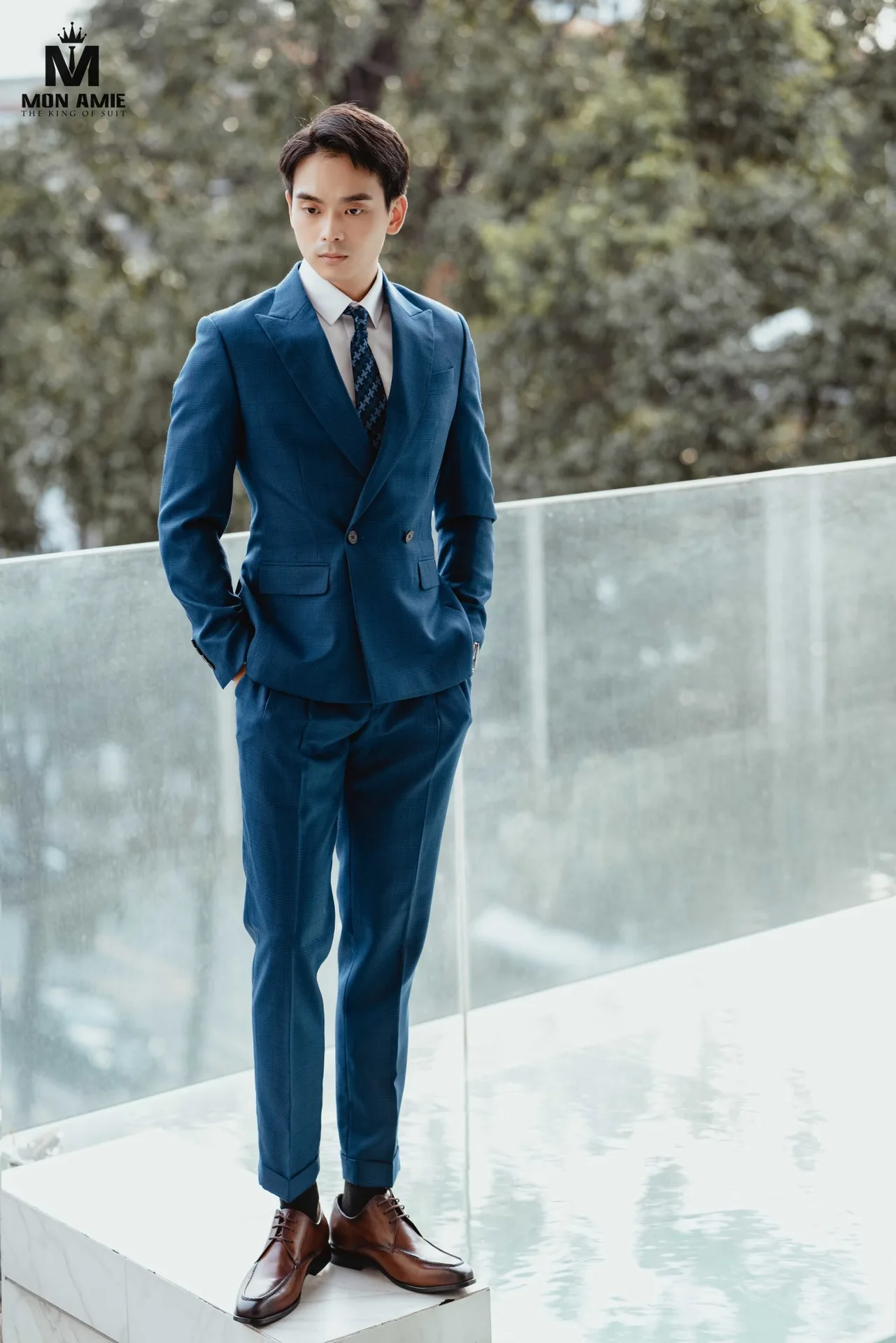
Suit trousers should fit at the waist without a belt cinched tight, the rise should not sit too low or leave excess cloth, and the pleats (if any) should lie flat and closed when you stand. The hem should rest lightly on the top of the shoe and break in a single small fold. Try sitting down: if the trousers pull across the thighs or the pockets show through, choose a looser fit.
Step 7: The canvas inside
This is the part customers notice least, yet it determines how long a suit holds its shape. There are three main types: full canvas (a stiff canvas layer built through the whole jacket body), half canvas (canvas at the chest and lapel), and fused (glued). A simple test: gently pinch the lapel at the chest. If the outer layer and the inner layer separate softly from each other, it is real canvas; if they are stuck together stiffly, it is most likely fused. Fused is not a flaw, but it can bubble after repeated dry cleaning and pressing. If you want to understand this structure more deeply, the article what is full canvas is a good place to start.
A checklist to bring when trying on a suit
Many men try on a suit in their everyday clothes and only realise at home that it is not right. Prepare these:
- The shirt you will wear with the suit. Shirt thickness changes how the collar and sleeves fit.
- The dress shoes you plan to wear. Trouser length is only accurate with shoes on.
- A belt or braces. To check the waistband.
- Wallet, phone, keys. Put them in the pockets as you normally would; many jackets only look good with empty pockets.
- The time of the fitting. Try on in mid-afternoon, when your body is in its normal state, not right after a big meal.
When you put the suit on, reach your arms forward as if holding a steering wheel, raise your arms high, sit on a low chair, and bend over to pick something up. If you feel the jacket pulling, a shoulder shifting out of line or the trousers straining, that is information to choose again.
Colour and style: what to choose for your first men's suit?
For a first suit, navy blue and charcoal grey are the two easiest colours to wear. A single-breasted, two-button style with a notch lapel (a gently curved lapel) suits both the office and parties. The pattern should be very subtle or completely plain. Bolder styles (double-breasted, peak lapel, strong stripes) are better left for a second suit. If you need more ideas based on body shape, read the article how to choose a suit for your body shape.
Common mistakes when choosing a men's suit
- Choosing by the size on the label. Size is only a starting point; the shoulders and sleeves decide.
- Buying bigger to "alter it later". The waist can be taken in, but altering the shoulders is almost impossible.
- Choosing the thinnest cloth because it looks "luxurious". Very fine cloth is beautiful but wears out quickly if worn every day.
- Ignoring how it feels when seated. A suit that looks good standing but is hard to sit in will rarely be worn.
- Buying by trend. The colours and styles that are fashionable right now may not suit your build.
Frequently asked questions
How is choosing a men's suit different from choosing a suit jacket or a blazer?
A suit is the full set of jacket and trousers in the same cloth, so when choosing a suit you need to check that both pieces work together. In Vietnam, a "vest" usually means just the jacket of a suit, while a blazer is a separate jacket, usually lighter and worn with trousers in a different cloth, so choosing a blazer only requires looking at the jacket and how well it pairs with the trousers you already own. Put simply: a suit is the whole set, a blazer is a single separate piece.
What colour should a first-time buyer choose for a men's suit?
Navy blue or charcoal grey, in a plain cloth or a very subtle pattern. These two colours work with most shirts and ties, and suit both work and parties. Black is more suitable for evening and formal occasions.
Is a made-to-measure or a ready-to-wear men's suit better?
Made-to-measure gives an exact fit because the measurements are taken from your own body, especially at the shoulders. Ready-to-wear is quick and convenient but needs extra alterations. If your build is standard, a ready-to-wear suit is still a fine choice; if you have uneven shoulders or a distinctive back shape, made-to-measure is almost irreplaceable.
How much does a men's suit cost?
For made-to-measure at Mon Amie, a full jacket-and-trousers set comes in three tiers: Essential from VND 4.8 to 10 million, Signature from VND 10 to 20 million, and Heritage above VND 20 million. The price depends most on the cloth, and you can see the details on the price list page.
How can you tell whether a men's suit fits at the shoulders?
The shoulder seam sits exactly at the tip of the shoulder bone, neither sticking out nor falling inside, and the shoulders lie smooth without rippling when you raise your arms. If you have to hold your breath or tug the jacket down to make it feel right, the shoulders are not right.
In closing
How to choose a men's suit sounds long, but these seven steps take only a few minutes in front of a mirror and spare you years of wearing a suit that does not fit you. If you would like a master tailor to measure your shoulders exactly and build the cut around you, book a fitting at a showroom or look at the Bespoke made-to-measure service.