
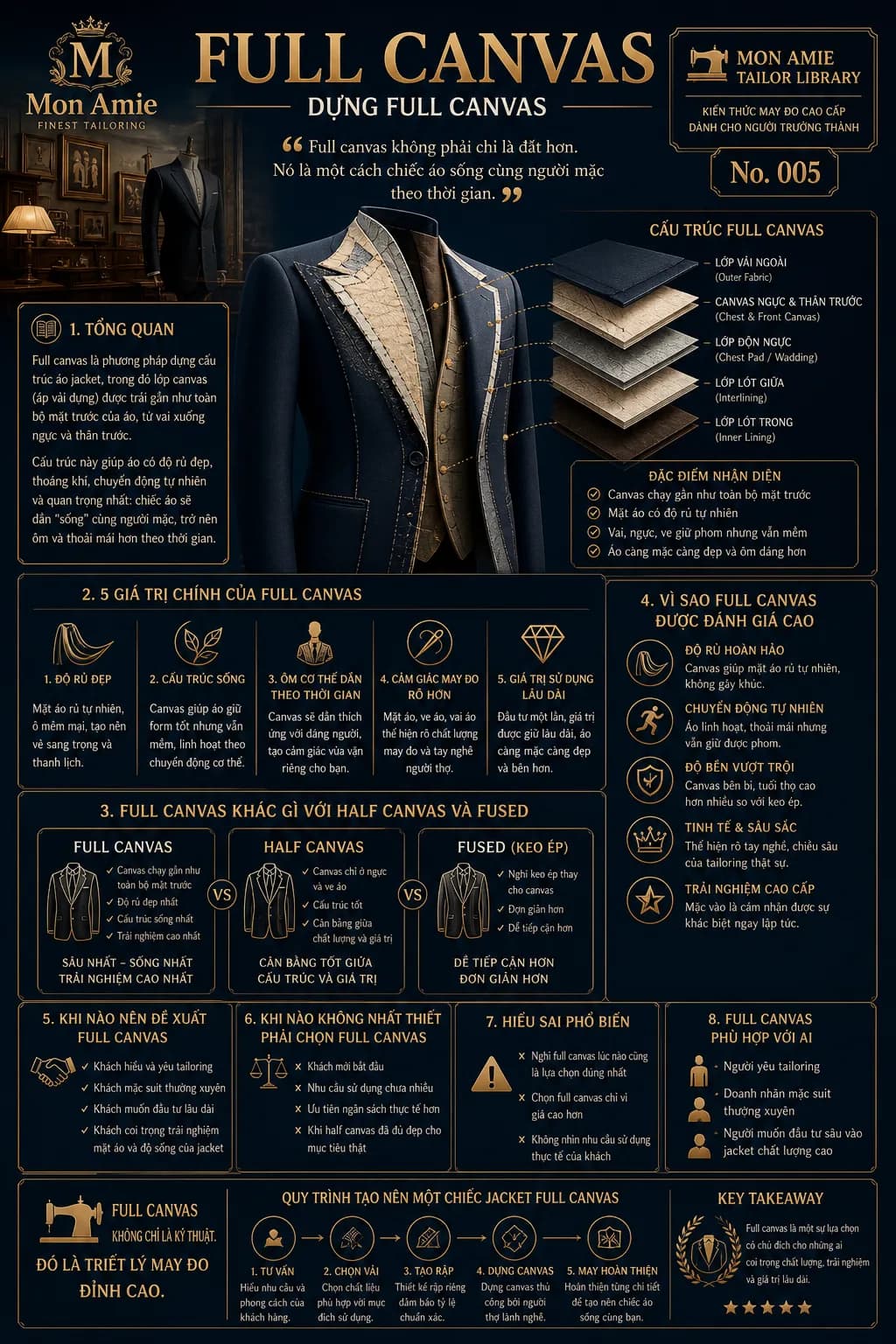
Full canvas is a method of building a jacket in which the canvas — the internal structural layer — extends across nearly the entire front of the garment, from the shoulder down through the chest and forepart. It is the finest construction in tailoring, giving the jacket beautiful drape, breathability and natural movement, and, most importantly, allowing the jacket to gradually come alive with its wearer, growing closer and more comfortable over time. As Mon Amie tells its clients, full canvas is not merely more expensive — it is a way for a jacket to live alongside the man who wears it.
The layers of a full canvas construction
Seen from the outside in, the forepart of a full canvas jacket is built from several layers, each with its own task:
- Outer fabric: the principal cloth you see and touch.
- Chest and front canvas: the heart of the construction, usually woven from horsehair or natural fibres, giving shape while remaining springy.
- Chest pad or wadding: filling and softening the chest, giving a masculine shape without stiffness.
- Interlining: binding and stabilising the layers.
- Inner lining: the silk or lining cloth that meets your shirt, letting the jacket go on and come off smoothly.
Because these layers are joined with loose stitching rather than fused with adhesive, the whole front of the jacket can flex and curve with the body as a single unified mass.
How to recognise a full canvas jacket
- The canvas runs across nearly the whole front, not stopping at the chest.
- The face of the cloth drapes naturally, without breaks or a hard sheen.
- Shoulder, chest and lapel hold their shape yet stay soft when pinched.
- The jacket looks better and fits closer the more it is worn — a sign only a living construction can give.
Five main values of full canvas
- Beautiful drape: the cloth falls naturally and softly, creating an elegance the eye recognises at once.
- A living structure: the canvas holds the shape well while staying soft and responsive to movement.
- A fit that grows with time: the canvas gradually adapts to your build, creating a fit that belongs to you alone — something no ready-made jacket can offer.
- A clearer sense of tailoring: the cloth, the lapel and the shoulder show plainly the quality of the making and the hand of the tailor.
- Lasting value: invested in once, held for years; the jacket grows finer and more durable with wear.
How full canvas differs from half canvas and fused
- Full canvas: the canvas runs across nearly the entire front, giving the finest drape, the most living structure and the highest experience. It is the deepest and most alive of the three.
- Half canvas: canvas at the chest and lapel only, with fused construction below. A sound structure, balancing quality against value — a sensible choice for many needs.
- Fused: canvas omitted altogether in favour of adhesive interfacing. Simpler and more accessible, suited to an entry-level budget, though over time the adhesive can age and leave the cloth less supple.
When to choose it — and when it is not yet necessary
Full canvas suits you when you understand and love tailoring, wear suits often, want a long-term investment and care about how the cloth feels and how alive the jacket is. Conversely, if you are just beginning with suits, do not yet wear them often, are prioritising a realistic budget, or find half canvas already handsome enough for your purpose — then full canvas is not yet essential.
Three misconceptions Mon Amie meets often:
- Assuming full canvas is always the right choice, whatever the need.
- Choosing full canvas simply because it costs more, treating price as the only measure.
- Not considering one's actual use before deciding.
How a full canvas jacket is made
- Consultation: understanding the client's needs and style before any talk of technique.
- Choosing the cloth: selecting a material suited to the intended use.
- Drafting the pattern: designing a pattern that ensures correct proportions for each individual.
- Building the canvas: shaping the canvas by hand, by a skilled tailor — the stage that decides the jacket's soul.
- Finishing: completing every detail to create a jacket that lives with its owner.
A word from Mon Amie's artisans
Years of building canvas by hand have shown Mon Amie that the finest full canvas jacket usually reveals itself after the first three to five wearings, when the canvas begins to remember the owner's shoulders and chest. So do not judge the jacket at the first fitting — wear it, move in it, feel it. And before choosing full canvas, answer honestly how often you actually wear a suit; a well-cut half canvas jacket is still better than a full canvas one bought in haste. Mon Amie always advises according to your real needs, not according to price.
Full canvas is not only a technique — it is the philosophy of tailoring at its height, where a jacket is made to live with the man who wears it. If you would like to feel the layers of canvas for yourself and hear our artisans advise on the right construction, you are welcome to book an appointment at one of Mon Amie's five showrooms in Ho Chi Minh City, or read first about the tailoring process — hotline 0888.111.118.