
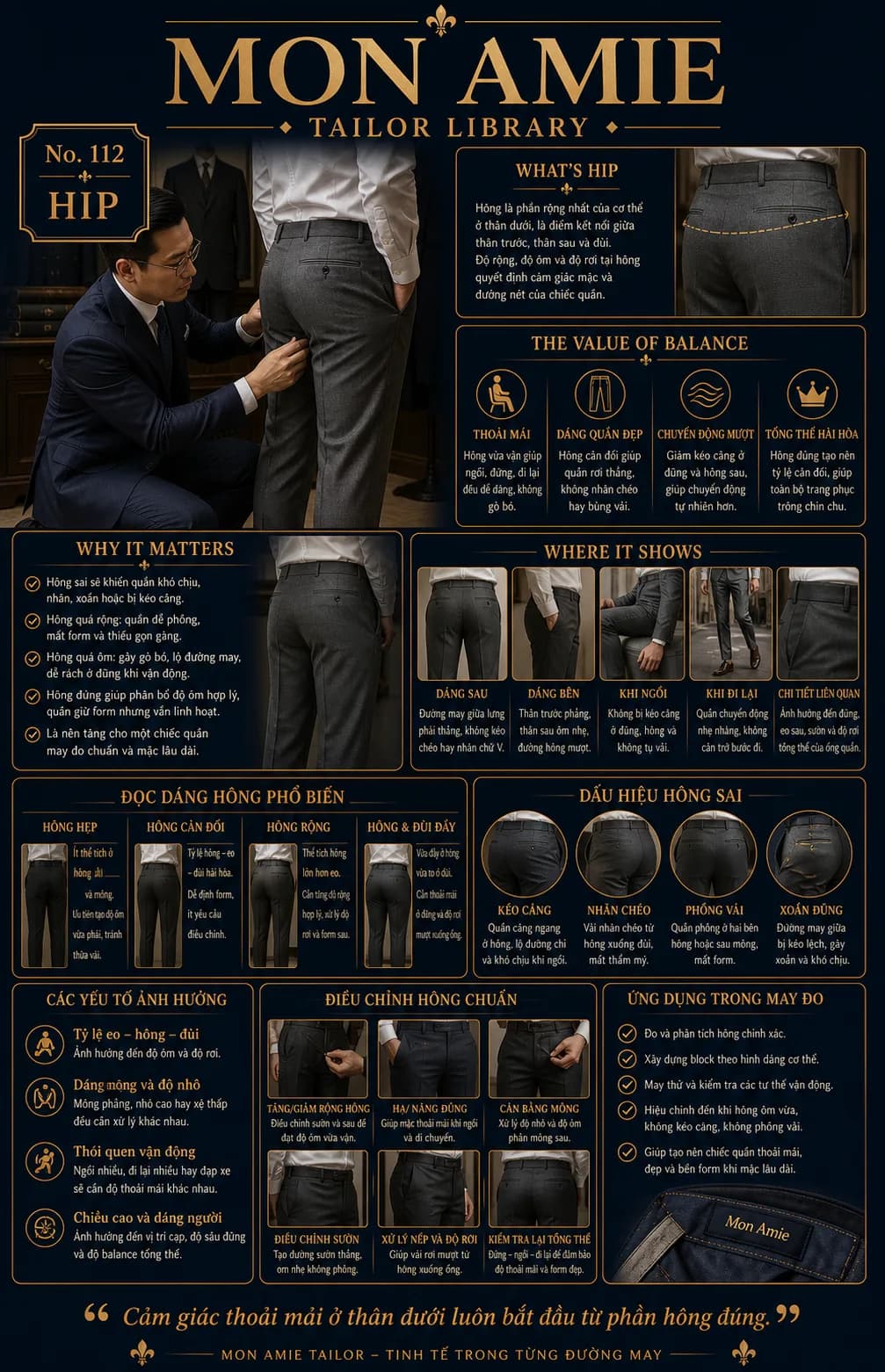
The hip is the circumference at the widest point of the lower body — the meeting point of front, back and thigh. On a pair of made-to-measure trousers, the width, closeness and drape at the hip determine almost everything about how they feel and how the leg falls. In this piece, Mon Amie shares how a tailor reads hip shape and adjusts for trousers that are both handsome and comfortable.
Why the hip measurement matters so much
Many gentlemen focus on waist and length when ordering trousers, yet it is the hip that carries the load when you sit, stand and move. Get the hip wrong and the trousers feel awkward, wrinkle, twist or pull from the very first wearing.
- Too wide at the hip: the trousers balloon, lose shape and look untidy.
- Too close at the hip: they restrict, expose the seams, and strain at the crotch when you move.
- Correctly fitted: the closeness is properly distributed, so the trousers hold their line yet still move with you.
Put simply, the hip is the foundation of trousers that fit well and last. A correct hip measurement delivers four balanced qualities: comfort sitting, standing and walking; a handsome line, because the cloth falls straight without diagonal creasing or bulge; easy movement, thanks to reduced strain at the crotch and rear; and overall harmony, since the hip sets the proportion of the entire outfit.
Where a good or bad hip fit shows
You can assess the trousers you are wearing now at five points:
- From behind: the centre back seam should run straight, with no diagonal pull or V-shaped wrinkling.
- From the side: a flat front, a lightly shaped back, a smooth hip line.
- Seated: no strain at the crotch or hip, and no pooling of cloth.
- Walking: the trousers move easily and never impede your stride.
- Related details: the hip governs the crotch, the rear waist, the side seam and the overall drape of the leg.
Four common signs of a poor hip fit: pulling (the cloth strains across the hip, seams show, sitting is uncomfortable); diagonal creasing (wrinkles running from hip to thigh); ballooning (excess volume at the sides or seat, with a loss of shape); and crotch twist (the centre seam is pulled off line, producing a twist and discomfort).
Four common hip shapes and how to treat them
Tailors classify hip shapes to choose the right approach:
- Narrow hips: little volume through hip and seat; aim for moderate closeness, avoiding surplus cloth that leaves the trousers looking hollow.
- Balanced hips: hip, waist and thigh in easy proportion; simple to shape, requiring little adjustment.
- Full hips: greater volume at the hip than the waist; add width judiciously and manage the drape and rear shaping for a smooth result.
- Full hips and thighs: volume through both; prioritise comfort at the crotch and a clean fall into the leg.
Beyond natural hip shape, four further factors influence how the trousers are built: the waist–hip–thigh ratio, which sets closeness and drape; the shape and prominence of the seat (flat, high or low all call for different handling); your habits of movement — a desk-bound day, a great deal of walking, or cycling each require different ease; and your height and build, which affect waistband placement, rise depth and overall balance.
How a tailor corrects the hip
At the fitting, a tailor has six principal adjustments to bring the hip right:
- Adding or reducing hip width: reworking the side and back seams for the correct closeness.
- Lowering or raising the rise: for comfort when sitting and moving.
- Balancing the seat: managing prominence and closeness at the rear.
- Adjusting the side seam: a straight, lightly shaped line with no bulge.
- Treating creasing and drape: so the cloth falls smoothly from hip into leg.
- A final overall check: standing, sitting and walking, to confirm both comfort and line.
How this is applied at Mon Amie
In our process, Mon Amie measures and analyses the hip precisely, builds a pattern block to each client's own shape, makes a fitting garment and checks it in motion, then adjusts until the hip sits exactly right — no pulling, no ballooning. Your measurements are kept for life, so future commissions need no fresh start, and every garment carries an alteration guarantee to keep its shape over the years.
A word from Mon Amie's artisans
An experienced tailor looks at the hip first when a client tries on trousers, because most faults down the leg originate there. Comfort in the lower body always begins with a correct hip. When the hip is properly handled, the centre back seam runs true, the cloth falls smoothly, and you very nearly forget you are wearing tailored trousers at all.
If you have ever been troubled by trousers that strain when you sit or crease diagonally when you stand, let Mon Amie's artisans measure and rebuild the hip properly. You may book an appointment at one of our five showrooms in Ho Chi Minh City or call 0888.111.118; see the tailoring process for each step we take.