
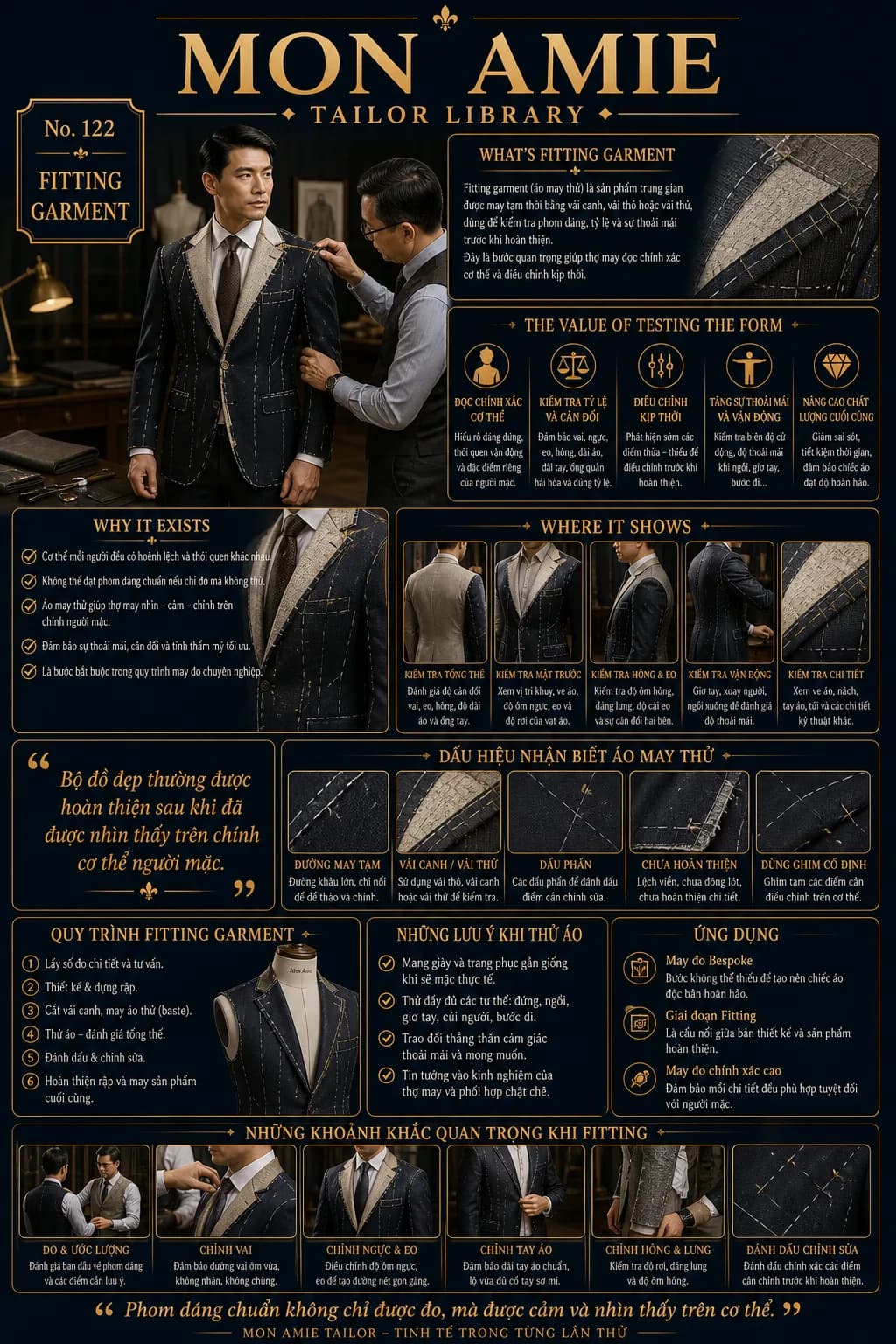
A fitting garment is an interim piece made up temporarily in calico, muslin or trial cloth, used to test shape, proportion and comfort before the final garment is completed. It is the crucial stage that lets the tailor read the body accurately and correct course in time. In bespoke tailoring, the fitting garment is not optional — it is a required part of any professional process.
The value of testing shape on a trial garment
Many gentlemen wonder: if the measurements were taken carefully, why make a trial at all? Because numbers tell only half the story. A trial garment delivers five things no measurement can replace:
- Reading the body accurately: understanding posture, habits of movement and individual characteristics — the things a tape measure cannot record.
- Checking proportion and balance: making sure shoulder, chest, waist, hip, jacket length, sleeve length and trouser leg all sit in harmony with one another.
- Correcting in time: spotting excess and shortfall early, while everything can still be changed easily.
- Improving comfort and movement: testing range of motion and ease when sitting, raising the arms, walking.
- Raising the final quality: fewer errors, less time lost, and the assurance that the garment is right before the good cloth is cut.
Why the trial garment exists in tailoring
The deeper reason lies in the human body itself. Every body has its asymmetries, its tilts, its habits of standing and sitting — the left shoulder may sit lower than the right, the back may round slightly, the arms may differ in length. A correct shape cannot be reached by measuring alone.
A trial garment lets the tailor see, feel and adjust directly on the wearer, rather than guessing on the cutting table. Comfort, balance and beauty are thereby secured to the fullest degree. There is a saying in the trade: a fine garment is usually finished only after it has been seen on the body it was made for.
What a fitting examines
During the fitting, the tailor works through each area in turn:
- The overall picture: assessing the balance of shoulder, waist and hip, jacket length and sleeve length as one whole.
- The front: button position, lapels, closeness through the chest and waist, and how the fronts hang.
- Hip and waist: closeness over the hip, the line of the back, waist suppression and the balance of the two sides.
- Movement: you will be asked to raise your arms, turn, and sit down so that real comfort can be judged.
- The details: lapels, armhole, sleeves, pockets and other technical points.
How to recognise a trial garment
A trial garment looks nothing like a finished one, and that is deliberate:
- Basted seams: long stitches and joining thread, easy to unpick and adjust.
- Calico or trial cloth: plain or trial cloth in place of the good cloth, purely to test shape.
- Chalk marks: chalk on the body of the garment marking the points to be altered.
- Unfinished: uneven edges, no lining fitted, details left incomplete.
- Pins: temporary pins holding the points being adjusted on the body.
The fitting garment process, and how to make the most of it
A full fitting cycle runs to six stages: detailed measuring and consultation; design and pattern drafting; cutting the calico and basting the trial garment; the fitting and overall assessment; marking and adjustment; and finally correcting the pattern and making the finished garment.
To get the most from your fitting, Mon Amie offers a few suggestions:
- Wear shoes and clothing close to what you will actually wear with the garment.
- Try every posture: standing, sitting, arms raised, bending, walking.
- Speak frankly about how it feels and what you would like.
- Trust your tailor's experience and work closely with him.
In bespoke tailoring, the fitting garment is the indispensable step towards a truly individual garment — the bridge between the design and the finished piece, ensuring every detail suits the wearer absolutely.
A word from Mon Amie's artisans
At Mon Amie we regard the fitting as the moment the suit truly takes form, because correct shape is not only measured but felt and seen on the body. Your measurements are kept for life, so every adjustment made at a fitting enriches the record of your own figure. That is why the second and third suit made at Mon Amie always fit better than the first.
If you would like to experience a properly conducted fitting for yourself, do book an appointment at one of Mon Amie's five showrooms in Ho Chi Minh City, or call 0888.111.118. You may also wish to read about the tailoring process first, to see where the fitting sits in the journey towards your suit.