
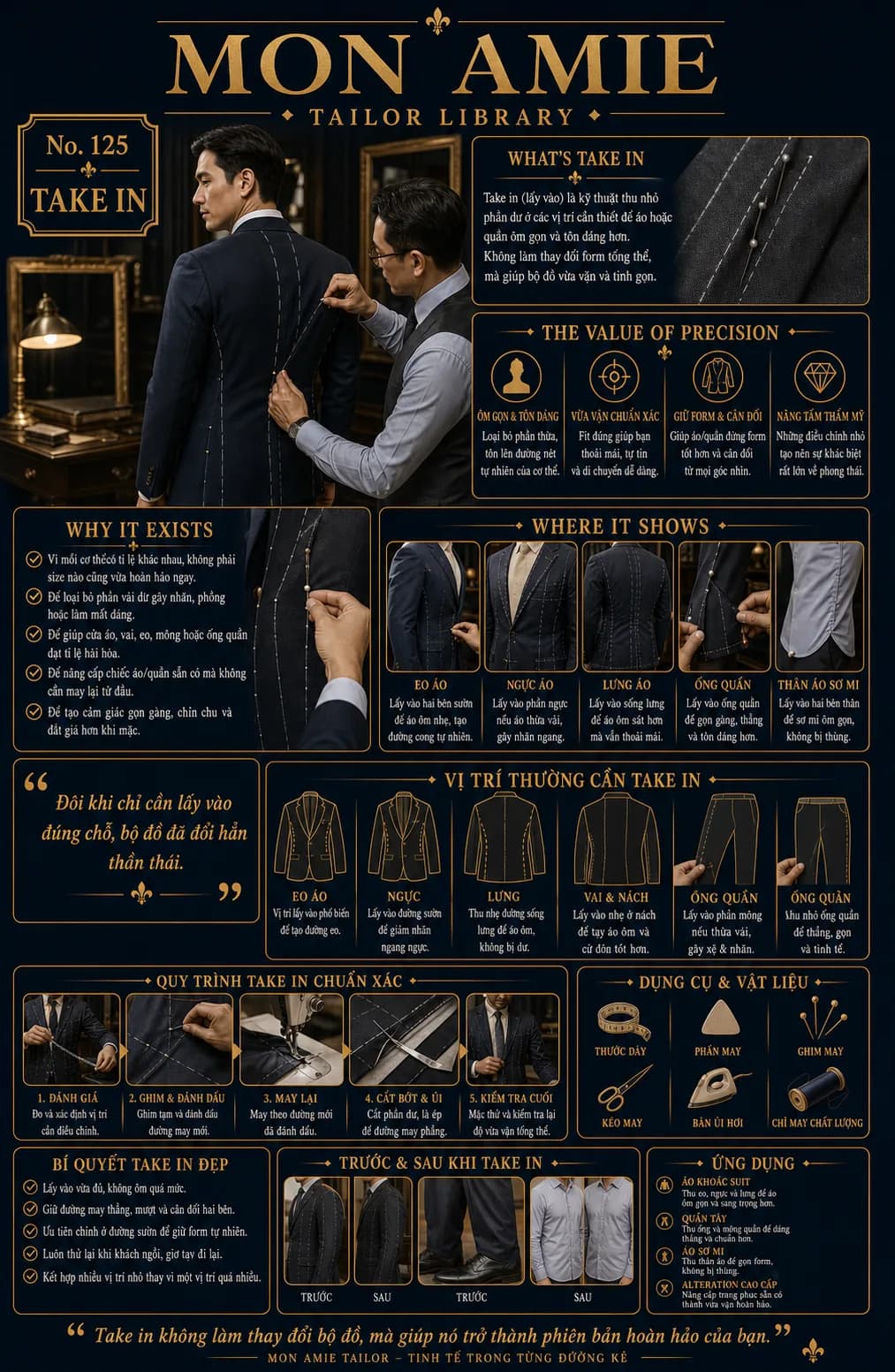
What is taking in? Taking in is the technique of reducing surplus at the points where it is needed, so that a jacket or a pair of trousers sits trimmer and flatters the figure. It does not change the overall shape; it simply makes the garment fit and read cleaner — and sometimes taking in at just the right place transforms the whole character of a suit.
Why taking in is needed
Every body has its own proportions, and no size fits perfectly from the outset. A tailor takes a garment in for the following reasons:
- To remove surplus cloth that wrinkles, bubbles or spoils the line.
- To bring the front, shoulder, waist, seat or trouser leg into harmonious proportion.
- To improve a jacket or a pair of trousers you already own, without remaking them.
- To create a trimmer, more considered and more valuable impression when worn.
The value of this precision rests on four points: closeness and flattery (removing surplus and drawing out the natural lines of the body), accurate fit (a correct fit leaves you comfortable, confident and free to move), shape and balance (the garment stands better and reads evenly from every angle), and elevated appearance — small adjustments make a very large difference to bearing.
Where taking in shows
The result of an alteration is most visible in five areas:
- Jacket waist: taken in at both side seams so the jacket closes gently, with a natural curve.
- Jacket chest: taken in through the chest where surplus cloth causes horizontal wrinkling.
- Jacket back: taken in at the centre back so the jacket sits closer while remaining comfortable.
- Trouser leg: taken in for a trimmer, straighter, more flattering line.
- Shirt body: taken in at both sides so the shirt sits trim rather than boxy.
The points that usually need taking in
On a complete suit, the common points are:
- Jacket waist: the most frequent point of all, to create the waistline.
- Chest: taken in at the side seam to reduce horizontal wrinkling across the chest.
- Back: a light reduction at the centre back seam so the jacket closes without surplus.
- Shoulder and armhole: a gentle take-in at the armhole for a closer sleeve and better movement.
- Trousers (thigh and seat): taken in at the seat where surplus cloth sags and wrinkles.
- Trousers (leg opening): narrowed for a straight, trim and refined line.
A correct taking-in process
A properly executed alteration runs to five stages:
- Assessment: measuring and identifying the points to adjust.
- Pinning and marking: pinning temporarily and marking the new seam line.
- Restitching: sewing along the newly marked line.
- Trimming and pressing: cutting away the surplus and pressing the seam flat.
- Final check: trying the garment on and reviewing the overall fit.
The tailor's familiar tools and materials are a tape measure, tailor's chalk, pins, shears, a steam iron and good thread — modest things that nonetheless decide how crisp the alteration reads.
The craft of a fine take-in
The trade's own wisdom for an alteration that looks entirely natural:
- Take in just enough, never too close.
- Keep the seam straight, smooth and even on both sides.
- Favour adjustment at the side seam to preserve the natural shape.
- Always try the garment again with the client seated, arms raised, walking.
- Combine several small reductions rather than one large one.
The technique has wide application: suit jackets (taking in waist, chest and back for a trimmer, more elegant line), trousers (narrowing leg and seat for a straighter, truer shape), shirts (taking in the body so it is trim rather than boxy) and fine alteration work — turning garments you already own into a perfect fit.
A word from Mon Amie's artisans
Taking in does not change a suit; it helps the suit become the perfect version of itself for you — the philosophy Mon Amie follows in every pin. Because we keep each client's measurements for life, we know how your figure changes from one commission to the next, and our alteration guarantee lets you return to have a garment taken in whenever it needs to meet your figure again.
If your suit has grown a little loose at the waist or boxy through the back, do bring it to one of Mon Amie's five showrooms in Ho Chi Minh City (Nguyen Trai, Ho Van Hue, 3/2 Street, Caravelle Hotel District 1, Nguyen Thi Thap) or call 0888.111.118. You may book an appointment for an artisan to assess it in person, and read more about the tailoring process at Mon Amie.