
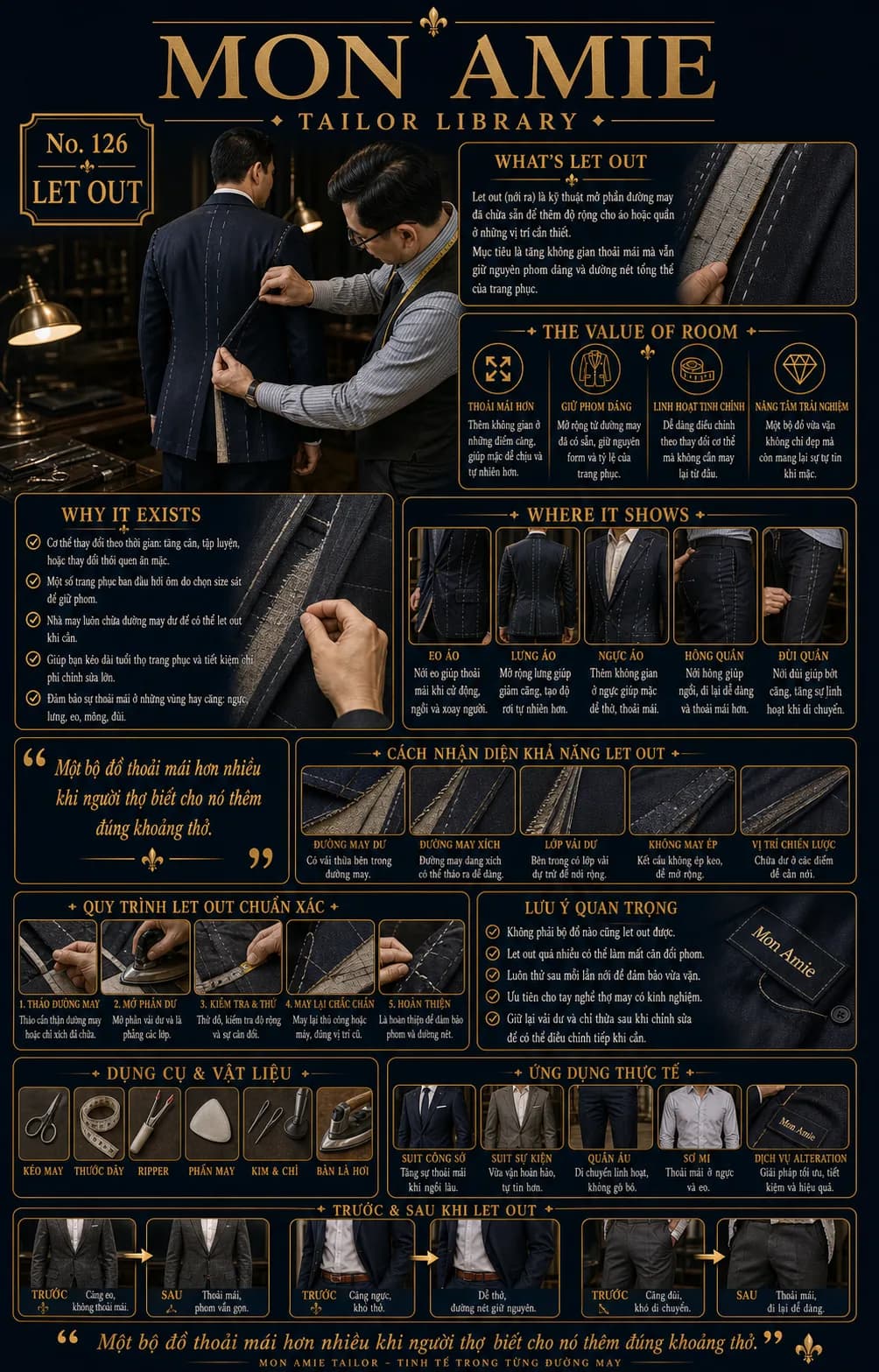
What is letting out? Letting out is the technique of opening the seam allowance a tailor reserved in advance to add width to a jacket or a pair of trousers exactly where it is needed. The aim is to gain comfort while keeping the silhouette and overall lines intact — in other words, to give the garment a little more room to breathe.
Why a garment needs letting out
No one keeps the same measurements for years on end, and a tailor understands that from the moment the cloth is cut:
- Bodies change over time through weight gain, training or shifting habits.
- Some garments start out close-fitting because a snug size was chosen to hold the shape.
- A serious tailoring house always reserves extra seam allowance so the piece can be let out later.
- Letting out extends the life of a garment and avoids the cost of a major remake.
- It restores comfort in the areas that strain first: chest, back, waist, seat and thigh.
The value of that extra room comes down to four things: greater comfort (space where the garment pulls, so it wears easily and naturally), a preserved silhouette (the width comes from an existing seam, so proportion and form stay intact), flexible refinement (adjustments follow the body without rebuilding the garment) and a better experience overall — a garment that fits well does not simply look good, it gives you confidence.
Where letting out is applied
The five places most often let out:
- Jacket waist: added room here eases movement, sitting and turning.
- Jacket back: opening the back relieves tension and restores a natural drape.
- Chest: extra space across the chest lets you breathe comfortably.
- Trouser hips: a little more room makes sitting and walking far easier.
- Trouser thighs: releasing the thigh removes strain and improves freedom of movement.
How to tell whether a garment can be let out
Not every garment can be opened up; it depends entirely on how it was made in the first place. Your tailor will check for:
- Seam allowance: whether spare cloth remains inside the seams.
- Chain stitching: chain-stitched seams can be unpicked cleanly.
- Reserve cloth: an inner layer of fabric held back for future width.
- No fusing: an unfused construction opens up far more readily.
- Strategic placement: allowance left precisely where width is likely to be needed.
This is also one of the clearest signs that separates true tailoring from factory production: a conscientious house always sets cloth aside for the client's future.
The correct letting-out process, and what to watch for
Done properly, letting out follows five steps: unpicking the seam (carefully releasing the reserved seam or chain stitch), opening the allowance (spreading the spare cloth and pressing the layers flat), checking on the body (a fitting to assess the new width and balance), restitching securely (by hand or machine, exactly on the original line) and finishing (a final press to restore shape and line).
Important considerations before you commit:
- Not every garment can be let out.
- Letting out too far can throw the silhouette off balance.
- Try the garment on after each stage to confirm the fit.
- Entrust the work to an experienced tailor.
- Keep the leftover cloth and thread afterwards, in case further adjustment is needed.
The familiar tools are shears, a tape measure, a seam ripper, tailor's chalk, needle and thread, and a steam iron. In practice the technique serves everything from business suits (comfort through long hours at a desk) and event suits (a flawless fit, and the confidence that follows) to trousers (ease of movement without restriction), shirts (room across the chest and waist) and general alteration work — a sensible, economical and effective solution.
A word from Mon Amie's artisans
At Mon Amie we believe a garment wears far better when the tailor has given it the right amount of room to breathe. That is why every suit made here carries reserved seam allowance at the strategic points, backed by an alteration guarantee and measurements kept on file for life — so that a year from now, or ten, the garment can grow with you rather than sit unworn in the wardrobe.
If your suit pulls across the chest or feels tight through the hips, do not give up on it. Bring it to one of Mon Amie's five showrooms in Ho Chi Minh City (Nguyen Trai, Ho Van Hue, 3/2 Street, Caravelle Hotel District 1, Nguyen Thi Thap) or call 0888.111.118. You are welcome to book an appointment so an artisan can assess what can be let out, and to read more about the tailoring process at Mon Amie.