
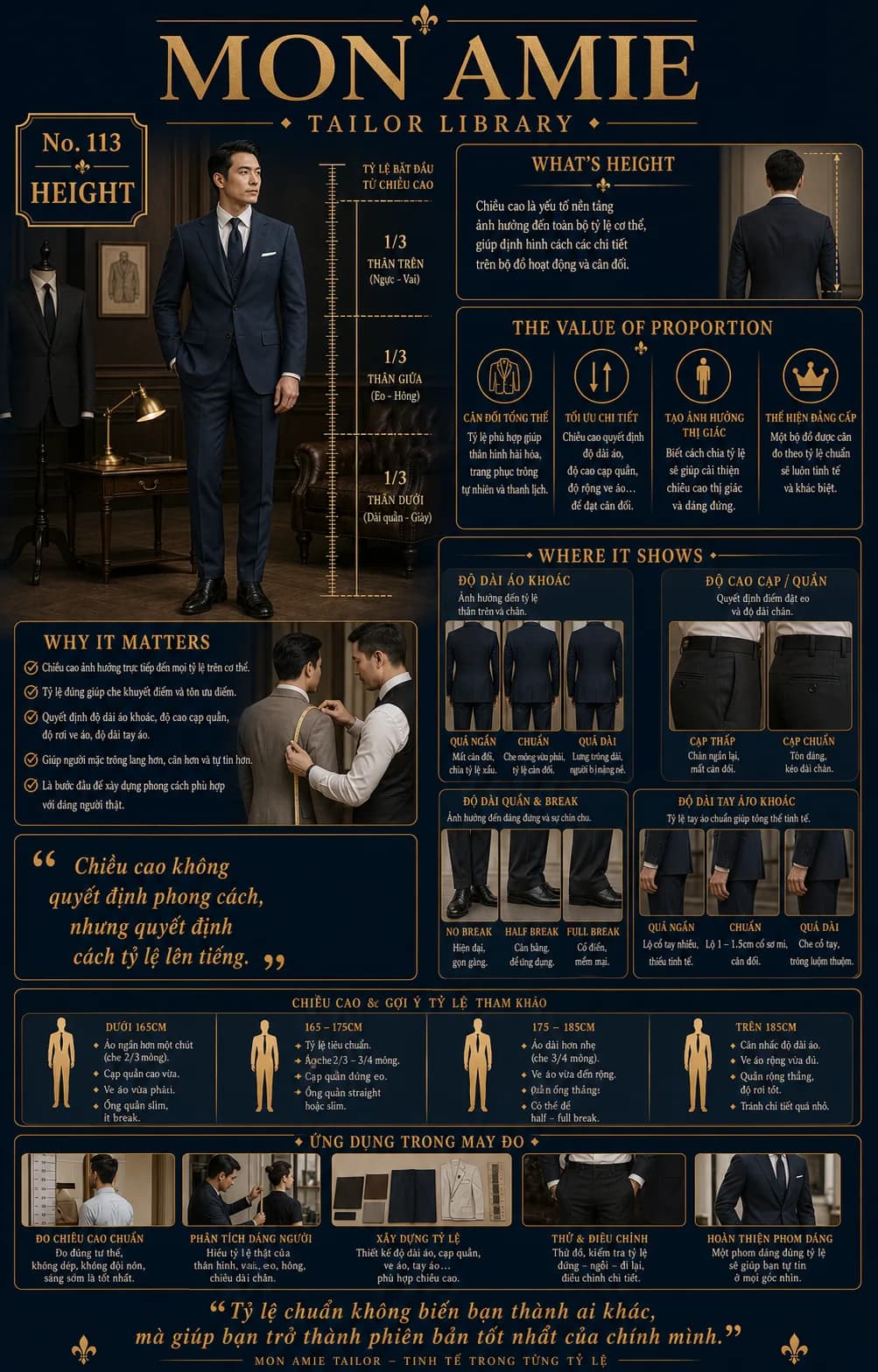
Height is the foundation that shapes every proportion of the body, determining how each detail of a suit behaves and balances against the rest. In tailoring, a cutter does not read height as a number but as the starting point for dividing the proportions of jacket, trousers, waistband and sleeve. Mon Amie shares here how height makes itself heard on a suit.
Proportion begins with height
In the trade, the body is read as three roughly equal parts: an upper third (chest and shoulders), a middle third (waist and hip) and a lower third (trouser length down to the shoe). A fine suit preserves that three-part rhythm — or adjusts for it skilfully when the real body is not divided so evenly.
Correct proportion delivers four things:
- Overall balance: the right ratios make the figure harmonious and the clothing look natural and elegant.
- Optimised detail: height governs jacket length, trouser rise and lapel width so everything settles into balance.
- Visual effect: knowing how to divide proportion improves apparent height and posture.
- A mark of quality: a suit measured to true proportion always reads as refined and distinct.
Why height matters in tailoring
Height bears directly on every proportion of the body. Correct proportion conceals what you would rather not emphasise and flatters what you would; it dictates jacket length, trouser rise, lapel line and sleeve length. A man dressed in true proportion looks taller, better balanced and more assured. It is also the first step in building a style suited to your real figure — height does not decide your style, but it decides how proportion speaks.
Where height shows itself
- Jacket length: this governs the ratio of torso to leg. Too short and the balance is lost, the divisions unflattering; correct length covers the seat appropriately and keeps the proportions even; too long and the back sags, weighing the figure down.
- Trouser rise: this sets where the waist sits and how long the leg reads. A low rise shortens the leg and unsettles the balance; a proper rise flatters the figure and lengthens the leg visually.
- Trouser length and break: these affect stance and neatness. No break is modern and clean; half break is balanced and versatile; full break is classic and softer.
- Sleeve length: a correct sleeve shows 1–1.5 cm of shirt cuff, refining the whole. Too short reveals too much cuff and looks careless; too long buries the cuff and looks untidy.
Proportion suggestions by height range
These are the guidelines Mon Amie usually works from in consultation:
- Under 165 cm: a slightly shorter jacket (covering roughly two-thirds of the seat), a moderately high rise, a moderate lapel, a slim leg and minimal break — everything working to lengthen the leg visually.
- 165–175 cm: standard proportions; a jacket covering two-thirds to three-quarters of the seat, the rise at the natural waist, a straight or slim leg.
- 175–185 cm: a slightly longer jacket (covering about three-quarters of the seat), a medium to wide lapel, a straight leg, and anything from a half to a full break.
- Above 185 cm: consider jacket length more carefully, keep the lapel generous but not excessive, choose a straight leg with good drape, and avoid details so small they throw the whole out of proportion.
How this is applied at Mon Amie
Our process runs through five stages: measuring height accurately in the correct posture — no shoes, no hat, and ideally early in the morning; analysing your build to understand the true proportions of torso, shoulders, waist, hips and legs; constructing the proportions — designing jacket length, rise, lapel and sleeve to suit that height; fitting and adjusting — checking the ratios standing, seated and walking, then refining the details; and finally perfecting the silhouette so the suit reads correctly from every angle. Your measurements and proportions are kept for life for future commissions.
A word from Mon Amie's artisans
Our artisans often say: correct proportion does not turn you into someone else, it helps you become the best version of yourself. Two men of the same height may need two entirely different proportional formulas, because the upper body, middle body and legs are never divided the same way twice. That is why a suit cut to true proportions will always outshine one made to an average size off the rack.
Would you like to know which proportional formula suits your height? Book an appointment at one of Mon Amie's five showrooms in Ho Chi Minh City (hotline 0888.111.118) to be measured and advised in person, or read about the tailoring process beforehand.