
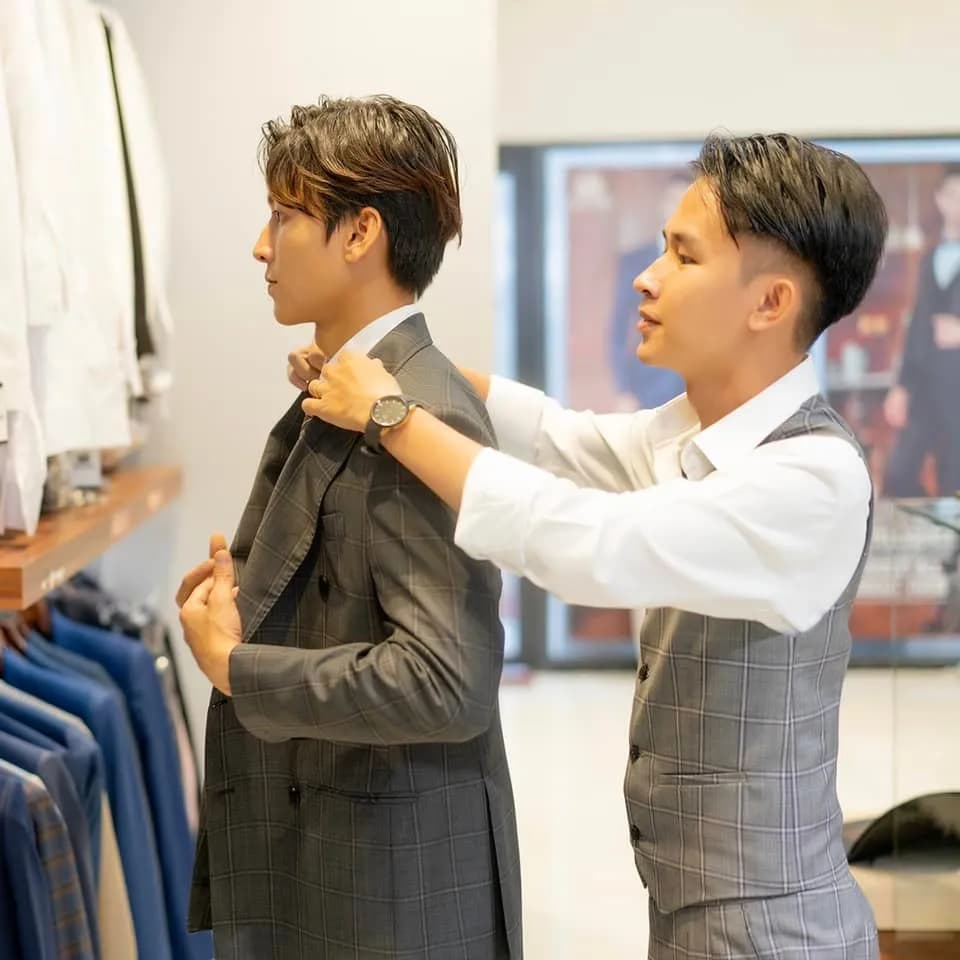
Two suits cut from the same cloth, hung side by side on hangers, look almost identical. Put them on and they are completely different: one hugs the neck and drops the shoulder in the right place, the other leaves a gap behind the collar and pulls a diagonal crease around the button. That difference doesn't come from the cloth. It comes from how the tailor measures, builds and adjusts the jacket on your body.
The short answer
A good suit tailor gets three layers right: a jacket that fits when you stand and when you move; proportions of length, lapel width and button position that suit your build; and finishing that is flat and clean, inside as well as out. You can check all three in the shop, from a sample jacket, from questions, and from how the person measuring looks at you.
Layer one: fit
Fit accounts for most of what makes a suit jacket look good. A cheap cloth that fits looks better than an expensive cloth that is wide at the shoulder. When you try on a sample jacket or a fitting jacket, check these six places in the mirror first.
| What to look at | Good | Not yet right |
|---|---|---|
| Collar at the back of the neck | Hugs the shirt collar when you stand straight | A gap, or the collar lifts when you turn your head |
| Shoulder tip | The shoulder line stops at the end of the shoulder bone, the sleeve hangs straight | A dimple below the shoulder tip, or the shoulder sticks out |
| Front when buttoned | Flat, with room for a flat hand at the button | An X-shaped crease around the button |
| Back | Flat from the neck down | A horizontal crease just below the collar, or a vertical fold of extra cloth |
| Sleeves | Hang straight, shirt shows about 1 to 1.5 cm | A twist behind the upper arm, the sleeve covering the cuff |
| Trousers | Seated, no strain across the thigh, no pressure in the rise | A pulled crease across the thigh, a twisting trouser leg |
What to look at in a good men's suit goes into more detail on each part of the jacket. Here, just remember that most of these faults can be corrected at the fitting, if the tailor sees them.
Layer two: proportion that suits the wearer
Two men with the same chest measurement still need two different jackets. A shorter man needs a slightly shorter jacket and a higher button point so the legs look longer. A man with broad shoulders and a large face suits a medium to wide lapel, because a lapel that is too narrow makes the shoulders look even bigger. A man with a larger belly needs a length that covers the seat and buttons placed so that the front hangs straight and doesn't bind against the belly.
No measurement form can record these things. This is the work of the stylist's and tailor's eye, and it is where a good suit tailor differs from a place that only sews to the numbers. When you ask “how long should my jacket be?”, someone long in the trade will answer from your build, not read out a single number meant for everyone.
Layer three: finishing
You can see this layer most clearly on a sample jacket hanging in the shop, even before trying it on.
- Lapels roll softly into a natural curve, not pressed flat into a sharp edge.
- The cloth surface is flat across the chest and both fronts, with no rippling or bubbling.
- Checked cloth matches at the pocket flaps and along the centre back.
- Buttonholes are evenly stitched with no frayed threads, and buttons are sewn on firmly.
- Inside, the lining seams are flat with no loose threads, and the facing and lining fit together.
Checking all three layers in one visit
You don't need to pay a deposit to know whether a place makes a good suit. Bring this list on the first visit.
- Look at the sample jackets on mannequins: does the collar hug the mannequin's neck, do the lapels roll softly?
- Ask to turn one sample jacket inside out: is the lining flat, are the seams clean?
- Find a checked jacket: does the check at the pocket flap match the body?
- Watch the person measuring: do they look at how you stand, your shoulders and your back, or only pick up the tape?
- Ask about proportion: “For my build, how long should the jacket be, and where should the button go?”
- Ask about the fitting: how many fittings, and what does the fitting adjust?
- Ask about the cloth: what is the wool percentage, and why does that grade suit the number of days I wear it?

Signs to look elsewhere
A few signs suggest that the place will find it hard to make you a good suit, even if the price is reasonable.
- No measuring, only asking your size. They ask what size you wear and how much you weigh, then settle it. That is making to a ready-made size chart, not to your body.
- Blaming your build. You point at a pulled crease across the back of the fitting jacket and the salesperson says everyone who wears a suit gets that. Such a crease can usually be corrected.
- One number for every build. You ask how long the jacket should be and where the button goes, and the answer is a general measurement with no mention of your shoulders, belly or height.
- The inside of the sample jackets is hidden. Nobody is willing to turn the lining out for you, or when they do you see loose threads and a lining that drags the hem.
- Vague pricing. They don't say whether VAT is included or whether there are any extra charges.
How Mon Amie answers those criteria
This article is written by Mon Amie, so this section is how Mon Amie holds itself to the three layers above. Use the same yardstick on every place you visit.
- Fit: a full measurement on an individual measurement form; a suit usually has 1 fitting, or none if you prefer. If a suit doesn't look good or doesn't match the style agreed, Mon Amie alters it until you are satisfied, and if it still falls short, you get a 100% refund.
- Proportion: the styles already made are in the lookbook; point to the one you like and ask the stylist which jacket length, lapel width and button position suit your build.
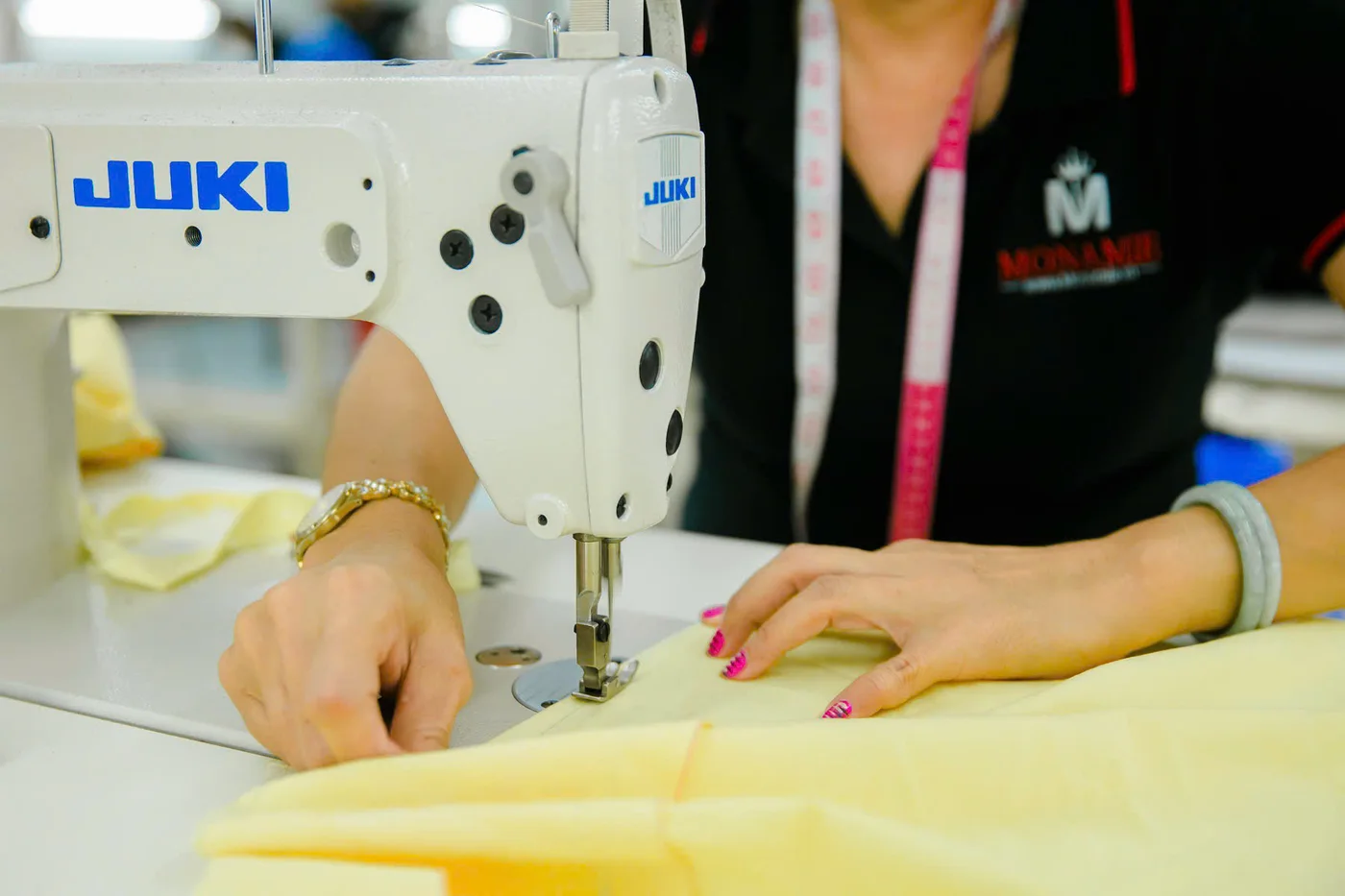
- Finishing: all 5 showrooms have sample suit jackets and shirts, so turn them inside out and look. Mon Amie has more than 50 tailors, with the workshop at the Đường 3/2 showroom; the steps are on the process page.
- A jacket made elsewhere: bring it in, and a stylist will look at it for free and point out what already fits and what doesn't.
The showroom with the workshop is at 80–82–84 Đường 3/2, Hòa Hưng Ward, Ho Chi Minh City (0901.811.116), open 8:30 a.m. – 9:30 p.m. every day. The other four addresses are on the showroom page.
Frequently asked questions
Does a higher price mean a better-made suit?
Not necessarily. The price of a suit differs mainly by cloth: wool percentage, Super number, mill. Fit and proportion are decided by measuring and fitting, so a 60% wool suit cut to your body still looks better than a 100% wool suit that is wide at the shoulders.
Is a half-lined jacket less good-looking than a fully lined one?
From outside there is no difference. A half lining is cooler in Saigon; in return the seams inside show, so they must be neatly bound, and that is another place to judge the work. Which lining suits depends on the cloth line you choose.
Are photos online enough to choose a tailor?
Photos tell you a place's style, not its fit. Fit has to be judged on a real person who is moving: raising arms, sitting, turning the head. Use photos to decide where to visit, then judge in the shop.
The jacket looked good when I collected it but looks different a few months later. Why?
Usually because your weight changed by 3 to 5 kg, because the jacket was hung on a thin hanger that deformed the shoulders, or because it was worn continuously without resting. Hang the jacket on a wide-shouldered hanger, let it rest at least one night after each wear, and be measured again when your weight changes.
Bring an old jacket with you
A good suit tailor gets fit, proportion and finishing all right, and you can check all three in one visit. Bring the jacket you wear most often and book an appointment so a stylist can compare it with your build.