
Eight to nine centimetres: that is the lapel width a classic suit tailor rarely dares to change. Small numbers like these are the secret behind a classic men's suit that still looks upright after ten years of wear, while a jacket chasing the trend goes back in the wardrobe after two seasons.
Quick answer
A classic men's suit has nine core details: an 8 to 9 cm notch lapel, a natural shoulder, a two-button jacket, double rear vents, flapped jetted pockets, four-button sleeves, a jacket length that covers the seat, pleated straight-leg trousers with a mid rise, and wool cloth in a sober colour. Keep to these proportions and the suit will not date.
Why “classic” always stands firm
Classic does not mean old. It is a set of proportions that have been tested over generations: a moderate lapel, a moderate shoulder, a moderate waist, a moderate length. Fashion, by contrast, tends to push one detail too far: a very narrow lapel, a super-short jacket, skinny trousers. It is this moderation that lets a suit stand outside time.
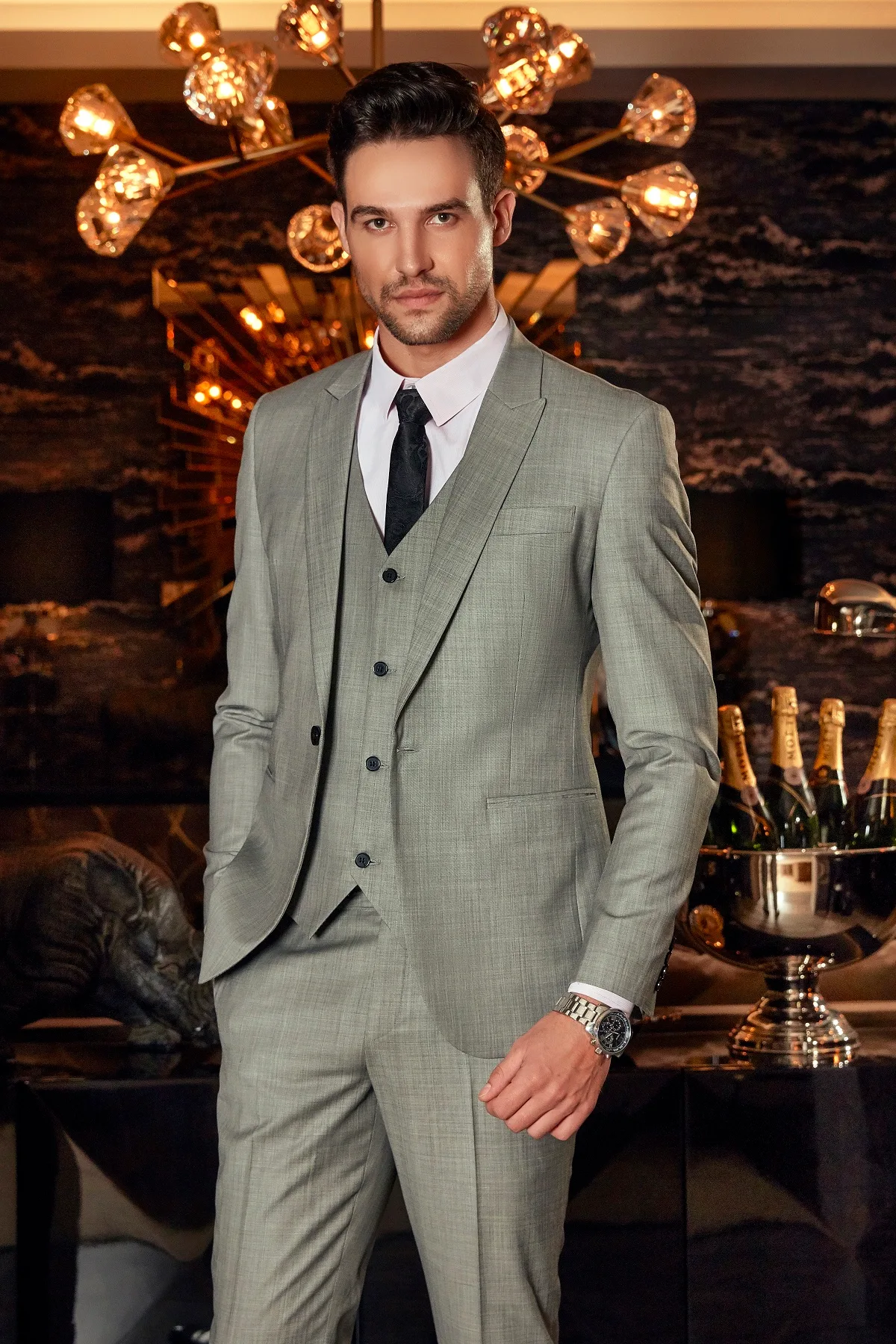
The nine details of a classic suit
| No. | Detail | Classic specification | Why it matters |
|---|---|---|---|
| 1 | Lapel | Notch, 8 to 9 cm wide | Balances the shoulder and chest |
| 2 | Shoulder | Natural, lightly padded | A lasting shape that never dates |
| 3 | Buttons | Two buttons, fasten the top one | Classic, easy to fasten when seated |
| 4 | Vents | Double rear vents (or a single vent) | Easy movement, the jacket does not flare at the back |
| 5 | Pockets | Flapped jetted pockets on both sides | Discreet, formal |
| 6 | Sleeves | Four buttons, reaching the wrist bone | Shows 1 to 1.5 cm of shirt cuff |
| 7 | Jacket length | Covers the seat | Balanced proportions, a longer-legged line |
| 8 | Trousers | Pleated, mid rise, turn-ups | Hang well, hold their line |
| 9 | Cloth and colour | Tightly woven wool, navy, charcoal | Durable, easy to pair, slow to date |
A closer look at each detail
1. Notch lapel, 8 to 9 cm wide
The notch lapel has a V-shaped notch where the lapel meets the collar, and it is the most common lapel on a classic suit. A width of 8 to 9 cm balances the shoulders and chest of most builds. A narrower lapel usually goes with a close-cut jacket, while a wider one gives a feel of decades past.
2. Natural shoulder
The shoulder line follows the real shoulder, with just enough padding to stand, never built up into a right angle. You can read more in the article distinguishing European and Vietnamese style.
3. Two-button jacket
Fasten the top button and leave the bottom one open. Two buttons make a balanced V that lengthens the torso. Three buttons are acceptable too, but fasten the middle one.
4. Double rear vents
Two side vents let you sit down without dragging the jacket skirt, which suits anyone who sits a lot. A single centre vent is also a classic choice. A ventless jacket looks best standing but binds when you sit.
5. Flapped jetted pockets
The two lower pockets are jetted pockets with flaps, discreet and suited to office occasions. The breast pocket is for a pocket square folded flat.
6. Four-button sleeves
Four buttons overlap lightly at the cuff, and can be made to open for real if you like that higher-end finish. The sleeve reaches the wrist bone, showing about 1 to 1.5 cm of shirt cuff.
7. Jacket length
It covers the seat, roughly level with your fingertips when your arms hang naturally. Too short and it becomes a cropped fashion jacket, too long and it becomes a topcoat.
8. Pleated trousers with turn-ups
Classic trousers sit at a mid rise, with one or two pleats, a straight or lightly tapered leg and turn-ups of about 3 to 4 cm depending on height. The pleats give room at the thigh and keep the line when you sit.
9. Tightly woven wool in a sober colour
Navy, charcoal and mid-grey are the three colours of the long-time suit wearer. Tightly woven wool recovers creases easily and keeps the lapel line and the trouser crease well.
How classic differs from modern
Modern or fashion-led tailoring usually emphasises a single feature: narrow shoulders, a short jacket, slim trouser legs, thin lapels. Classic emphasises nothing; instead everything is moderate. If you are undecided, see the concrete comparison in the article on modern versus classic men's suits. A good way to choose is to take the classic frame and add a single modern touch, such as a fine-stripe cloth, a deep ink-blue colour or a slimmer tie.
Elegant and luxurious men's suits: what is the difference
- Elegant is about the cut and how you wear it: fitted at the shoulder and waist, with restrained colour pairing.
- Luxurious is about material and finish: the cloth, the stitching, the small details.
The two go hand in hand. A suit made from Italian or English cloth but cut wrong at the shoulder is still not elegant. Conversely, a well-fitting suit in tired cloth is not luxurious either. At Mon Amie, the Heritage line uses cloth from Canonico, Holland Sherry, Dormeuil and Scabal, Italian and English mills, with some suits reaching VND 60 million. The Signature line, from VND 10 to 20 million, is the most popular, and Essential, from VND 4.8 to 10 million, is the starting point for a properly fitted cut. Details are in the price list.
A tip from Mon Amie's master tailors
What the master tailor wants to stress most about a classic suit: do not look at each detail in isolation, look at the proportions. An 8 to 9 cm lapel only looks right when it balances your shoulders. A man with narrow shoulders should choose a width closer to 8 cm, and a man with broad shoulders can go closer to 9 cm. Two suits with the same “classic specification” can still look different on two men. That is why being measured in person and having a baste fitting, as in bespoke tailoring with more than 30 measurements, matters more than memorising a table of specifications.
Common mistakes
- Chasing fashion: choosing very thin lapels and over-tight trousers, then finding them dated two seasons later.
- Choosing a shiny cloth or a glaring bright colour for a classic suit.
- Bright gold metal buttons instead of horn or dark plastic.
- Changing too many details at once, which loses the overall proportion.
Frequently asked questions
What details does a classic men's suit have?
A medium-width notch lapel, a natural shoulder, two buttons, double rear vents, flapped jetted pockets, four-button sleeves, a jacket long enough to cover the seat, pleated straight trousers and wool cloth in a sober colour.
How does a classic suit differ from a modern suit?
Classic keeps moderate proportions in every detail, while modern emphasises one feature such as narrow shoulders, a short jacket or slim trouser legs. Classic is less prone to dating.
What colour should an elegant men's suit be?
Navy and charcoal are the two safest colours. Black is for evenings or formal occasions. Mid-grey is a light choice for sunny days.
What does a luxurious men's suit depend on?
The quality of the cloth, the fit and the finish of the stitching. The three need to go together; lacking one of them, the suit will feel less luxurious.
How much should I invest in a luxurious men's suit?
It depends on the purpose. Essential is the starting point, Signature is for regular wear, and Heritage is for high-end Italian and English cloth.
Investing in a suit that lasts
If you want a classic men's suit that will serve you for a decade, start with navy or charcoal in a classic cut, then let the master tailor balance the proportions for your build. You can make an appointment through the booking page so the master tailor can choose the proportions with you.