
There are four doors to a made-to-measure suit: the regular tailor shop of your neighbourhood tailor at the end of the lane, a workshop that takes orders, a large tailoring house with showrooms and a team, or online made-to-measure with measuring at home. No single door is right for everyone. Right or wrong depends on what you need: the lowest price, the most beautiful cloth, the most fittings, or the greatest convenience. This article compares all four plainly, so that you can answer the question of where to have a suit made.
The short answer
Have your suit made where you can see the real cloth, get at least one baste fitting, have your measurements kept on file and receive a warranty after delivery. A regular tailor suits you if you trust the tailor and need a simple suit. A workshop suits bulk orders, a large tailoring house suits you when you need a wide fabric library, a clear process and a long warranty, and online made-to-measure suits people who live far away or are busy.
Where to have a suit made: four options
1. A regular tailor shop (a small shop where the tailor does the work)
This is the traditional choice. The owner is often the tailor himself, knows the figures of regular customers and remembers old measurements.
- Advantages: a personal relationship, flexibility with alterations, a price that can be gentle, a tailor who remembers you.
- Limitations: the fabric range is usually limited, the process is less standardised, the warranty depends on verbal promises, and if the tailor changes careers the measurements are lost too.
- Suits: customers who already trust a long-time tailor, need a simple suit and accept fewer fabric choices.
2. A workshop
A production-focused workshop that can take orders by measurement or by ready-made sizes. Strongest at volume and speed.
- Advantages: competitive prices by quantity, fast production time, suited to uniforms.
- Limitations: usually little direct interaction with each customer, possibly fewer fittings, and cloth that usually comes from ready-made sample ranges.
- Suits: groups that need many suits at once, or people who know exactly what they need and only need production.
3. A large tailoring house (several showrooms, a specialist team)
It has a diverse fabric library, advising stylists, master tailors, a standard process and a warranty.
- Advantages: many fabric choices, a clear process, measurements kept on file, a warranty, and the chance to have fittings several times at several locations.
- Limitations: prices are usually higher than at small shops, and an appointment is needed at peak hours.
- Suits: people who want a precisely fitted suit that lasts, and need in-depth advice on cloth and cut.
4. Online or at-home made-to-measure (provided by a large tailoring house)
A new format: measuring via video call, or an artisan coming to your home, with cloth chosen from photos or from a sample set they bring.
- Advantages: convenient, saves time, serves people who live far away, delivered to your door.
- Limitations: if the tailor has not met you, accuracy depends on how you are measured and on the measurements on file, so you need a service with an alteration step after delivery.
- Suits: busy business people, people in another province or abroad, and customers who have had a suit made before and have measurements on file.
Comparison table on five criteria
| Criterion | Regular tailor | Workshop | Large tailoring house | Online / at home |
|---|---|---|---|---|
| Price | Usually gentle | Competitive by quantity | Higher, depends on the cloth line | Similar to a large tailoring house |
| Fabric range | Limited | From ready-made samples | Diverse, many mills | Browsed through samples and detailed photos |
| Number of fittings | Usually few | Usually few | Baste fitting, many adjustments | Depends on the service, needs confirmation |
| Time | Flexible | Fast for quantity | Per the process | Saves travelling |
| Warranty | Verbal promise | Per contract | Clear policy | Per the tailoring house |
Price: what should you expect?
Price depends largely on the cloth. At Mon Amie, the price list for a full suit (jacket and trousers) is split into three lines: Essential from VND 4.8 – 10 million (Kevinlli 40 – 70% wool), Signature from VND 10 – 20 million (Kevinlli 80 – 100% wool, Dolce & Taylor, Luciano, Salford, Vercelli) and Heritage over VND 20 million (Canonico, Holland Sherry, Dormeuil, Scabal, up to VND 60 million for one suit). You can see the full list on the price list page. Wherever you go, always ask for the cloth name and specifications, because two suits at the same price but with different cloth is common.
6 questions to ask before paying a deposit
- Can you see the real cloth, with a label or specifications?
- How many baste fittings are there, and is there a fitting before the suit is finished?
- Are your measurements kept, and for how long?
- If the jacket does not fit yet, who pays for the alteration, and within what time?
- Can you see a finished suit, including the inside of the jacket?
- Is the delivery date clear and written on the receipt?
A trustworthy place will answer all six comfortably. The article criteria for choosing a good men's suit tailor in Ho Chi Minh City expands on each point.
Where does Mon Amie sit in the comparison table?
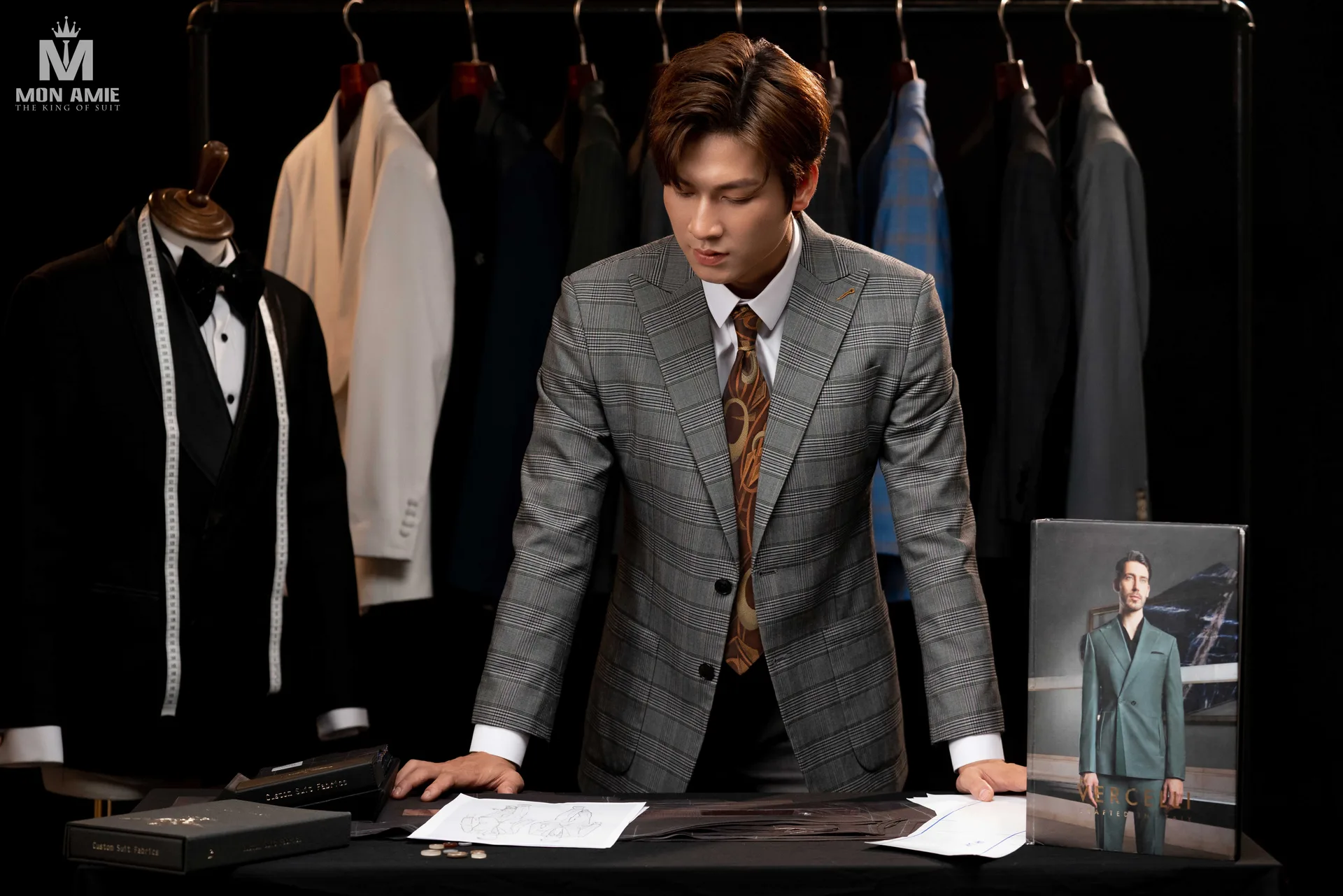
Mon Amie belongs to the large tailoring house group, with a bespoke made-to-measure service at the showroom: you meet an artisan in person, have more than 30 measurements taken (kept for life), choose cloth from an Italian and British fabric library, have a baste fitting and adjustments until it fits, and receive a long-term alteration warranty. For people who live far away there is online made-to-measure; for busy people there is at-home made-to-measure within Ho Chi Minh City. The five showrooms in Ho Chi Minh City are open daily, from 8:30 a.m. to 9:00 p.m. (the Đường 3/2 showroom until 9:30 p.m.), and the Caravelle Hotel is the flagship showroom.
Tips from Mon Amie's master tailors
When weighing where to have a suit made, and whichever tailor you choose, bring along the suit you feel fits you most comfortably, so the tailor can see what you like about it. An old jacket says more than a sheet of measurements. And do not choose only because the price is lowest: a well-fitting suit worn for two years costs less than two suits you never dare to wear.
Common mistakes
- Comparing only price, ignoring cloth. The same price but different cloth means a different suit.
- Not asking about the warranty. Bodies change, and the jacket needs adjusting too.
- Choosing a workshop for a single order. A workshop is strongest at volume.
- Choosing online without ever having been measured. Be measured in person the first time; use the saved measurements afterwards.
Frequently asked questions
Which suit tailor can be trusted?
One that lets you see the real cloth, offers at least one baste fitting, keeps your measurements and gives a clear warranty. As long as all four of those are there, a small or a large operation is worth considering.
How does a men's suit tailor differ from a workshop?
A tailor shop works customer by customer, with direct interaction. A workshop leans towards volume production, speed and batch pricing.
How much does a men's suit cost at a tailor?
It varies with the cloth. At Mon Amie, from VND 4.8 – 10 million (Essential) up to over VND 20 million (Heritage). Ask for the specific cloth name and specifications before comparing prices.
Do you need to book before having a suit made?
You should, because one-on-one advice takes time. You can book a measurement appointment or call 0888.111.118.
Conclusion
Choosing where to have a suit made is choosing a companion for many years, because a good suit will need adjusting to your body. If you want to compare with your own eyes, visit the Mon Amie showroom to see the cloth, see the inside of a jacket and ask everything listed above.