
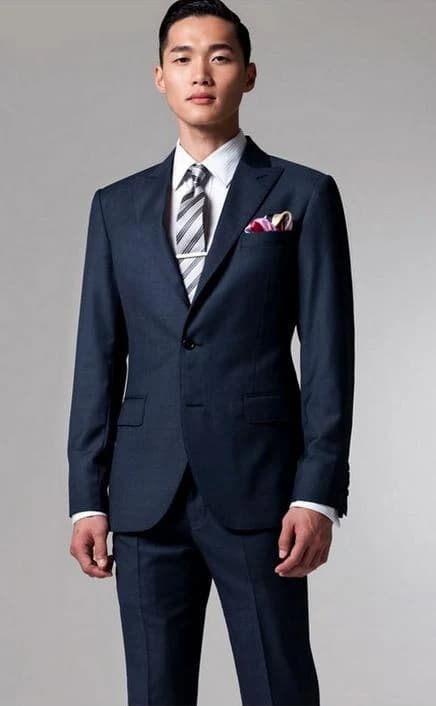
Men who wear larger sizes tend to meet one of three scenes in a ready-to-wear suit shop. Scene one: the jacket fits the stomach, but the shoulders are loose and baggy and the collar stands away from the back of the neck. Scene two: it fits the shoulders, but the button won't fasten and the cloth pulls into an X-shaped crease around it. Scene three: the jacket fits at last, but the sleeves are short and expose half the forearm. None of this is the wearer's fault. Ready-made plus-size men's suits in Ho Chi Minh City are cut to a general size chart, while every fuller figure has a shape of its own.
Quick answer
Ready-made plus-size suits tend to be wide in the shoulders, short in the sleeves and strained at the stomach button because they are simply scaled up uniformly by size. Made-to-measure rebalances every point from your real measurements, with a draping cloth, a deep colour and a one- or two-button style, so it fits properly and makes the figure look neater.
Why large-size ready-made suits often don't fit
A ready-to-wear suit is built from one standard pattern, then graded up through the sizes. In grading, every measurement grows by a set proportion. The problem is that a larger body doesn't grow evenly like that: some men have small shoulders and a large stomach, some have a thick chest but short legs, some have arms longer than the torso.
| Common problem | Why it happens | How made-to-measure handles it |
|---|---|---|
| Wide shoulders, collar gapping at the back of the neck | The pattern enlarges the shoulders in step with the stomach | The shoulders are built to your real shoulders, the one part that cannot be altered later |
| Button strain, X-shaped creases | The stomach measurement is larger than the standard pattern | Let out exactly the right amount at the stomach, and rebalance the lapel and front panels |
| Sleeves too short, wrists exposed | Sleeve length does not grow with the chest measurement | Sleeve length is measured separately, leaving 1 to 1.5 cm of shirt cuff showing |
| Back of the jacket rippling or sagging | The back panel has surplus cloth at the sides | The back is rebalanced to create a moderate waist line |
| Trousers tight on the thigh, waistband slipping | Trousers are enlarged at the waist but short in the rise | Stomach, thigh and rise are measured separately, and a moderately high waistband is chosen |
How made-to-measure solves the plus-size problem
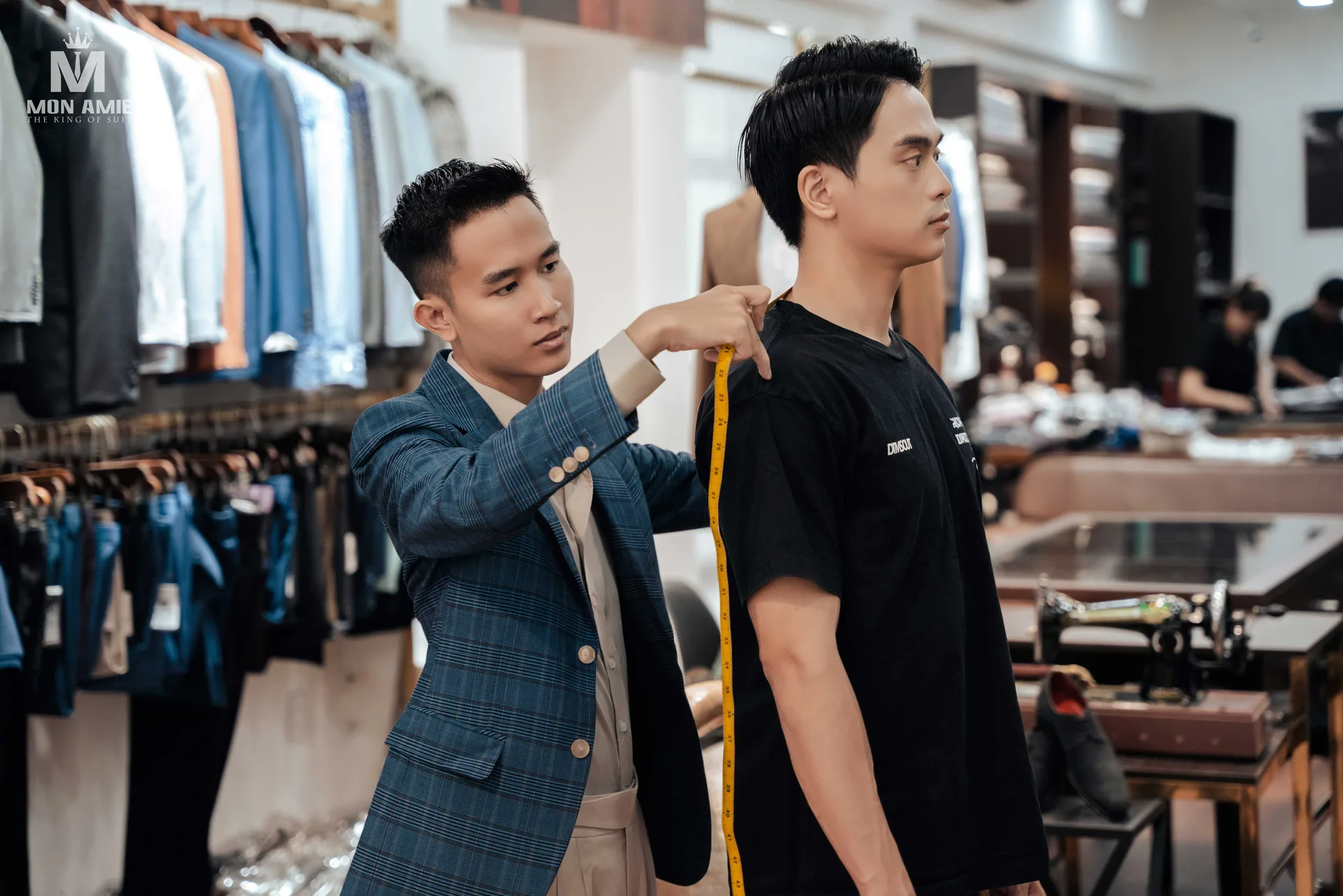
Made-to-measure does not scale up an existing pattern; it builds the pattern from your own measurements. With Mon Amie's bespoke tailoring service, you have more than 30 measurements taken and a baste fitting, with adjustments until the fit is right. That number matters especially for a fuller figure, because every point needs to be considered separately:
- Shoulders: measured to your real shoulders, not to the stomach. Only when the shoulder line sits exactly on the shoulder bone does the whole jacket hang correctly.
- Chest and stomach: measured at the widest point. The tailor will rebalance the proportions so the jacket follows the stomach without squeezing it.
- Jacket length: the skirt of the jacket should cover the seat, drawing the eye along a vertical line.
- Sleeve length: measured separately, independent of size.
Shoulders: the first rule
For a bigger man, the shoulders decide whether the whole suit “looks the part.” Shoulders that are too wide make you look as if you are wearing a borrowed jacket; shoulders that are too tight make the jacket pull and crease across the back. A good made-to-measure tailor always builds the shoulders first, and only then considers the waist and stomach.
Stomach: don't squeeze, balance
Instead of squeezing the stomach with a tight jacket, the made-to-measure tailor builds the jacket so the front seams run straight, the front skirts are cut with a gentle curve, and the button sits in balance with the stomach rather than right at the point of greatest strain. The result is a jacket that fastens without creasing.
Choosing cloth, colour and style for a plus-size suit
- Colour: deep navy, charcoal, black or blue-black. Deep colours make the lines neater. Avoid head-to-toe light colours or shiny finishes, since they reflect light and make the figure look larger.
- Pattern: a small vertical stripe makes you look taller; avoid horizontal stripes and large checks. A plain cloth is the safest choice.
- Cloth: draping, smooth wool that is not too thick. A thick, stiff cloth makes the jacket balloon; a cloth that is too thin clings and shows ripples. The Essential line, with Kevinlli at 40 to 70% wool (100s to 140s), is a sound starting point; the Signature line uses 80 to 100% wool (140s to 150s) that drapes and feels softer.
- Jacket style: one or two buttons, a medium-width lapel, front skirts cut with a gentle curve. Double-breasted suits a large stomach less well because it piles extra cloth across the front.
- Trousers: a moderately high waistband, a single pleat, a straight or slightly tapered leg, no cuff. Measure the stomach after a natural exhale.
Not just suits: plus-size trousers and shirts
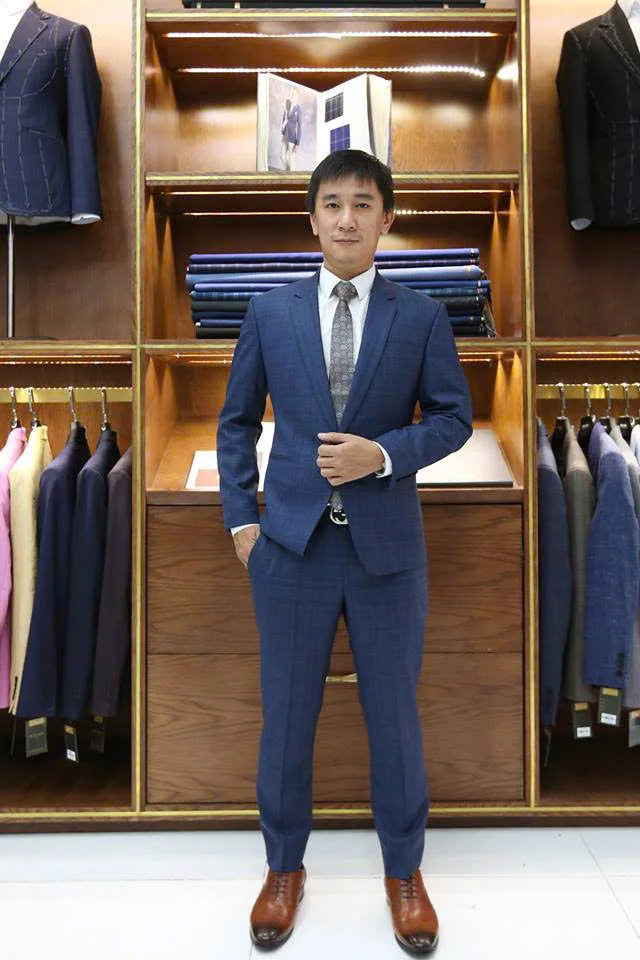
A good suit needs trousers and a shirt that fit. Many larger men have trouble with ready-made plus-size men's trousers in Ho Chi Minh City: short in the rise, loose in the leg, waistband slipping. With plus-size men's shirts in Ho Chi Minh City the situation is similar: tight collar, gaping buttons at the stomach, short sleeves. Both can be made to measure at the same time as the suit so the proportions are consistent. If you want to know what rules apply to a suit for a bigger stomach, read the article on suits for men with a belly.
Common mistakes when choosing a large-size suit
- Choosing the size by the stomach. The result is surplus in the shoulders. Choose by the shoulders, then ask the tailor to adjust the stomach.
- Choosing a tight jacket to look “slimmer.” A jacket that is too tight creates horizontal pull lines and makes the stomach more obvious.
- Wearing a jacket that is too long or trousers that are too short, which throws the proportions off.
- Buying several suits at once before you know which style flatters your build; make one foundation suit first.
- Forgetting to tell the tailor your habits: sitting a lot, driving a lot, keeping a phone in a pocket.
Tips from Mon Amie's master tailors
- Measure the stomach in the afternoon, when your body is in its most normal state, and don't pull in your stomach while being measured.
- If your weight is changing, tell the tailor; your measurements are stored for life and can be adjusted when you need to make your next suit.
- Call right away if any part of the jacket doesn't fit. The long-term alteration warranty after you receive the suit lets you fine-tune the fit rather than put up with it.
- To pick a size for reference, the article on the men's suit size chart by height and weight gives you a starting figure, but your real measurements remain the compass.
Frequently asked questions
Where can I buy plus-size men's suits in Ho Chi Minh City that fit?
With a larger build, choose made-to-measure rather than ready-made, because the pattern is built from your real measurements. Mon Amie has 5 showrooms in Ho Chi Minh City, open 8:30 a.m. to 9:00 p.m. daily (Đường 3/2 until 9:30 p.m.); you can view the showroom list to choose the nearest one.
What colour should a plus-size men's suit be?
Deep navy, charcoal and black are the three colours that give the neatest figure. A plain cloth or a very fine vertical stripe is the safe choice; avoid large checks and horizontal stripes.
Does a made-to-measure suit in a larger size cost more?
Price depends on the cloth line, not the size. The price list for a full jacket-and-trousers set: Essential VND 4.8 to 10 million, Signature VND 10 to 20 million, Heritage over VND 20 million. For an unusual build, ask a stylist for the specific cloth allowance.
Can plus-size men's trousers and shirts in Ho Chi Minh City be made to measure?
Yes. Mon Amie makes both trousers and shirts to measure, taking the exact stomach, thigh, rise and neck measurements so you can wear them comfortably and still look neat.
In closing
A fuller figure is not at fault; it is only a jacket that has not been built correctly. If you are looking for plus-size men's suits in Ho Chi Minh City that truly fit, see the made-to-measure price list and then book a measurement appointment so an artisan can take your measurements and advise on cloth and colour for your build.