
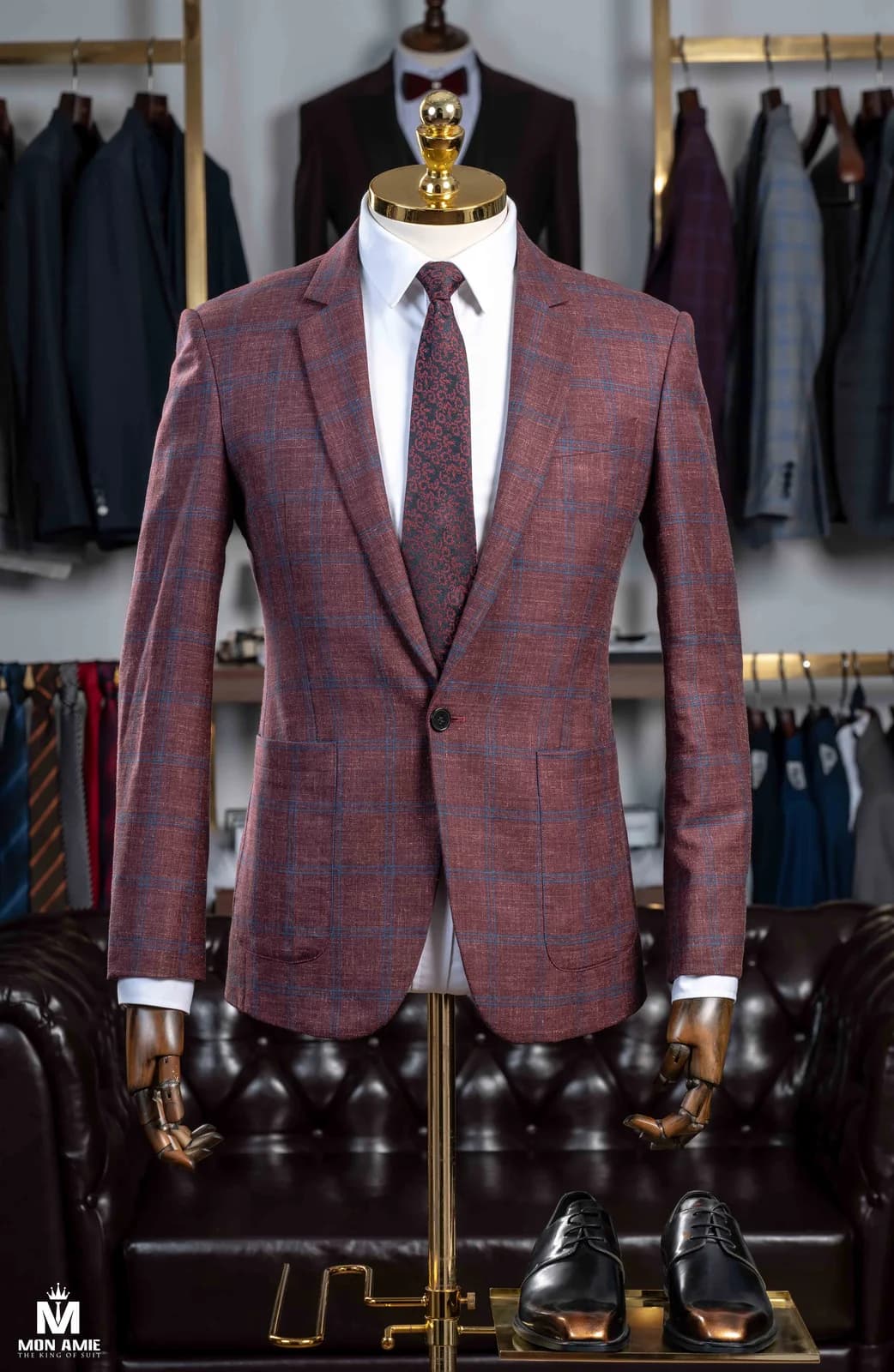
Every blazer on a hanger looks good. It only shows whether it fits when you put it on, button it, raise your arms and turn your back to the mirror. The six tests below take five minutes at any counter, before you hand over your card.
The short answer
You can buy a men's blazer anywhere, as long as the shop lets you try it on and lets you have it altered. Before paying, test six places: shoulders, lapels, back, sleeves, lining, buttons. If the shoulders or back are wrong, walk away, because they can hardly be altered; sleeves that are too long or a body that is a little loose can be fixed. If the shoulders still don't fit after three shops, go made-to-measure.
Where to buy: four places, four things to know
| Where | Try on first | Alterations after buying | Suits you when |
|---|---|---|---|
| Menswear shop | Yes | Many shops offer hemming and sleeve alterations; ask clearly before paying | Your build is near standard and you need a jacket now |
| Online | No | Depends on each seller's return policy | You already know your exact size in that brand |
| Second-hand, consignment | Yes | You take it to be altered yourself | You want good cloth at a low price and will check carefully |
| Made-to-measure | Fitting by appointment | Adjusted during the making | Uneven shoulders, a larger belly, arms longer or shorter than the size |
The six tests are the same wherever you buy. With online orders, run all six the moment the parcel arrives, while the return window is still open. If you aren't sure which cut, how much structure, or what pocket style to choose, read how to choose a men's blazer before you go.
Before trying on, wear the shirt you usually wear to work and the shoes you plan to wear with it, and take the phone and wallet out of your pockets. Heavy things in the pockets make any jacket sag.
Test 1: Shoulders
- What to do: put the jacket on, stand straight, arms down. Then stand sideways, leaning one shoulder against the wall.
- Right: the shoulder line stops right at the end of your shoulder bone, and the sleeve hangs straight down. Leaning against the wall, the jacket's shoulder tip and your shoulder touch the wall at almost the same time.
- Wrong: if the jacket's shoulder tip touches the wall first, the shoulder is too wide, usually with a dimple on the upper arm. If the shoulder is too tight, the cloth pulls across the upper back and the sleeve head ripples.
- Can it be altered: almost never. The shoulder is the hardest part of a jacket to alter; walk away from a jacket with the wrong shoulders, even at a good price.

Test 2: Lapels
- What to do: button the jacket and look from the side in the mirror. Gently squeeze the front just below the chest pocket.
- Right: the lapel lies against the chest, rolls softly from the top button to the collar, and both lapels are symmetrical. The cloth surface is flat. When you squeeze, some jackets feel like a loose layer of canvas inside, while in others the layers are bonded together because they are fused; fusing isn't bad, as long as the cloth surface stays flat.
- Wrong: the lapel lifts away from the chest when buttoned, usually a sign that the jacket is tight across the chest. Small bubbles on the cloth surface mean the glue layer inside has come apart.
- Can it be altered: a lapel that lifts because the jacket is tight, no. Re-pressing delaminating interfacing usually only holds for a while, so don't buy a jacket that is already bubbling.
Test 3: Back
- What to do: button the jacket and turn your back to the mirror both ways, or ask whoever is with you to take a photo.
- Right: a flat back, the collar of the jacket hugging the neck of your shirt, the vent closed when you stand.
- Wrong: a horizontal crease just below the collar, a gap between the collar and the shirt collar, a vent that gapes open, an X-shaped crease around the fastening button.
- Can it be altered: an X-shaped crease from a slightly tight belly can sometimes be let out if the side seams have spare cloth. A gap at the collar and a crease below it are harder to fix than other faults: if they are severe, walk away; if they are slight, ask a tailor whether they can be corrected.
Test 4: Sleeves
- What to do: let your arms hang naturally, then reach both arms forward as if holding a steering wheel.
- Right: your shirt shows about 1 to 1.5 cm beyond the jacket sleeve. Reaching forward, the jacket doesn't ride up the whole body. The sleeve hangs straight, with no diagonal twist on the upper arm.
- Wrong: a sleeve that covers the cuff completely, or stops short at the wrist. A diagonal twist means the sleeve was set in at an angle that doesn't match how your arm hangs.
- Can it be altered: too long can usually be shortened if the cuff buttons are only decorative; too short can only be let down if the inside hem of the sleeve has spare cloth. Where the cuff has working buttonholes, shortening from the cuff is almost impossible, because the buttonholes are cut in the old position. A twist is hard to fix.
Test 5: Lining
- What to do: open the front and look at the lining on the body, back and hem.
- Right: a flat lining with a spare fold at the hem and usually at the centre back, so the lining doesn't pull on the outer cloth. Firm lining seams, no loose threads.
- Wrong: a taut lining that drags the jacket hem up, lining poking out below the hem edge, thick lining that makes the back stuffy.
- Can it be altered: lining that pokes out or pulls slightly can be fixed. In Saigon, a thin lining or half lining is usually more comfortable, as analysed in men's blazers for summer.
Test 6: Buttons
- What to do: fasten and undo each button, including the cuff buttons if they are real.
- Right: buttons sewn on firmly, buttonholes with thick, even stitching tight to the edge. On a two-button jacket, the top button fastens without pulling creases in the body.
- Wrong: frayed buttonholes, loose buttons, a body dragged out of line when fastened.
- Can it be altered: replacing or resewing buttons is easy. Frayed buttonholes are a mark of rushed work, and they usually come with other rushed places.
Buy, alter or walk away
| Test | If it fails |
|---|---|
| Shoulders | Walk away |
| Lapels | Walk away if the lapel lifts or the cloth surface bubbles |
| Back | Walk away if the collar gaps or there is a crease below it; think again if it is only a little tight at the belly |
| Sleeves | Alter if it is only length and the cuff buttons have no real buttonholes |
| Lining | Alter |
| Buttons | Alter, but look again at the earlier tests |
If it fails at test 1 or test 3, don't buy it intending to alter it. For a jacket that needs only minor adjustment after you buy it, Mon Amie's price list for outside alterations is: hemming a jacket VND 250,000; fixing the body, sleeves or shoulders VND 300,000, which is minor adjustment and can't rescue a jacket that is far too wide or narrow in the shoulders; taking a jacket up or down a size VND 800,000.
When to go made-to-measure instead of buying
- The shoulders still don't fit after three shops: uneven shoulders, steeply sloping shoulders, or shoulders wide for your waist.
- A belly clearly larger than your chest: it fits the belly but is wide at the shoulders, or fits the shoulders and strains at the button.
- Arms clearly longer or shorter than the size.
- You wear a blazer from three days a week and need cloth that suits your needs.
A single made-to-measure Kevinlli blazer at Mon Amie is VND 3.6–12 million depending on the wool percentage, excluding 8% VAT, with details on the price list. If you only need a jacket for one occasion, renting a suit usually costs less than buying or having one made.
Frequently asked questions
Should I buy a blazer a size too big and have it taken in?
Only if the shoulders already fit and the extra room is in the body, waist or sleeves. If the shoulders are too wide, taking in the body doesn't rescue it; the shoulder still collapses onto the upper arm. Choose the size by the shoulders first, and handle the other places afterwards.
Does a label saying 100% wool mean I can relax?
Not yet. The label states the cloth, not whether the cut suits your build or whether it was sewn carefully. A blended-wool jacket that fits the shoulders with a neat lining is worth more than a 100% wool one with the wrong shoulders.
Should I buy a stretch blazer?
It suits someone who moves around a lot or travels for work, because it creases less and moves easily. In return, how well stretch cloth holds and recovers its shape depends on its composition and weave; some are thin and tend to bag at the elbows over time, so judge the actual swatch in your hand. For daily office wear, woven cloth without stretch usually keeps its shape better.
Five minutes before you pay
Shoulders, lapels, back, sleeves, lining, buttons: if it passes all six, buy it; if it fails at the shoulders or back, leave it. If you go to a few places and the question of where to buy a men's blazer still has no answer because the shoulders don't fit, book an appointment to be measured and have your first one made to your build.