
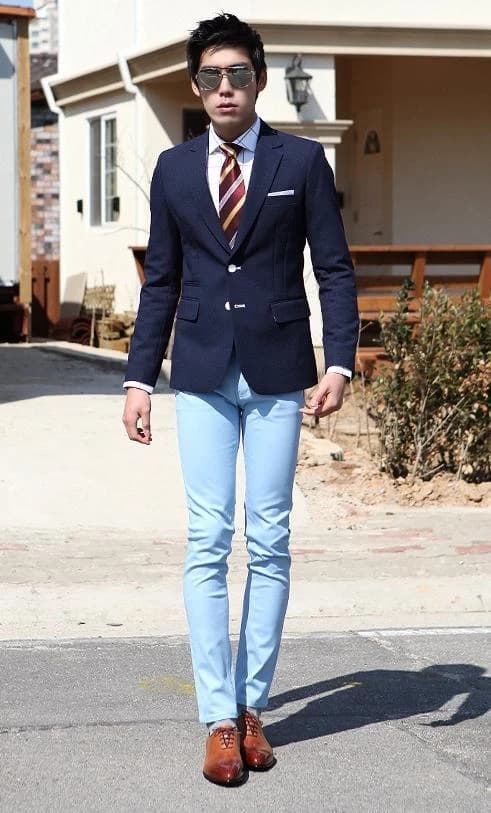
We all know the type: a friend who wears the jacket of a suit with jeans to a café and looks as though he has just lost his suit trousers. It is not that the jacket is ugly; it simply was not made to be worn on its own. This is where choosing a men's blazer correctly begins: a blazer is a jacket designed specifically to be worn separately, so its shoulders, structure, pockets, buttons and fabric all differ from those of a suit jacket. Understand these six details and you will pick a blazer that, once worn, you want to keep wearing.
Quick answer
Choose a men's blazer in this order: a shoulder that fits and is natural, a softer structure than a suit jacket, a length that covers the seat, patch or flap pockets, buttons in a different color or in metal, and a fabric with texture. Navy is the first color to buy. Try it with one button fastened: if the front lies flat, the shoulder seam sits at the end of your shoulder bone and about 1 cm of shirt cuff shows, the blazer fits.
How a blazer differs from a suit jacket
| Criterion | Blazer | Suit jacket |
|---|---|---|
| Purpose | Worn separately with different trousers | Worn with matching trousers in the same fabric |
| Fabric | Textured: hopsack, flannel, linen, velvet | Usually plain, smooth |
| Structure | Soft, light, partly lined or unlined | Fully structured, fully lined |
| Pockets | Patch or flap | Jetted or flap |
| Buttons | Metal, horn, mother-of-pearl, wood | Same color as the fabric |
| Color | Navy, gray, olive, camel, brown | Navy, gray, black |
| Formality | Low to medium | Medium to high |
That is also why a suit jacket worn on its own so easily ends up an "orphan": the evenly smooth fabric, matching buttons and jetted pockets all announce "I belong to a set." A blazer is the opposite; it is designed to stand alone.
How to choose a men's blazer by six details
1. Shoulder: natural, lightly padded
The shoulder is the part that cannot be altered. Choose a natural or lightly padded shoulder, with the shoulder seam sitting at the end of the shoulder bone. A heavily padded shoulder makes a blazer as stiff as a suit jacket; a very light shoulder gives a softer feel, right for wearing separately.
2. Structure: softer than a suit jacket
A blazer worn on its own should be light: a thin interfacing or none (unstructured), half-lined or unlined. A light build keeps you comfortable all day and suits a hot climate. If you often go to an office, a mid-structured blazer can still stand in for a suit jacket on ordinary days.
3. Length: covers the seat
The hem should cover your seat; with your arms hanging naturally, the hem ends near where your fingertips touch. A blazer that is too short looks childish; one that is too long looks like a coat.
4. Pockets: patch or flap
Patch pockets are the mark of a blazer: casual and easy to wear. Flap pockets are common and suit a light office look. Plain jetted pockets are more formal, like those of a suit jacket.
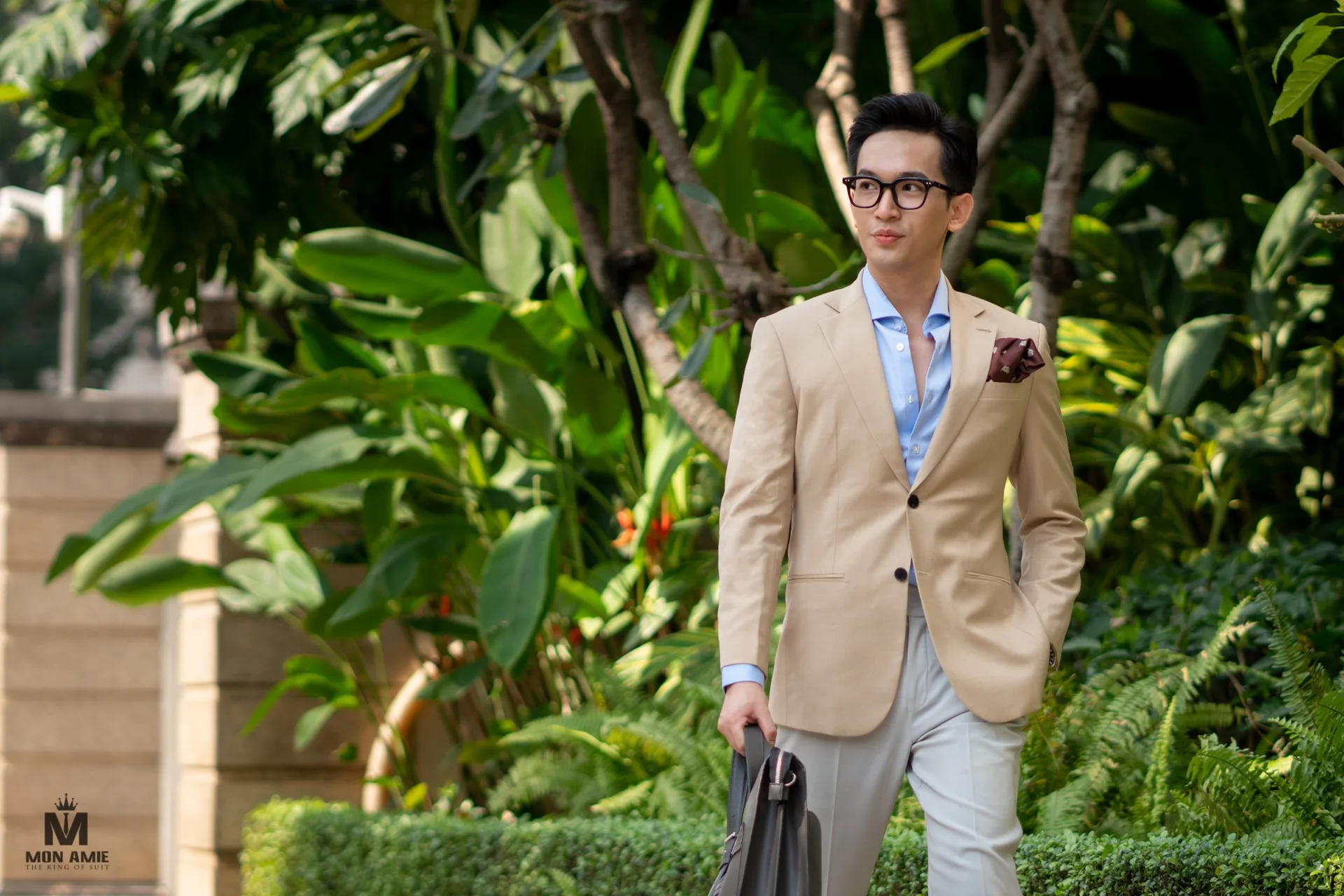
5. Buttons: where a blazer "gives itself away"
Metal buttons (silver, gold, brass), horn, mother-of-pearl or wood give a blazer personality at first glance. Single-breasted blazers usually have two or three buttons; the double-breasted style (6x2) with metal buttons is the classic variant, more formal.
6. Fabric and color
- Plain navy or hopsack: the first blazer, goes with gray, beige and white trousers.
- Medium gray: understated, suits the office.
- Olive, camel, brown: earth tones for the cooler seasons and weekends.
- Linen, linen-wool blend: for hot weather, breathable and textured.
- Check, large stripes: for someone who already has a few basic blazers.
- Velvet: for evening events.
As for black, think twice: a black blazer easily looks like a black suit jacket separated from its trousers.
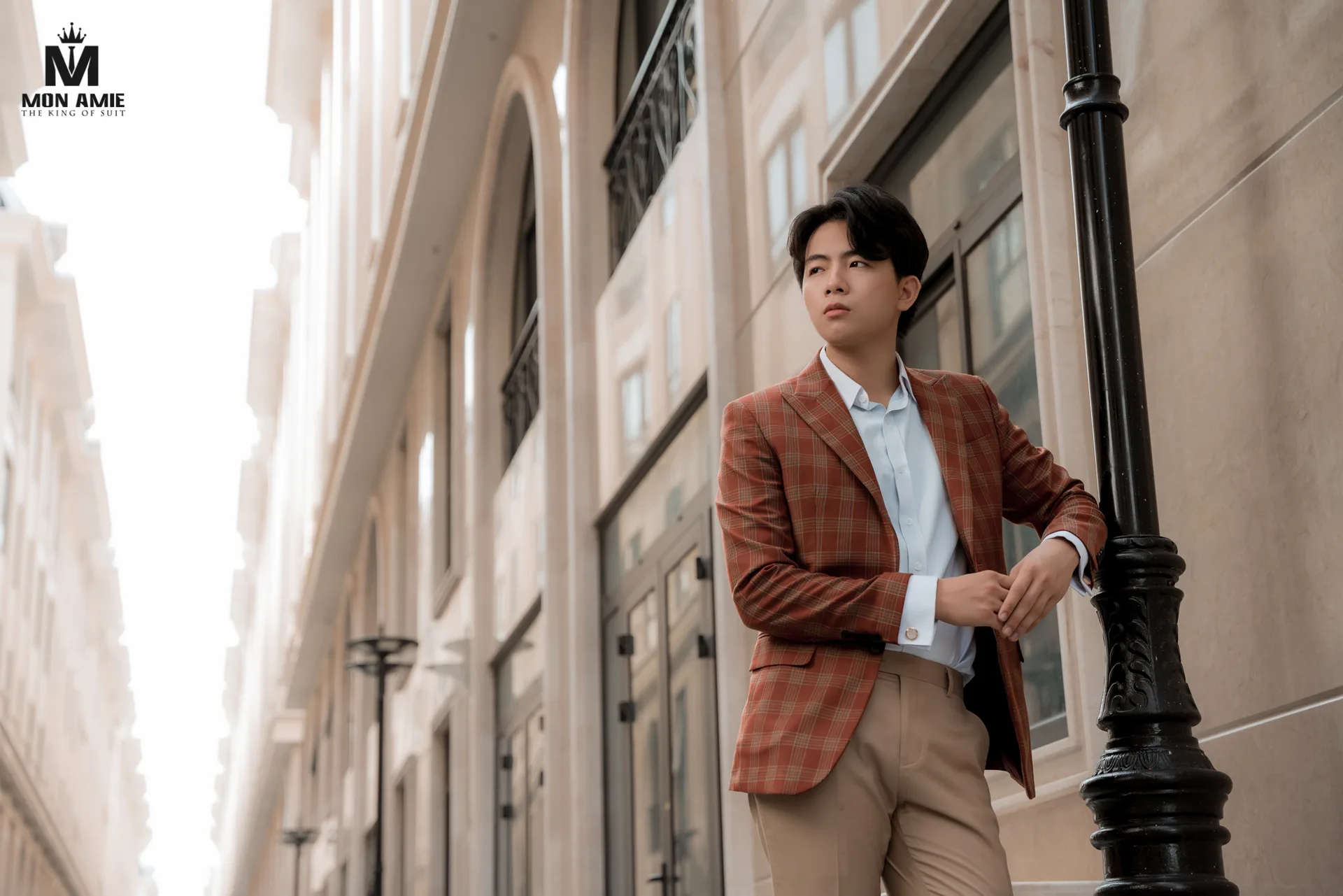
Trying a blazer in front of the mirror: five quick checks
- Button up. The front lies flat; an X-shaped crease around the button means it is tight.
- Shoulder. The shoulder seam sits at the end of the shoulder bone.
- Collar. It hugs the shirt collar and does not lift away at the back of the neck.
- Sleeves. They stop at the wrist bone, showing about 1 to 1.5 cm of shirt cuff.
- Arms out, arms bent. The jacket does not pull at the shoulders or strain across the back.
If you plan to wear the blazer outside the office, try it with the shirt and trousers you intend to pair it with. For specific pairing ideas, the article how to style a men's blazer has plenty of suggestions, while wearing a suit jacket with trousers of a different color explains the rules of dark and light.
Choosing a men's blazer by occasion
| Occasion | Suggested blazer | Pair with |
|---|---|---|
| Business casual office | Navy or medium gray, mid-structure, flap pockets | White or light blue shirt, gray trousers, leather shoes |
| Weekend, café | Navy hopsack, olive, camel; unlined or half-lined | Polo or open-collar shirt, khaki trousers, loafers |
| Evening party, event | Blue or wine-red velvet, flap over jetted pockets | White or black shirt, charcoal or black trousers, polished shoes |
| Travel, business trip | High-twist wool or linen blend, light, wrinkle-resistant | Breathable shirt, chinos, soft leather shoes |
| Hot season | Linen, linen-wool blend, light colors | Linen or cotton shirt, beige or white trousers |
For every occasion, how to choose a men's blazer remains the six details above; only the fabric and the structure change to suit the weather and the level of formality.
Common mistakes
- Using a suit jacket as a blazer. Smooth fabric and matching buttons make it look like it has lost its set.
- A blazer with overly thick shoulder padding makes the body stiff and loses the relaxed feel.
- Choosing a size for "comfort." A blazer that is wide at the shoulder looks slouchy and is no more comfortable.
- Shiny metal buttons on a cheap-looking fabric: the result looks like a stage costume.
- Buying only a patterned blazer without the basic navy one.
Frequently asked questions
What color should a men's blazer be first?
Navy. It pairs with gray, beige, white and khaki, and suits a café outing or a light meeting alike. Once you have a navy one, add a medium gray or an olive.
How is a men's blazer different from a suit jacket?
A blazer is designed to be worn separately: textured fabric, soft structure, buttons in a different color or in metal, patch pockets. A suit jacket is usually smooth, fully structured and cut from the same fabric as its trousers.
Can a men's blazer be worn to work?
Yes, if your company allows business-casual dress. Choose a navy or gray blazer with mid structure, worn with a light shirt and trousers. For important meetings, wear a full suit.
Can a men's blazer replace a winter coat?
No. A blazer is light and does not replace a thick coat. In cold weather, you can wear the blazer under an overcoat, or choose a thicker flannel or tweed blazer.
Should a men's blazer be made-to-measure?
Yes, if you plan to wear it often or your build is not standard size. The shoulder is the part that cannot be altered, so a ready-to-wear blazer that fits the waist but falls short at the shoulder is common. Made-to-measure lets you choose the fabric, structure, pocket style and buttons to match how you actually wear it, instead of accepting what is already on the rack.
A blazer that fits is a blazer you wear for years
A blazer is one of the most worthwhile pieces to invest in for refreshing a whole wardrobe, but only when it fits at the shoulder. You can try colors and styles on the online suit design tool, browse the samples in the product collection, or order to your own measurements with the Bespoke tailoring service at Mon Amie.