
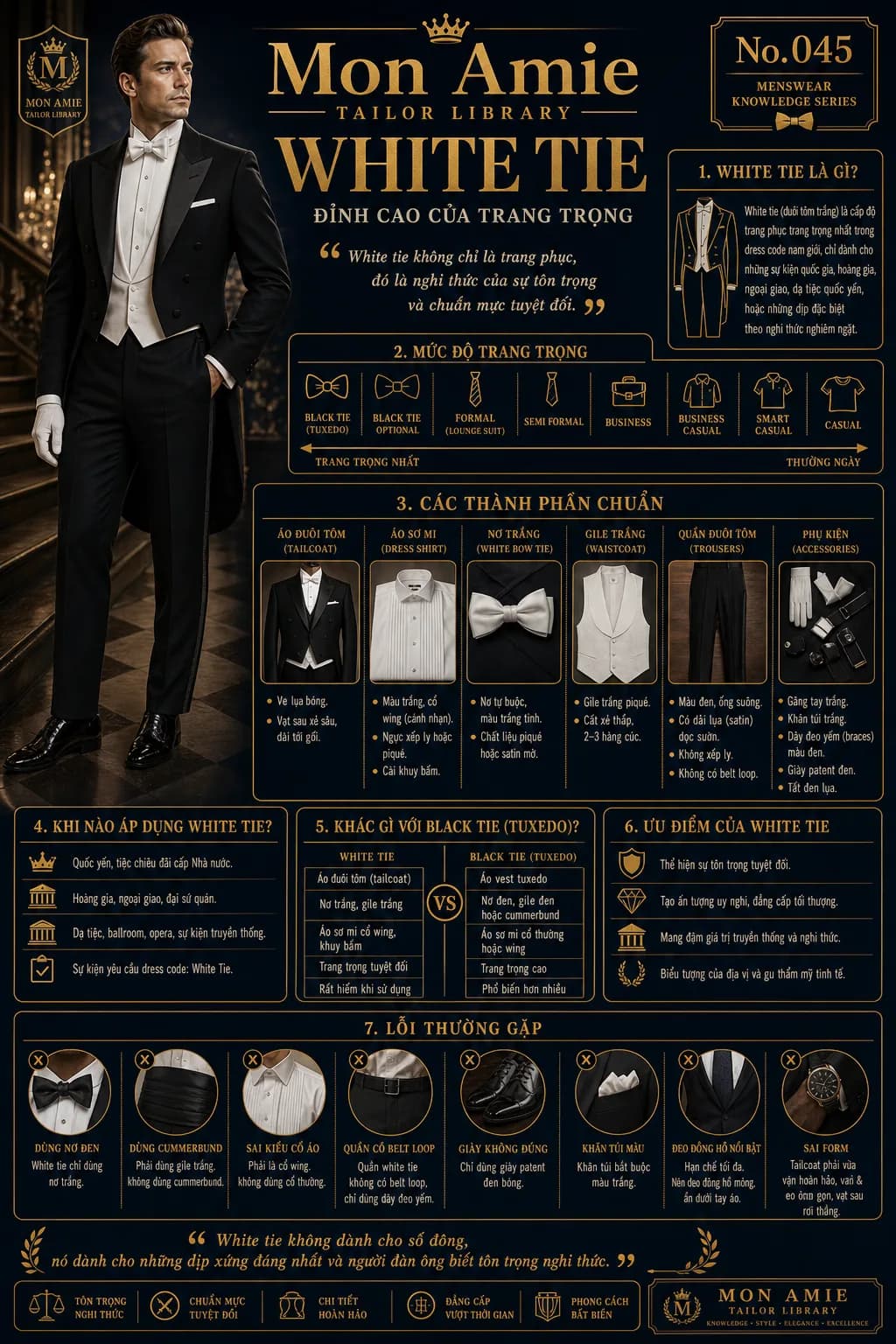
White tie, also known as full evening dress, is the most formal level in the hierarchy of men's dress codes — standing above even black tie. It is reserved for state occasions, royal and diplomatic events, official banquets, and other moments governed by strict protocol. For Mon Amie, white tie is not simply an outfit; it is a rite of respect and of absolute standards.
Where does white tie sit on the formality scale?
Men's dress codes can be arranged on a scale from the most formal to the most everyday, and white tie stands at the summit, above all the rest:
- White tie — absolute formality
- Black tie (tuxedo)
- Black tie optional
- Formal (lounge suit)
- Semi formal
- Business
- Business casual
- Smart casual
- Casual
Knowing this scale means you will never be overdressed or underdressed at any occasion. White tie in particular leaves no room for interpretation: when an invitation names it, every component must be correct.
The correct components of white tie
A properly composed white tie outfit comprises six groups of components, each with its own requirements:
- Tailcoat: lustrous silk lapels, a front cut horizontally at the waist, and long tails split deeply to the knee. This is the soul of the outfit.
- Dress shirt: white, with a wing collar, a pleated or piqué-woven front, and detachable studs in place of ordinary buttons.
- White bow tie: self-tie, pure white, in piqué or matte satin. It is this bow tie that gives the dress code its name.
- White waistcoat: in piqué, cut low to reveal the shirt front, usually with two or three buttons.
- Trousers: black, straight-legged, with satin braid down the outseam, unpleated and with absolutely no belt loops — they are held by braces.
- Accessories: white gloves, a white pocket square, black braces, polished black patent shoes and black silk socks.
When does white tie apply?
White tie is very rarely called for, and that rarity is precisely what gives it its value. The occasions that genuinely warrant it include:
- State banquets and official receptions.
- Royal, diplomatic and embassy occasions.
- Ballroom dinners, opera nights, and long-established traditional events.
- Any occasion whose invitation specifies the dress code: White Tie.
If the invitation does not say so, you will almost never need white tie — in which case black tie or a formal suit is the correct answer.
How does white tie differ from black tie?
The two are often confused, but the differences are unmistakable:
- Jacket: white tie calls for a tailcoat; black tie calls for a conventional tuxedo jacket.
- Bow tie and waistcoat: white tie takes a white bow tie with a white waistcoat; black tie takes a black bow tie with a black waistcoat or cummerbund.
- Shirt: white tie requires a wing collar with studs; black tie allows either a turndown or a wing collar.
- Level: white tie is absolute formality and very rarely worn; black tie is highly formal but far more common.
Why does white tie remain a symbol?
Rare as it is, white tie holds an irreplaceable place in the culture of men's dress:
- It expresses complete respect for the host and for protocol.
- It creates an impression of dignity and of the highest standing as you enter the room.
- It carries traditions and ceremony preserved across centuries.
- It stands as a mark of position and of refined taste.
Seven common mistakes when wearing white tie
Because the occasions are so few, many gentlemen make basic errors that undo the entire outfit:
- Wearing a black bow tie: white tie takes a white bow tie, without exception.
- Wearing a cummerbund: a white waistcoat is required; the cummerbund belongs to black tie.
- The wrong collar: the shirt must have a wing collar, never a turndown.
- Trousers with belt loops: white tie trousers have no belt loops and are held by braces alone.
- The wrong shoes: only polished black patent shoes, never ordinary leather Oxfords.
- A coloured pocket square: it must be white.
- A conspicuous watch: keep it to a minimum; if worn at all, choose something slim and hidden by the cuff.
Above all there is the matter of fit: a tailcoat must fit perfectly, clean through the shoulder and waist, with the tails falling straight. A poorly cut tailcoat reveals itself instantly beneath the chandeliers of a ballroom.
A word from Mon Amie's artisans
White tie is the hardest examination a tailor can sit, because a tailcoat permits no deviation at the shoulder, the waist, or in the fall of the tails. If you have an occasion that calls for white tie, allow at least two fittings and stand, sit and raise your arms in the fitting room itself so the artisan can adjust every point of contact. Mon Amie keeps your measurements for life and guarantees alterations after delivery, so you can be entirely confident the outfit will be correct right up to the moment you enter the room.
White tie is not for the many — it is for the occasions that deserve it most, and for the man who honours ceremony. When such an occasion comes, book an appointment with Mon Amie at one of our five showrooms in Ho Chi Minh City, or read about our bespoke service to begin the journey towards a garment at the very summit — hotline 0888.111.118.