
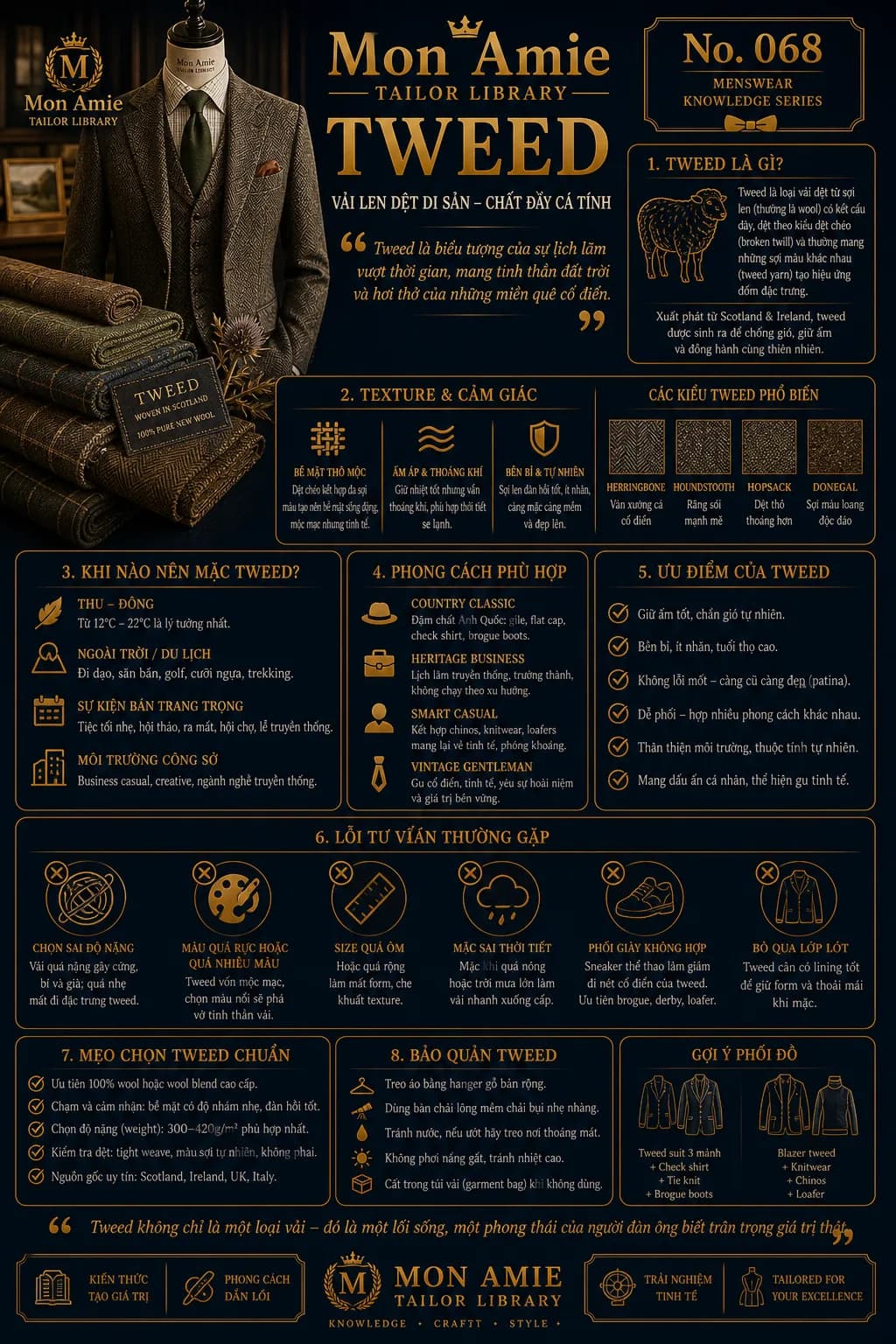
Tweed is a woollen cloth with a dense structure, woven in a broken twill and typically combining yarns of different colours to create its characteristic flecked effect. Born in Scotland and Ireland, tweed was made to block wind, hold warmth and accompany a life spent outdoors. For Mon Amie, tweed is a symbol of timeless elegance — carrying the spirit of open country and the breath of the classical countryside.
The texture and hand of tweed
The first thing that identifies tweed is not its colour but its surface. Three qualities give this heritage wool its character:
- A rustic surface: broken twill combined with multi-coloured yarns creates a lively, earthy yet refined face — up close you see each strand interlacing, from a distance it reads as deep and quietly luxurious.
- Warm and breathable: tweed insulates well while still breathing, which suits cool weather rather than trapping heat as many assume.
- Durable and natural: the wool fibre is springy and crease-resistant, and above all the cloth softens and improves with the years.
Among common weaves you will most often meet four names: herringbone (the classic chevron), houndstooth (a bold, assertive check), hopsack (a coarser, airier weave) and Donegal (the distinctive flecked yarn, Ireland's speciality). Each carries its own personality — herringbone is the easiest for a first tweed, while Donegal suits a man who wants to stand apart.
When to wear tweed
Tweed was made for cool climates and an outdoor life, so the occasions for it are clear:
- Autumn and winter: 12°C to 22°C is ideal. In Vietnam, that means the year's end in the north, a trip to Da Lat, or deeply air-conditioned interiors.
- Outdoors and travel: walking, shooting, golf, riding, trekking — precisely the country origins of the cloth.
- Semi-formal occasions: light dinners, conferences, launches, fairs and traditional ceremonies.
- The workplace: well suited to a business casual dress code, to creative industries, and to professions with a traditional character.
In terms of style, tweed lends itself to four main directions: Country Classic, thoroughly English with a waistcoat, flat cap, check shirt and brogue boots; Heritage Business, traditional and mature, indifferent to trends; Smart Casual, with chinos, knitwear and loafers for a relaxed refinement; and Vintage Gentleman, for the man who loves classic taste, nostalgia and lasting value.
The strengths that keep tweed alive
Few cloths have held their place in the male wardrobe for more than a century as tweed has. The reasons are entirely practical:
- Excellent warmth and natural wind resistance.
- Durable, crease-resistant and long-lived.
- Never out of fashion — the older it grows, the better it looks, developing a patina over the years.
- Easy to combine, at home in many different styles.
- Environmentally sound, being an entirely natural material.
- Personal in character, expressing the wearer's refined taste.
Common mistakes when choosing and wearing tweed
In the course of consultation, Mon Amie sees six recurring errors:
- The wrong weight: cloth that is too heavy feels stiff, bulky and ageing; too light and tweed loses its defining character.
- Colours too bright or too many: tweed is by nature earthy, and loud colours break the spirit of the cloth.
- A cut too tight or too loose: either loses the line of the jacket and obscures the texture — the most valuable thing tweed has.
- Wearing it in the wrong weather: wearing it when it is too warm, or letting it take heavy rain, degrades the cloth quickly.
- Ill-matched shoes: sports trainers dilute the classic note; favour brogues, derbies and loafers.
- Neglecting the lining: a tweed jacket needs a good lining to hold its shape and to wear comfortably.
Choosing tweed well, and caring for it
When selecting cloth, five principles serve you: favour 100% wool or a fine wool blend; handle it and judge the surface — good tweed has a slight grain and springs back well; choose a weight around 300–420 g/m², the most versatile range; check the weave — tight, with natural, colourfast yarns; and choose a reputable origin from Scotland, Ireland, England or Italy.
Caring for tweed is straightforward, provided it is done properly:
- Hang the jacket on a broad wooden hanger to preserve the shoulder.
- Brush away dust gently with a soft brush after each wearing.
- Keep it from water; if it does get wet, hang it somewhere cool and airy to dry naturally.
- Never dry it in strong sun, and avoid high heat.
- Store it in a garment bag when it will not be worn for some time.
For combinations, two formulas are both safe and handsome: a three-piece tweed suit with a check shirt, knitted tie and brogue boots for formal occasions; or a tweed blazer with knitwear, chinos and loafers for everyday.
A word from Mon Amie's artisans
For the Vietnamese climate, Mon Amie usually suggests beginning with a tweed blazer in a moderate weight rather than a full heavy suit — it serves far more occasions while keeping all the character of the cloth. When commissioning, let the tailor advise you carefully on lining and weight according to where you will wear it most; a properly made tweed will stay with you for a decade and only grow more beautiful. Mon Amie keeps your measurements for life and guarantees alterations after delivery, so you may invest with confidence in a piece of such lasting value.
Tweed is not merely a cloth — it is a way of living, the bearing of a man who values what is genuine. If you would like to handle tweeds from Canonico, Holland & Sherry, Dormeuil or Scabal, we invite you to book an appointment at one of Mon Amie's five showrooms in Ho Chi Minh City, or read about the tailoring process beforehand — hotline 0888.111.118.