
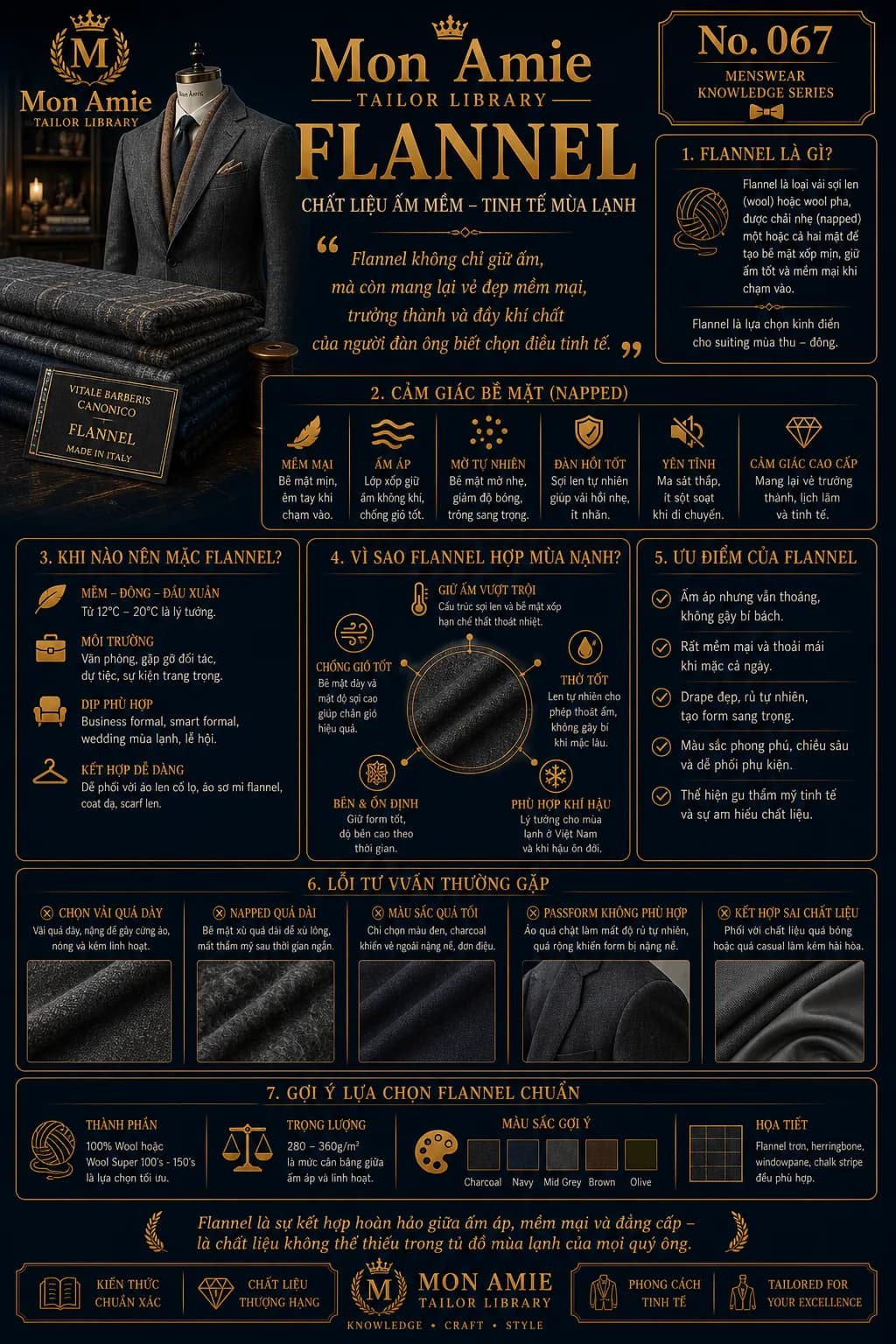
Flannel is a woollen or wool-blend cloth that has been lightly brushed — napped — on one or both faces to create a soft, downy surface that holds warmth and feels gentle to the touch. It is the classic choice for autumn and winter suiting: flannel does more than keep you warm, it lends a soft, mature and quietly assured presence to the man who knows how to choose well.
The napped surface — flannel's signature
Flannel's most recognisable trait is the fine layer of raised fibre on the surface, known in the trade as the "nap". That soft bloom gives flannel six qualities that set it apart from smooth worsted cloths:
- Softness: a fine, gentle surface — the first thing you notice when you handle a flannel swatch.
- Warmth: the nap traps air between the fibres and blocks wind far better than a flat weave of the same weight.
- A natural matte: the subdued surface reduces sheen, giving a deep, refined look well suited to formal settings.
- Good elasticity: natural wool fibres give the cloth spring, so it creases little across a long day.
- Quietness: low friction means no rustle as you move.
- A sense of quality: it lends the whole suit an air of maturity, elegance and refinement.
When to wear flannel
Flannel is a cold-weather cloth, and timing determines most of the experience:
- Season: autumn, winter and early spring, ideally between 12°C and 20°C.
- Setting: the office, meetings with partners, dinners and formal events.
- Suitable occasions: business formal, smart formal, cold-season weddings, year-end celebrations.
- Easy to combine: flannel pairs naturally with roll-neck knitwear, flannel shirts, wool overcoats and scarves — exactly the spirit of a cold-weather wardrobe.
In Vietnam, flannel is especially at home in Hanoi and the northern provinces in winter, or on trips to temperate countries. In Ho Chi Minh City, a moderately weighted flannel still performs well in boardrooms, restaurants and hotels kept at deep air conditioning.
Why flannel suits the cold
Flannel is regarded as the classic autumn-winter suiting cloth for good reason. Its structure answers every demand of cold weather:
- Outstanding warmth: the wool structure and napped surface together limit heat loss.
- Good wind resistance: a dense surface and high fibre count block wind effectively.
- Breathability: natural wool releases moisture, so it never feels stifling over long wear — a clear advantage over synthetic insulating cloths.
- Durability and stability: it holds its shape and lasts well over the years.
- Climate suitability: ideal for the cold season in Vietnam and for temperate climates alike.
Beyond that, flannel is warm yet breathable rather than close; it drapes beautifully, falling naturally into an elegant line; and its colours are rich, deep and easy to accessorise. Worn well, flannel is a discreet way to show refined taste and a genuine understanding of cloth.
Common mistakes when choosing flannel
Mon Amie's consultation experience shows a few errors recurring often:
- Choosing cloth that is too heavy: overly thick, heavy cloth makes a jacket stiff, warm and inflexible — particularly in the southern climate.
- Too long a nap: an excessively raised surface sheds fibre and loses its looks within a short time.
- Colours that are too dark: staying only with black and charcoal makes the whole look heavy and monotonous; flannel is at its best in mid grey, brown and olive.
- The wrong cut: too tight and the natural drape disappears; too loose and the silhouette turns ponderous.
- Mismatched materials: pairing flannel with cloths that are too shiny or too casual breaks the harmony.
Choosing flannel well
- Composition: 100% wool, ideally Wool Super 100's–150's — the best balance of softness and durability.
- Weight: 280–360 g/m² strikes the balance between warmth and flexibility.
- Suggested colours: charcoal, navy, mid grey, brown and olive — deep, subdued tones that build a wardrobe easily.
- Patterns: plain flannel, herringbone, windowpane and chalk stripe all work; chalk stripe on grey flannel is the classic image of traditional suiting.
As for sources, the great Italian and English mills — Vitale Barberis Canonico, Holland & Sherry, Dormeuil and Scabal — each offer their own flannel range for autumn and winter, and these are the very collections Mon Amie carries in its showrooms.
A word from Mon Amie's artisans
With flannel, Mon Amie usually suggests beginning with a plain mid grey around 300 g/m² — warm enough for a trip to a cold country, light enough for an air-conditioned office in Saigon. When your measurements are taken, describe clearly where you will wear it so the tailor can allow the right amount of movement: flannel needs drape, and a jacket cut too close loses all the softness that makes the cloth beautiful. And do not hesitate to try brown or olive; against a matte nap, these tones read as deep and quietly luxurious.
Flannel is the perfect union of warmth, softness and distinction — an essential in any gentleman's cold-weather wardrobe. If you would like to handle flannel swatches from Canonico, Holland & Sherry, Dormeuil or Scabal, we invite you to book an appointment at one of Mon Amie's five showrooms in Ho Chi Minh City, or review our pricing beforehand — a full suit from VND 4.8 million in the Kevinlli line, hotline 0888.111.118.