
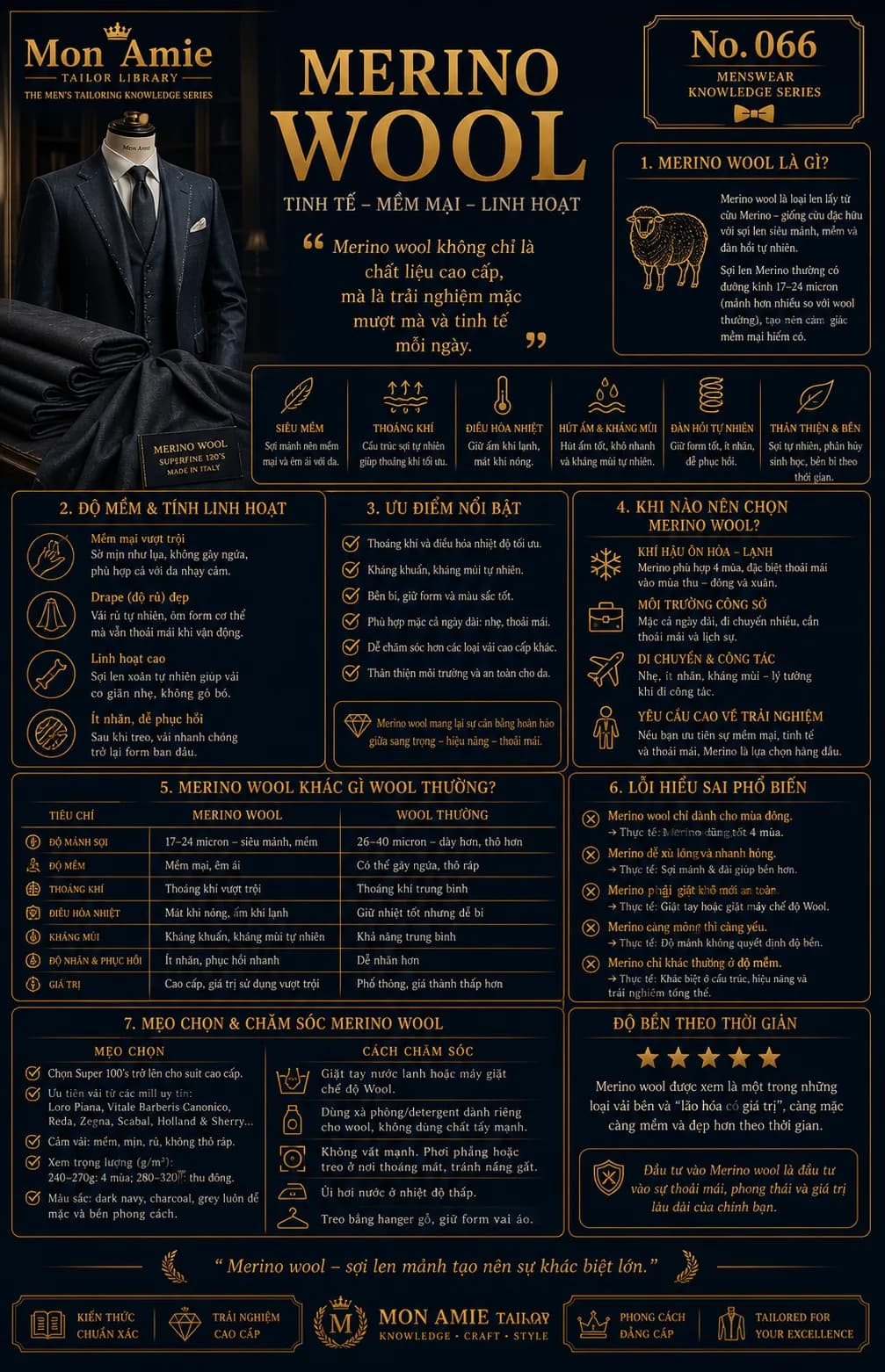
Merino wool comes from the Merino sheep, whose fleece measures only 17–24 microns — considerably finer than ordinary wool — making it soft, naturally elastic and free of any itch. For a man who wears a suit regularly, merino delivers a smooth, breathable and refined experience day after day, rather than simply being a "luxury" word printed on a label.
What Merino wool is, and what makes it special
Merino sheep originate from harsh climates, so their fleece evolved to hold warmth in the cold and release heat when it turns warm. Merino fibres typically measure 17–24 microns in diameter, while ordinary wool runs 26–40 microns. That fineness is precisely what creates the rare softness you feel against the skin.
Six qualities have built Merino's reputation:
- Exceptionally soft: fine fibres sit gently on the skin, suitable even for sensitive complexions.
- Breathable: the natural fibre structure allows air to circulate freely.
- Thermoregulating: warm when it is cold, cool when it is hot.
- Moisture-wicking and odour-resistant: absorbs moisture well, dries quickly, naturally resists odour.
- Naturally elastic: holds its shape, resists creasing, recovers easily.
- Sustainable and durable: a natural fibre that biodegrades over time.
The softness and versatility of Merino wool
What tailors truly value in Merino is not only its softness, but the way the cloth moves with the body:
- Outstanding hand: silky to the touch, with none of the itch commonly associated with wool.
- Beautiful drape: the cloth falls naturally, following the body while allowing free movement.
- High flexibility: the natural crimp of the fibre gives the cloth a slight give, so nothing feels restrictive.
- Wrinkle-resistant and quick to recover: hung overnight, the cloth returns to its original shape.
For a suit worn all day — meetings, driving, constant movement — these qualities matter far more than how the cloth looks fresh off the press.
When to choose Merino wool
Merino suits nearly every situation, but it comes into its own in four:
- Temperate to cool climates: Merino wears well year-round, and is most comfortable in autumn, winter and spring.
- Corporate settings: long days and frequent movement, where comfort and formality must coexist.
- Travel and business trips: light, wrinkle-resistant and odour-resistant — ideal on long flights, ready to wear on arrival.
- High expectations of comfort: if softness, refinement and ease are your priorities, Merino leads the field.
In Ho Chi Minh City's climate, a lightweight Merino suit of roughly 240–270 g/m² is comfortable all year, in deeply air-conditioned offices and outdoors alike.
How Merino differs from ordinary wool
A direct comparison across the criteria that matter:
- Fibre fineness: Merino at 17–24 microns, ultra-fine and soft; ordinary wool at 26–40 microns, thicker and coarser.
- Softness: Merino is gentle on the skin; ordinary wool can feel scratchy and rough.
- Breathability and thermoregulation: Merino excels, cool in heat and warm in cold; ordinary wool insulates well but can feel stifling.
- Odour resistance: Merino is naturally antibacterial and odour-resistant; ordinary wool is average.
- Creasing: Merino creases little and recovers quickly; ordinary wool wrinkles more readily.
- Value: Merino sits in the premium segment with outstanding wearing value; ordinary wool is more common and less expensive.
Common misconceptions about Merino
- "Merino is only for winter" — in fact it wears well in all four seasons thanks to its thermoregulating ability.
- "Merino pills and wears out quickly" — the fibres are fine but long, making the cloth more durable than many alternatives.
- "Merino must be dry cleaned to be safe" — hand washing in cold water or a machine's Wool cycle works perfectly well.
- "The finer the Merino, the weaker it is" — fibre fineness does not determine durability.
- "Merino only differs from ordinary wool in softness" — the difference lies in fibre structure, performance and the entire wearing experience.
Choosing and caring for a Merino suit
When selecting cloth:
- Choose Super 100's and above for a premium suit.
- Favour respected mills: Loro Piana, Vitale Barberis Canonico, Reda, Zegna, Scabal, Holland & Sherry.
- Judge the cloth by hand: soft, smooth, well-draping, never rough.
- Consider the weight: 240–270 g/m² for year-round wear, 280–320 g/m² for autumn and winter.
- Colour: dark navy, charcoal and grey are always easy to wear and lasting in style.
When caring for it:
- Hand wash in cold water or use a machine's Wool cycle with a wool-specific detergent, never harsh bleach.
- Do not wring; dry flat or hang somewhere cool and airy, away from direct sun.
- Steam press at low temperature; use a wooden hanger to preserve the shoulder line.
Merino is also considered a cloth that ages well: with proper care it becomes softer and more beautiful the more it is worn.
A word from Mon Amie's artisans
In Mon Amie's experience, a Merino suit in Super 110's–130's at 240–270 g/m² is the finest balance for the Vietnamese climate: light enough for all-day wear, structured enough to hold the shoulder. If you are commissioning your first suit, choose dark navy or charcoal — both travel easily from the boardroom to an evening dinner. And never apply high heat directly to Merino; gentle steam is enough for the cloth to recover its own lines.
Merino wool is an investment in comfort, bearing and lasting value — the fineness of the fibre makes all the difference. If you would like to handle Merino cloths from Canonico, Holland & Sherry, Dormeuil or Scabal at one of Mon Amie's five showrooms in Ho Chi Minh City, we invite you to book an appointment or review our pricing beforehand — hotline 0888.111.118.