
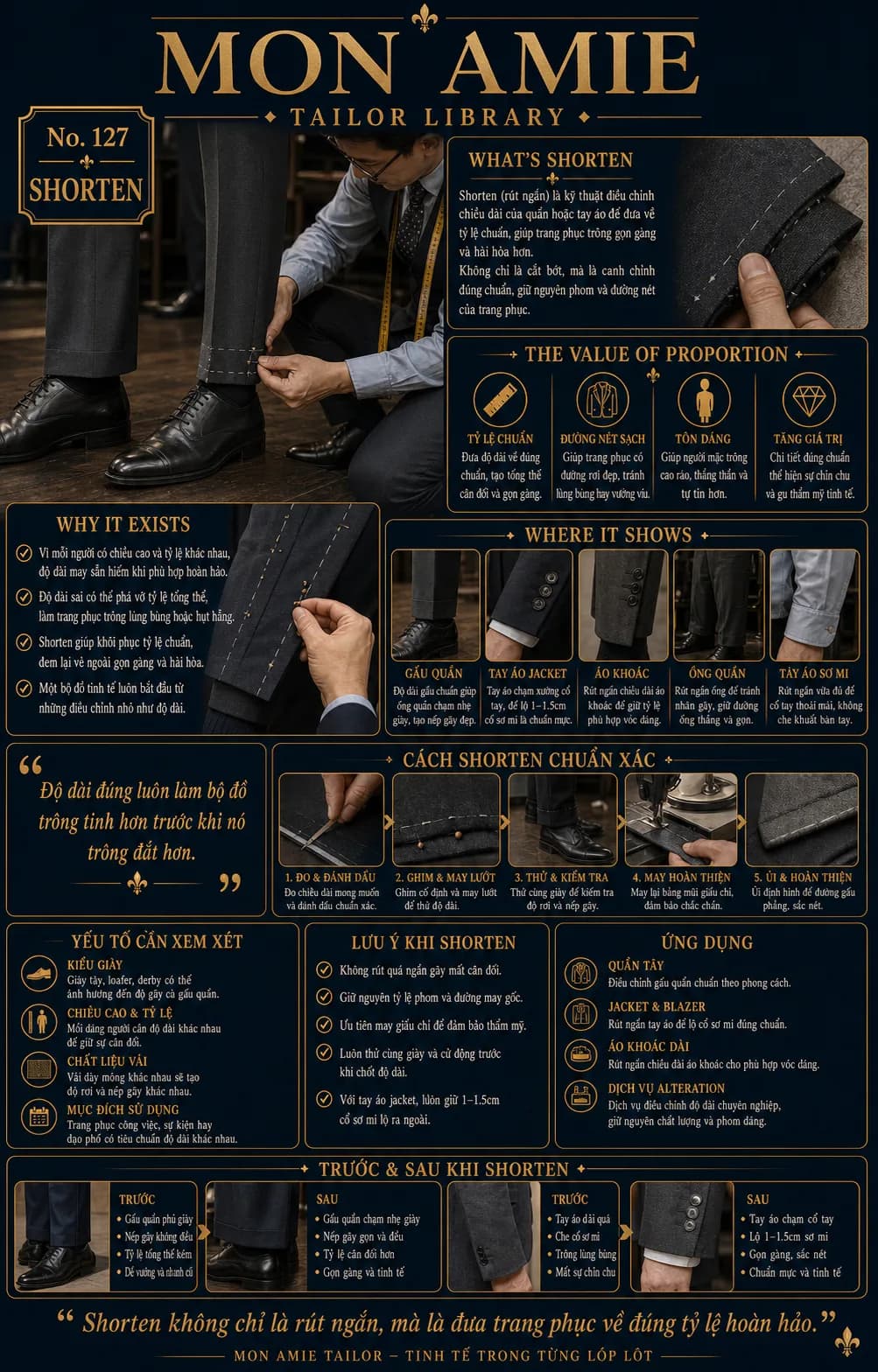
What is shortening? It is the technique of reducing the length of trousers or sleeves to bring a garment back to correct proportion, so the whole silhouette reads neat and balanced. One thing to understand from the outset: shortening is not simply cutting cloth away — it is measuring precisely and preserving the shape and lines the garment already has.
Why the technique exists
Every man has a different height and different proportions, so ready-made lengths rarely suit any one frame perfectly. However fine a pair of trousers may be, a hem that piles onto the shoe undoes it; however refined a jacket, a sleeve that swallows the wrist undoes it too.
- The wrong length breaks overall proportion, leaving a garment either bunched or stranded.
- Shortening restores correct proportion and returns a clean, harmonious line.
- A refined outfit always begins with small corrections such as length — something every long-time suit wearer comes to know.
In the workroom, Mon Amie often tells clients this: correct length makes a garment look finer before it makes it look more expensive. A suit in ordinary cloth cut to the right length still reads better than one in precious cloth with the proportions off.
The value of correct proportion
Why should a few centimetres matter so much? Shortening delivers four things:
- Correct proportion: length brought to standard, producing a balanced, tidy whole.
- Clean lines: the garment drapes properly instead of bunching or catching as you move.
- A flattering figure: you appear taller, straighter and more assured — the eye reads proportion long before it reads cloth.
- Added value: correct detail signals care and a refined eye.
Where shortening is applied
The technique appears across nearly every part of a man's wardrobe:
- Trouser hem: the right length lets the hem rest lightly on the shoe, creating a clean break instead of piling over the instep.
- Jacket sleeve: the sleeve should end at the wrist bone, showing 1–1.5 cm of shirt cuff — the classic standard.
- Overcoat: shortening the body keeps the coat in proportion to the wearer, especially for men of modest height.
- Trouser leg: reducing length prevents creasing and keeps the leg line straight and trim.
- Shirt sleeve: shortened just enough to leave the wrist free without covering the hand.
Shortening properly, in five steps
Done well, shortening is far more than cut and restitch. The correct process has five stages:
- Measure and mark: measure the desired length with the garment on you, marking precisely with chalk or pins.
- Pin and baste: pin the length, then baste it so it can be assessed before final stitching.
- Fit and check: try it with the shoes you actually wear, to judge drape and break.
- Final stitching: finish with a blind stitch, secure yet invisible from the outside.
- Press and finish: press the hem so it sits flat and crisp, as though newly made.
What to weigh up before shortening
Four factors deserve consideration:
- The shoe: oxfords, loafers and derbies sit at different heights and change the break directly.
- Height and proportion: every frame calls for a slightly different length to stay balanced.
- The cloth: heavy and light cloths drape and break differently, so the amount taken up differs too.
- The occasion: business, formal and casual wear each carry their own length conventions.
And the points our workroom insists on:
- Do not go too short — an over-shortened hem is far harder to rescue than an under-shortened one.
- Preserve the garment's original proportions and seam lines.
- Favour blind stitching for a clean finish.
- Always fit with shoes on, and move, before settling the length.
- On jacket sleeves, always leave 1–1.5 cm of shirt cuff showing.
A word from Mon Amie's artisans
At Mon Amie the master tailors remind the younger hands that shortening is not about removing length but about restoring perfect proportion. A proper trouser hem is fitted with the client's own shoes, pinned, basted and only then finished — there are no shortcuts. That is why Mon Amie's alteration work always preserves the original cloth and silhouette, correcting only what genuinely needs correcting.
If your suit runs long — hems covering the shoes, sleeves hiding the shirt cuff — visit one of Mon Amie's five showrooms in Ho Chi Minh City (Nguyen Trai, Ho Van Hue, 3/2 Street, Caravelle Hotel District 1, Nguyen Thi Thap) or call 0888.111.118. You may book an appointment for a measurement and consultation in person, or read more about the tailoring process at Mon Amie.