
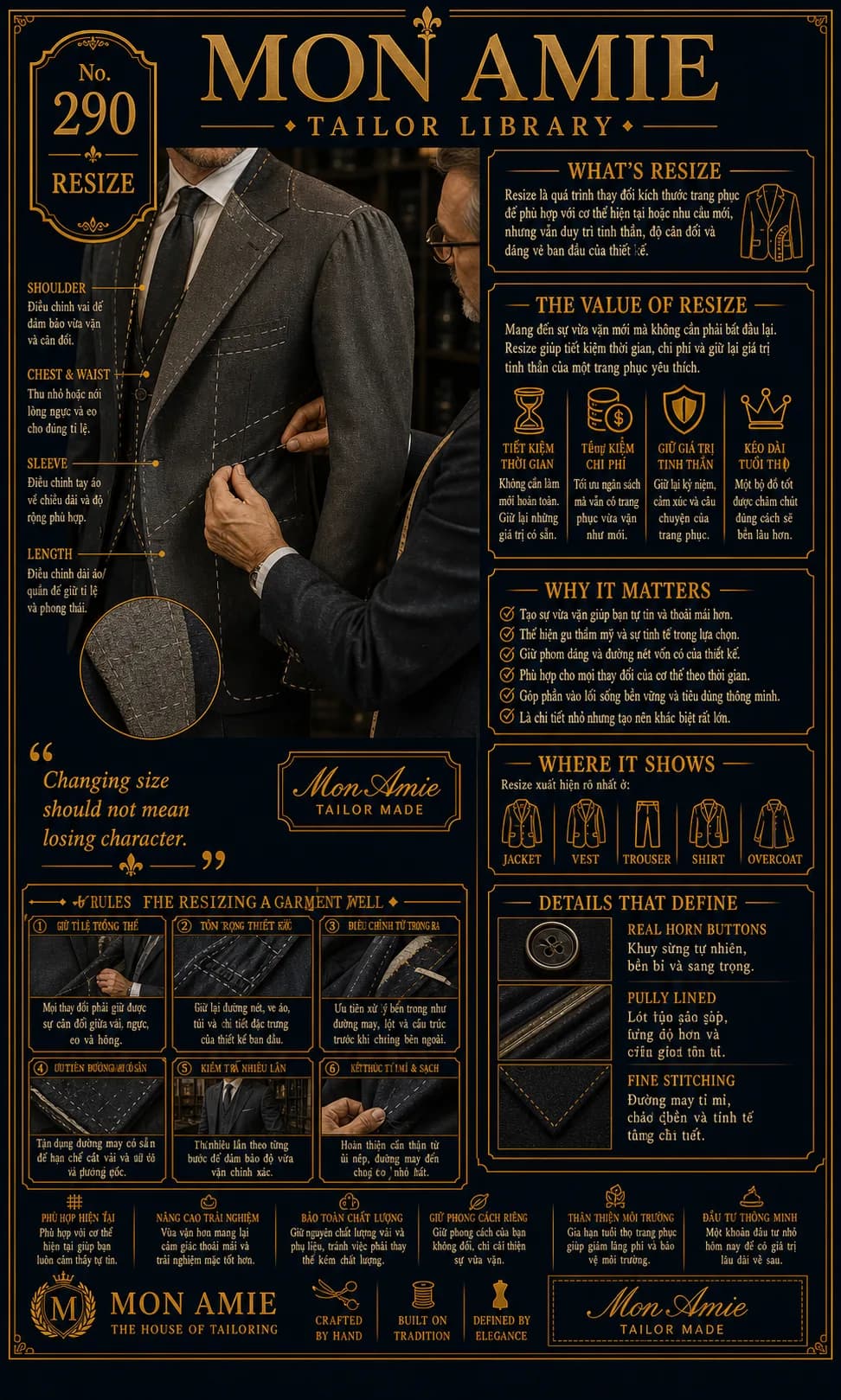
What is resizing? It is the process of changing a garment's dimensions to suit your body today, or a new requirement, while preserving the spirit, balance and silhouette of the original design. Put another way, resizing is not about making something wearable again; it is about making a jacket fit as though it had been cut for the man you are now.
What is resizing, and where does the work happen
The body changes over time — weight gained or lost, training that broadens the shoulders or trims the waist. A good suit need not be discarded for that. Resizing generally concentrates on four areas:
- Shoulder: adjusted for correct fit and balance — the hardest area of all, and the one that governs the whole line of the jacket.
- Chest and waist: taken in or let out to the right proportion, preserving the natural curve of the body panels.
- Sleeve: length and width corrected so exactly the right amount of shirt cuff shows.
- Length: jacket and trouser lengths adjusted to hold the overall proportion and bearing.
Each area is bound to the others: taking in a waist without reconsidering the chest, or shortening a sleeve while ignoring its width, will unbalance the garment.
What resizing gives you: a new fit without starting over
Resizing delivers a fresh fit without commissioning a new garment. Four clear benefits:
- Time saved: nothing is built from scratch, and everything good about the jacket is kept.
- Cost saved: the budget is used well and the result fits like new.
- Sentimental value preserved: the memories and story of the garment remain — a wedding jacket, a first suit of a career.
- A longer life: a good suit, properly cared for, lasts far beyond the average.
With suits made from fine cloth — Canonico, Holland & Sherry, Dormeuil or Scabal — the fabric and internal construction retain their value for many years. Discarding such a jacket over a few centimetres would be a waste.
Six principles for resizing a jacket properly
Resizing done well follows clear professional rules:
- Hold the overall proportion: every change must preserve the balance between shoulder, chest, waist and hip — adjust one point, look at the whole garment.
- Respect the original design: keep the lines, lapel, pockets and defining details of the design as it was.
- Work from the inside out: address seams, lining and structure before touching the exterior.
- Favour existing seams: use the seams already there to minimise cutting and keep the garment original.
- Fit repeatedly: try the garment on at each stage to confirm the fit precisely.
- Finish meticulously and cleanly: from pressing to stitching, work so that no one can see the garment has been altered.
The crucial factor is seam allowance. A properly made bespoke suit always leaves cloth at the side seams, the back and the cuffs — that hidden reserve is what allows a garment to be let out later. Factory suits are usually cut close, so their scope for resizing is far narrower.
Where resizing shows
Resizing is most evident on jackets, waistcoats, trousers, shirts and even topcoats. Each has its own limits: a jacket waist can be taken in 3–4 cm quite safely, but letting out a shoulder is difficult work requiring almost the entire upper section to be dismantled; trousers are easier to let out at the waistband thanks to the centre back seam; shirts are mainly adjusted through the body and sleeves. A good tailor will tell you plainly what can be corrected and what should be left alone.
A properly resized garment also keeps every detail that defines its class: durable, elegant natural horn buttons, fine silk lining, meticulous and refined stitching — all preserved rather than replaced with lesser materials.
A word from Mon Amie's artisans
In the Mon Amie workshop we hold to a simple belief: changing a garment's size should never mean losing its character. Every resize begins by reading the original construction — the grain, the canvas, the stress points — before any chalk is laid. Because Mon Amie keeps each client's measurements for life, comparing the body today with the record from before tells us exactly how much to adjust, and where, without guesswork.
If you have a favourite suit that no longer matches your measurements — or you would like a new one that fits from the start, with an alteration guarantee — book an appointment at one of Mon Amie's five showrooms in Ho Chi Minh City (Nguyen Trai, Ho Van Hue, 3/2 Street, Caravelle Hotel District 1, Nguyen Thi Thap) or call 0888.111.118. You may also wish to read the tailoring process to understand how we work from the very first measurement.