
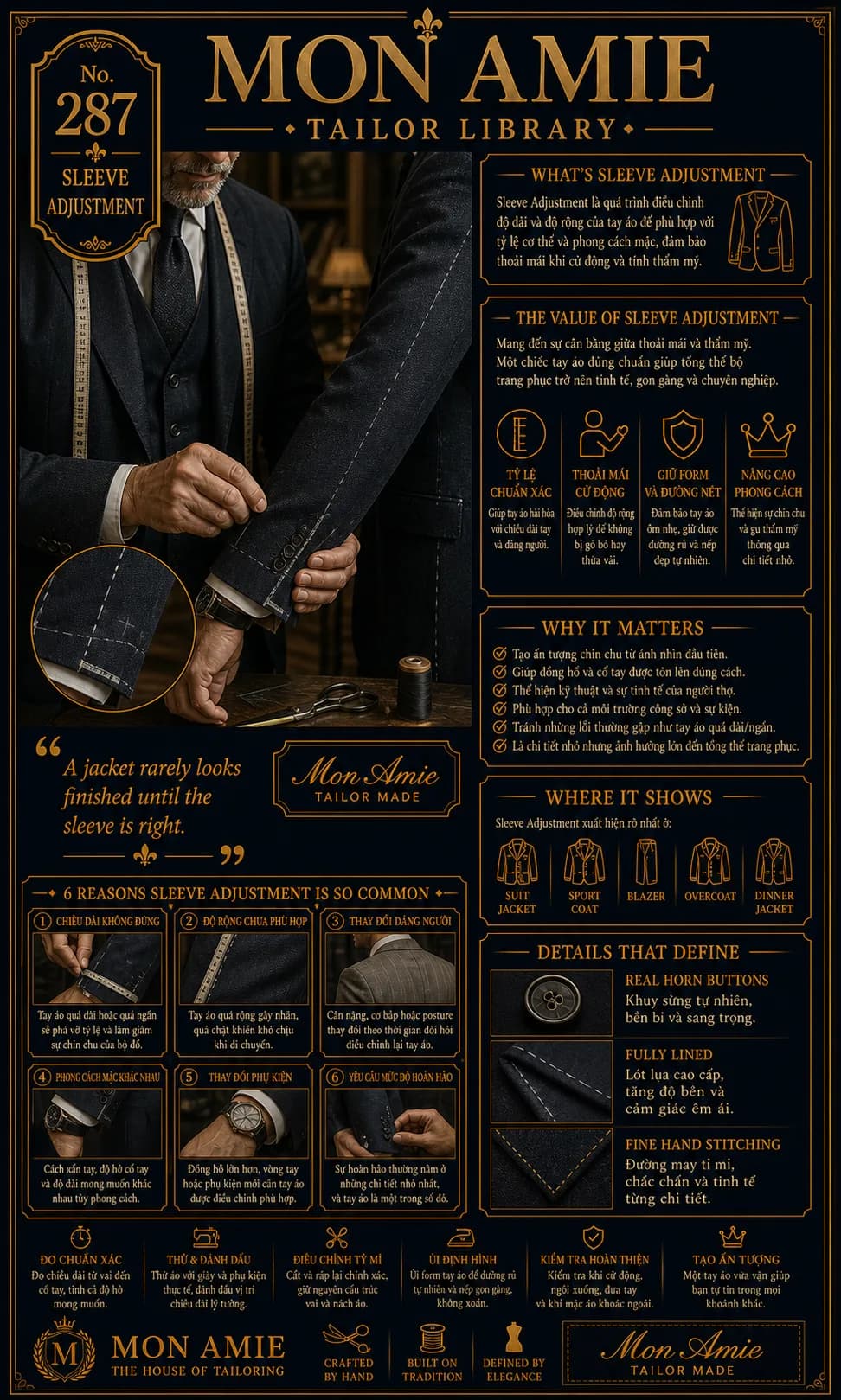
What is sleeve adjustment? It is the process of altering the length and width of a jacket sleeve to suit your proportions and the way you dress, ensuring comfort in movement as well as a good appearance. There is a saying in tailoring: a jacket rarely looks finished until the sleeves are right.
What sleeve adjustment is, and why sleeves decide the polish
The sleeve sits directly in the eyeline of whoever is in front of you: when you shake hands, offer a card or rest your arms on the meeting table, the sleeve length and the amount of shirt cuff showing are the first things seen. A sleeve that runs too long swallows the wrist and makes the whole outfit look untidy; too short and it breaks the proportions, undermining the composure of the entire suit.
Sleeve adjustment strikes the balance between comfort and appearance. A correctly finished sleeve makes the whole outfit look refined, neat and professional, through four core benefits:
- Correct proportion: the sleeve sits in harmony with your arm length and build.
- Comfort in movement: a sensible width, with neither restriction nor surplus cloth.
- Shape and line preserved: the sleeve traces the arm lightly, keeping a natural drape and clean folds.
- Elevated style: it signals attention to detail and taste through a small feature.
Six reasons sleeves are the most common alteration
In the Mon Amie workshop, sleeve work is the single most frequent alteration, for six reasons:
- Wrong length: a sleeve too long or too short breaks the proportions and undermines the polish of the outfit.
- Unsuitable width: too wide and the sleeve creases; too narrow and it feels uncomfortable in movement.
- A changing build: weight, muscle or posture shift over the years and call for the sleeves to be reset.
- Different ways of dressing: how you turn back a cuff, how much shirt you like to show and your preferred length all vary by personal style.
- New accessories: a larger watch, a bracelet or a new piece calls for the sleeve to be adjusted accordingly.
- The pursuit of perfection: perfection usually lives in the smallest details, and the sleeve is one of them.
Where sleeve adjustment shows most
The technique applies to nearly every form of men's outerwear: suit jacket, sport coat, blazer, overcoat and dinner jacket. Standards differ slightly for each — an overcoat needs a longer sleeve to cover the suit sleeve beneath, while a dinner jacket demands the greatest precision of all, being the dress of formal occasions.
Why does this detail matter so much?
- It creates an impression of polish at first glance.
- It shows a watch and the wrist to their best advantage.
- It reveals the skill and refinement of the tailor.
- It works equally in the office and at an event.
- It avoids the common faults of sleeves that are too long or too short.
- It is a small detail with a large effect on the whole outfit.
How sleeves are adjusted in the workshop
A thorough sleeve alteration runs through six stages:
- Measuring precisely: measuring from shoulder to wrist, allowing for the desired shirt cuff exposure.
- Fitting and marking: trying the jacket on with the actual shoes and accessories, then marking the ideal length.
- Adjusting carefully: cutting and re-setting exactly, leaving the shoulder and armhole structure untouched.
- Pressing to shape: pressing the sleeve so the drape is natural and the folds clean, with no twist.
- Final inspection: checking the sleeve in movement, seated, arm extended, and worn under an overcoat.
- Creating the impression: a well-fitted sleeve carries you confidently through every moment.
One point to note: on jackets with working buttonholes — natural horn buttons that actually fasten and unfasten — the length must be altered from the shoulder rather than the cuff, which demands considerably greater skill. That is also why details such as horn buttons, fine silk lining and meticulous sleeve stitching always appear together on a properly finished jacket.
A word from Mon Amie's artisans
At Mon Amie we often remind one another that a client may forget the colour of the cloth, but the person across from him always sees the cuff. The standard we work to is a sleeve ending at the wrist bone, showing roughly 1 to 1.5 cm of shirt — enough to set off a watch without display. Every suit made at Mon Amie carries an alteration guarantee and a lifetime record of your measurements, so as your body or your style changes, the sleeves change with them.
If the sleeves on your suit are running long or short, do visit one of Mon Amie's five showrooms in Ho Chi Minh City or call 0888.111.118. You may book an appointment to be measured in person, and read more about the tailoring process at Mon Amie — where every sleeve is fitted, marked and finished by hand.