
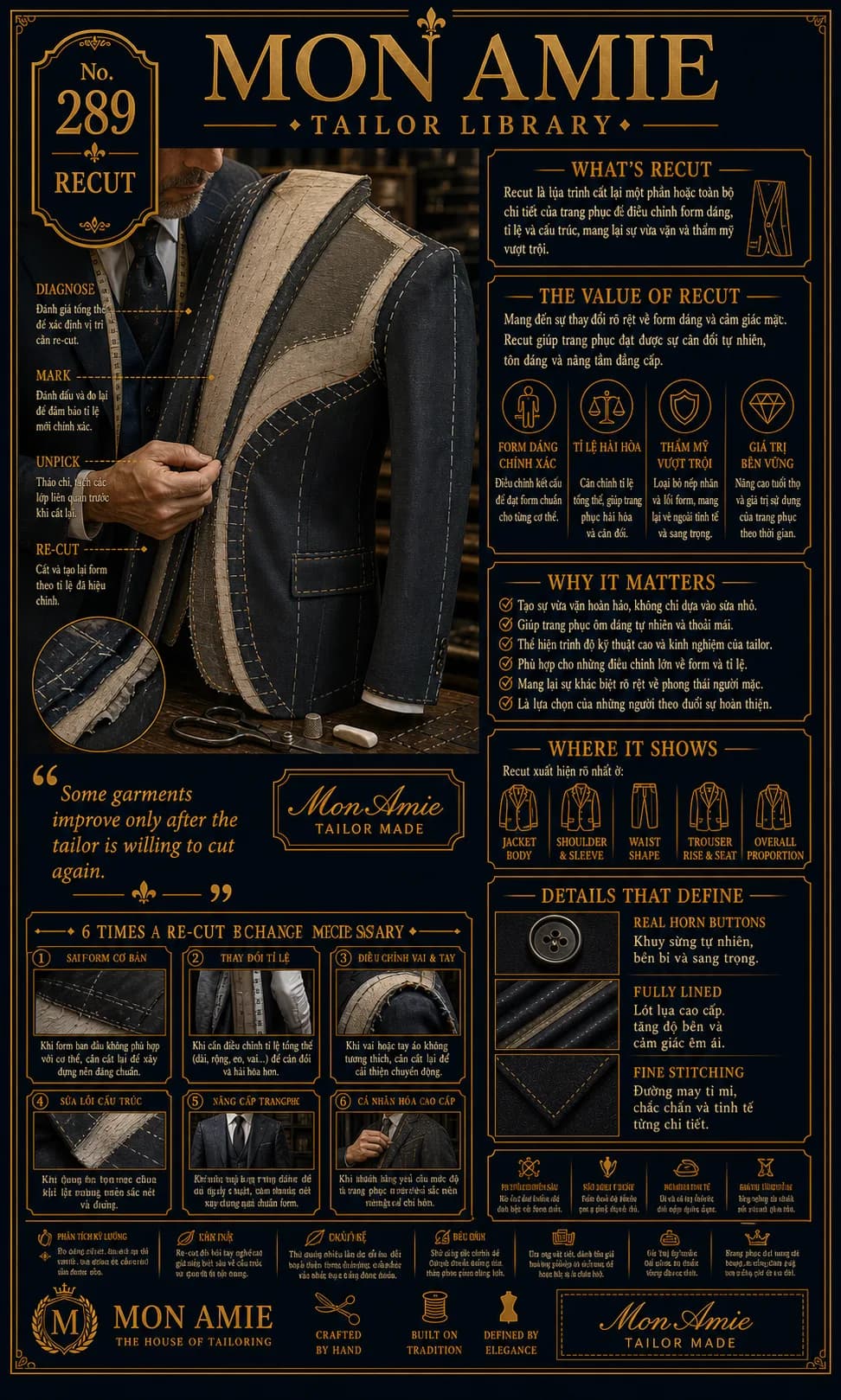
What is a recut? It is the process of re-cutting part or all of a garment's panels in order to correct its silhouette, proportion and structure, producing a level of fit and elegance that ordinary work cannot reach. There is a truth in this trade that few people say out loud: some garments only become beautiful when the tailor is willing to cut them again.
What is a recut, and how does it differ from a standard alteration
A standard alteration takes in, lets out or shortens a hem — the tailor works within the seams that already exist. A recut goes considerably further: panels are taken apart, measured again to a new proportion, then cut and rebuilt. Put simply, an alteration repairs; a recut remakes part of the pattern.
A disciplined recut moves through four stages:
- Diagnose: assess the garment as a whole to identify what must be re-cut — whether the fault lies in the silhouette, the proportion or the structure.
- Mark: mark and re-measure so the new proportions are exact before any scissors touch the cloth.
- Unpick: unpick the stitching and carefully separate the affected layers before cutting.
- Re-cut: cut and reshape to the corrected proportions, then rebuild the garment completely.
What a recut delivers
A recut produces a visible change in silhouette and in the way a garment feels — not an improvement of a few percent, but a shift into a different class of fit altogether. It brings a natural balance that flatters the body and raises the garment's standing, through four benefits:
- Accurate silhouette: the structure is adjusted to achieve the correct shape for one particular body.
- Harmonious proportion: overall proportions are recalibrated so the garment reads as balanced.
- Superior elegance: creases and structural faults are removed, leaving a refined, luxurious appearance.
- Lasting value: the garment's working life and usefulness are extended over the years.
Six cases that call for a recut
From experience in the workshop, Mon Amie finds a recut becomes necessary in six situations:
- A fundamentally wrong silhouette: when the original shape does not suit the body, the garment must be cut again to build a correct foundation — no amount of small fixes can rescue a flawed pattern.
- A change of proportion: when the overall proportions — length, width, waist, shoulder — need rebalancing.
- Shoulder and sleeve correction: when the shoulder or sleeve does not work with the body, re-cutting improves freedom of movement.
- Structural faults: when something inside the garment has gone wrong, leaving it soft and shapeless.
- Upgrading a garment: when an older suit deserves a higher level of finish, both technically and in the way it wears.
- Deep personalisation: when a client asks for a level of customisation that makes the garment unmistakably his own.
Where a recut shows most, and why it is worth it
A recut is most apparent in the jacket body, the shoulder and sleeve, the waist shape, the trouser rise and seat, and the overall proportion. These are all areas that minor alterations cannot reach, because they belong to the cut of the garment itself.
Why the technique matters:
- It creates genuine fit rather than relying on small corrections.
- It allows the garment to follow the body naturally and comfortably.
- It demonstrates a tailor's technical command and experience — a recut demands a deep understanding of structure, and not every tailor will attempt one.
- It is the right answer for substantial changes in shape and proportion.
- It makes a visible difference to the wearer's bearing.
- It is the choice of those who pursue the finished thing rather than the acceptable one.
Naturally, a recut is only worth doing on cloth and construction that deserve it: sound, durable fabric, natural horn buttons, fine lining and meticulous stitching are what make re-cutting a sensible investment rather than a reason to start again.
A word from Mon Amie's artisans
At Mon Amie, the willingness to take a garment apart and cut it again is our measure of professional self-respect: if a suit is not right, we recut it rather than persuading you that "it will feel normal after a few wears". That is why every suit made at Mon Amie comes with an alteration guarantee, and why your measurements are kept for life, so every adjustment rests on precise records.
If you own a suit that has never quite felt right — even after several alterations — bring it to one of Mon Amie's five showrooms in Ho Chi Minh City, or call 0888.111.118 for a diagnosis in person. You are welcome to book an appointment and read about the tailoring process beforehand — where every cut, including a second one, is made by hand and by people who refuse to settle.