
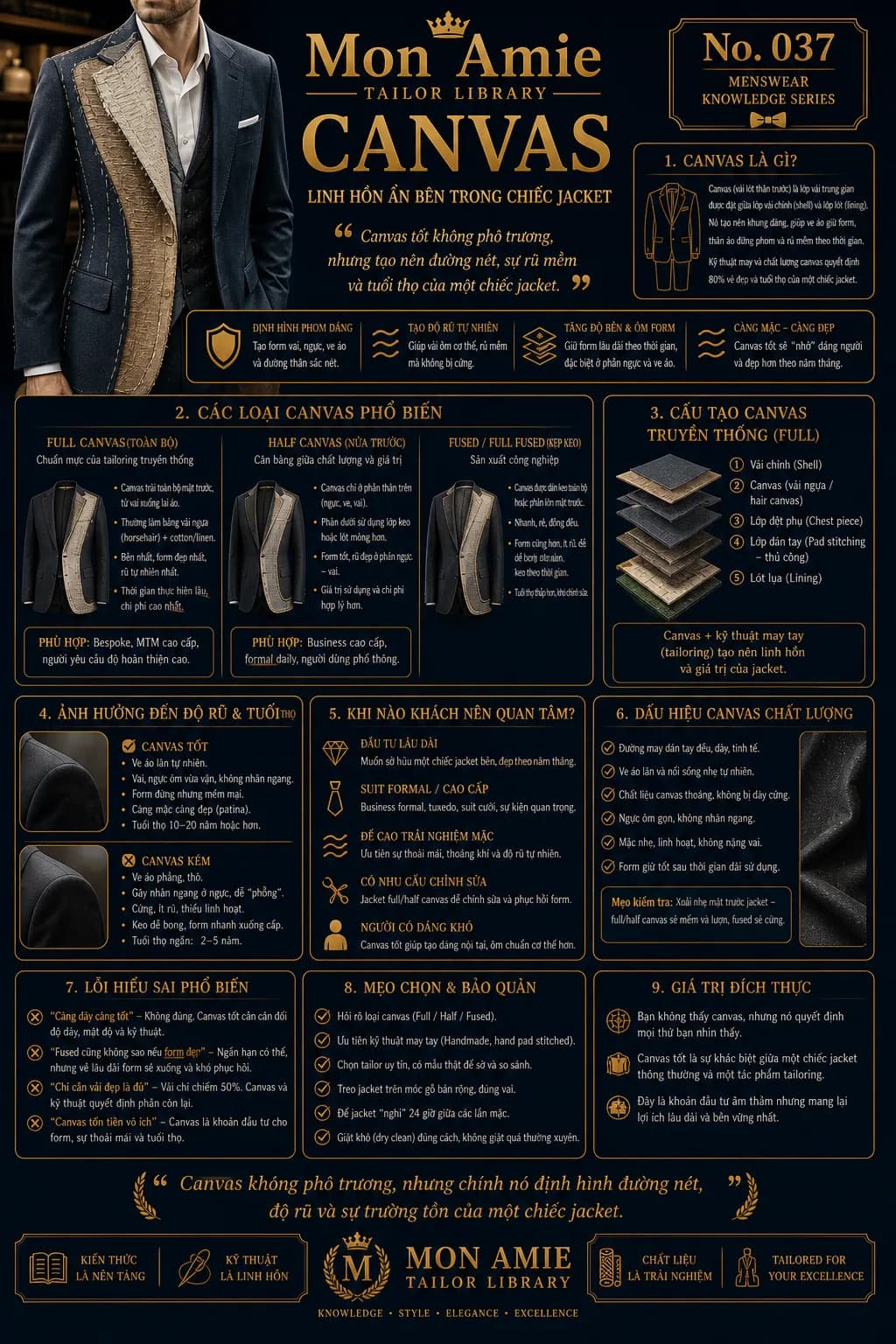
Canvas in a jacket is the interlining placed between the shell fabric and the lining across the forepart. You never see it, yet it is this layer that builds the structure, holds the roll of the lapel and keeps the body of the jacket standing cleanly while softening over time. In the trade, the tailoring technique and the quality of the canvas account for as much as 80% of a jacket's beauty and lifespan.
What canvas does inside a jacket
A good canvas never announces itself, but it carries four essential roles:
- Building the silhouette: creating clean shoulder, chest, lapel and body lines.
- Creating natural drape: letting the cloth follow the body and fall softly rather than standing rigid.
- Adding durability and shape retention: holding form over the years, particularly through the chest and lapel.
- Improving with wear: good canvas gradually "remembers" the wearer's shape and grows more handsome season by season — what tailors call the patina of a jacket.
The common types of canvas
There are three principal constructions, and this is what you should ask about before commissioning any suit.
Full canvas — the standard of traditional tailoring. The canvas runs across the entire forepart, from shoulder to hem, and is usually made of horsehair blended with cotton or linen. It is the most durable construction, giving the finest shape and the most natural drape; in exchange it takes longer to make and costs more. It suits bespoke, high-end made-to-measure and anyone who expects the highest level of finish.
Half canvas — the balance between quality and value. The canvas covers only the upper body (chest, lapel, shoulder), while the lower portion uses fusible or a lighter interlining. It gives good shape and attractive drape through the chest and shoulders at a sensible cost. It suits high-quality business suits and formal wear worn daily.
Fused / full fused — the industrial method: the interlining is glued directly to all or most of the forepart. It is fast, inexpensive and consistent, but the shape is stiffer, the drape flatter, and over time bubbling and delamination appear. Lifespan is short and the jacket is all but impossible to alter.
How traditional canvas is built
A true full-canvas forepart is a deliberate stack of layers:
- Shell fabric — the cloth you see on the outside.
- Canvas — the hair canvas that forms the framework.
- Chest piece — filling out and gently lifting the chest.
- Pad stitching — thousands of hand stitches that shape the roll of the lapel.
- Silk lining — the innermost layer against the body.
Canvas combined with handwork is the soul and the real value of a tailored jacket.
How canvas affects drape and longevity
You can recognise the difference by eye and by hand:
- Good canvas: a lapel that rolls naturally; shoulders and chest that sit close without horizontal wrinkles; a shape that stands yet stays supple; a jacket that improves with wear; a lifespan of 10 to 20 years or more.
- Poor canvas: a flat, coarse lapel; horizontal creasing across the chest and a tendency to bubble; a stiff feel with little drape or give; adhesive that lifts and lets the shape collapse; a lifespan of only about 2 to 5 years.
A simple test: twist the forepart gently — full or half canvas will feel soft and follow your fingers, while a fused jacket feels stiff and springs back coarsely.
When canvas should matter to you
Not every case calls for full canvas, but you should weigh it carefully when:
- You want a long-term investment: a jacket that stays durable and handsome for years.
- You are commissioning a formal suit, a tuxedo, a wedding suit or clothing for an important occasion.
- You value the wearing experience: comfort, breathability and natural drape.
- You may need alterations later — full and half canvas jackets can be altered and reshaped, while fused ones essentially cannot.
- You have a figure that is hard to fit: good canvas builds shape internally and follows the body more accurately.
Common misconceptions
- "Thicker is better" — untrue. Good canvas requires balance in weight, density and handling.
- "Fused is fine as long as the shape looks good" — perhaps in the short term, but the shape degrades over time and is hard to recover.
- "Good cloth is all you need" — cloth is only about half the story; canvas and construction decide the rest.
- "Canvas is money wasted" — in truth it is an investment in shape, comfort and the lifespan of the suit.
A word from Mon Amie's artisans
When commissioning a suit, ask your tailor directly: is this jacket built with full canvas, half canvas or fusible, and is the pad stitching done by hand? A confident workroom will open a real sample for you to handle and compare. As for care, hang the jacket on a broad wooden hanger matched to your shoulder, let it rest for 24 hours between wears, and dry clean it properly and sparingly. Good canvas plus proper care gives you a jacket that looks better with every year of wear.
You never see the canvas, yet it shapes everything you do see: the lines, the drape and the longevity of the jacket. If you would like to feel the difference between full canvas and fusible for yourself, we invite you to book an appointment at one of Mon Amie's five showrooms in Ho Chi Minh City, or to read about the tailoring process first — hotline 0888.111.118.