
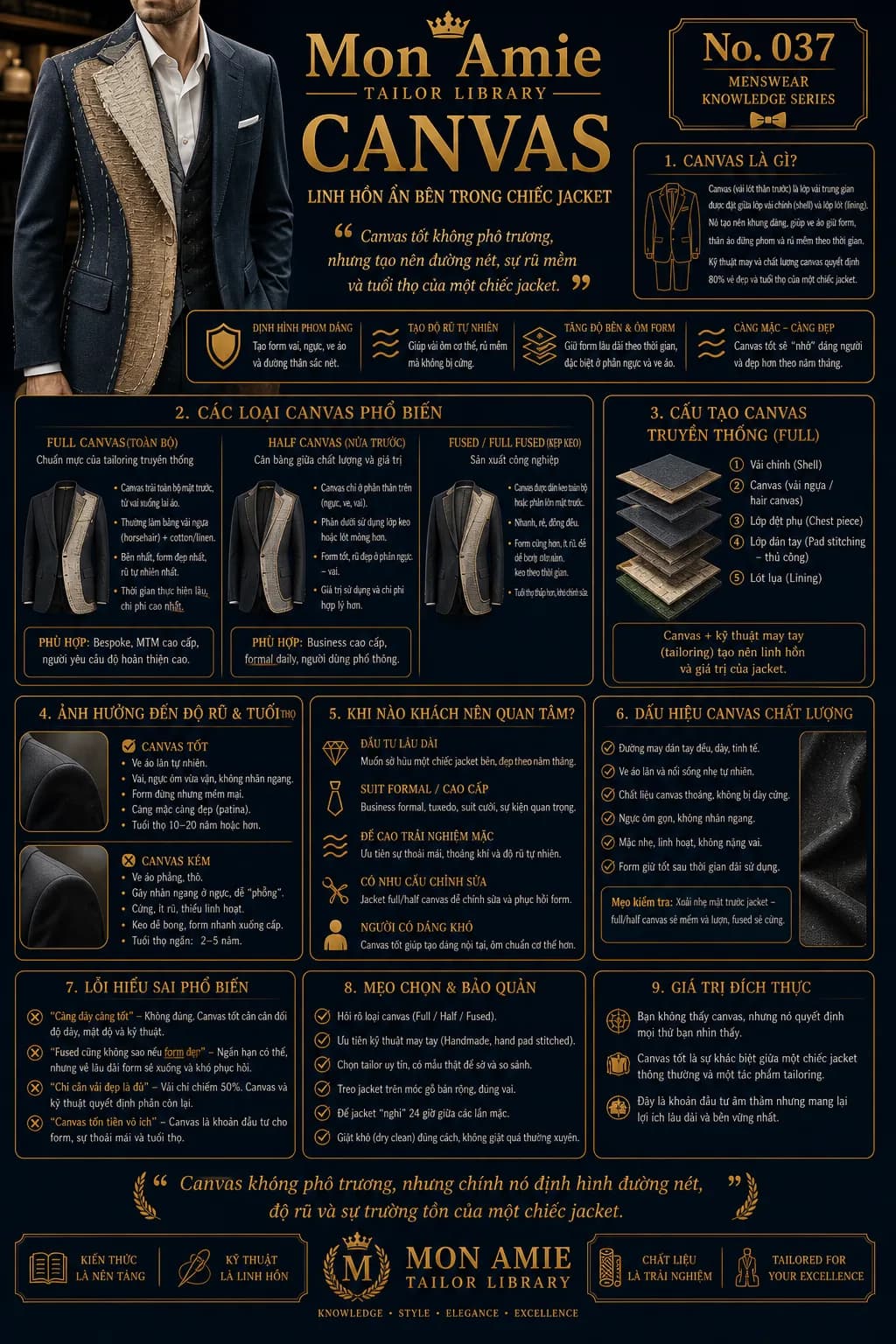
When commissioning a jacket, the most important question is not which cloth, but what lies inside it. The choice of canvas — full canvas, half canvas or fused — decides as much as 80% of a jacket's beauty and lifespan, even though you will never see it. This article compares the three constructions and helps you choose the one that fits your needs and your budget.
Why the canvas should be settled before the cloth
Canvas is the interlining placed between the shell fabric and the lining, building the structure of the entire forepart. It carries four responsibilities:
- Building the silhouette: creating clean shoulder, chest, lapel and body lines.
- Creating natural drape: letting the cloth follow the body and fall softly rather than stiffly.
- Adding durability and shape retention: holding form over the years, particularly through the chest and lapel.
- Improving with wear: good canvas "remembers" the wearer's shape and grows more handsome over time.
However beautiful a length of Canonico or Dormeuil may be, it cannot rescue a jacket built on poor canvas. Cloth accounts for roughly half a jacket's value; the construction inside decides the rest.
Comparing the three constructions
Full canvas — the standard of traditional tailoring:
- The canvas runs across the entire forepart, from shoulder to hem.
- Usually made of horsehair blended with cotton or linen.
- The most durable, the finest shape, the most natural drape.
- The longest to make and the highest in cost.
- Suited to: bespoke, high-end made-to-measure, anyone who expects the highest level of finish.
Half canvas — the balance between quality and value:
- Canvas only through the upper body (chest, lapel, shoulder); the lower portion uses fusible or a lighter interlining.
- Good shape and attractive drape through the chest and shoulders — where it matters most.
- More sensible in both cost and everyday value.
- Suited to: fine business suits, formal wear worn daily, the general wearer.
Fused — the industrial construction:
- The forepart is glued throughout in place of canvas.
- Fast, inexpensive and consistent — the advantages of mass production.
- A stiffer shape, less drape, prone to bubbling and adhesive failure over time.
- A markedly shorter lifespan and difficult to alter.
The difference in longevity is stark: a well-canvassed jacket can be worn handsomely for 10 to 20 years or more, while a fused jacket typically holds its shape for only 2 to 5 years before the chest creases horizontally, the lapel bubbles and the line is lost.
How to test the canvas yourself
You need not be a tailor to tell them apart. A few signs of quality canvas:
- Even, dense, delicate pad stitching on the underside of the lapel.
- A lapel that rolls and turns softly, with no hard break.
- A chest that sits close, without horizontal wrinkling as you move.
- A jacket that feels light and flexible, never heavy on the shoulder.
A quick test: roll the forepart gently between two fingers — a full or half canvas jacket will feel soft and follow your hand, while a fused one feels stiff and flat. In a traditional jacket, the full construction comprises five layers: shell fabric, canvas (horsehair), the chest piece, hand pad stitching and silk lining.
When good canvas is worth the investment
Not everyone needs full canvas, but you should favour good canvas if:
- You want a long-term investment: a jacket that stays durable and handsome for years.
- You are commissioning fine formal clothing: business suits, tuxedos, wedding suits, important occasions.
- You value the wearing experience: comfort, breathability and natural drape.
- You may need alterations later — full and half canvas jackets can be altered and reshaped, while fused ones essentially cannot.
- You have a figure that is hard to fit: good canvas builds shape internally and follows the body more accurately.
A few misconceptions are worth avoiding as well. "Thicker is better" is wrong — good canvas requires balance in weight, density and handling. "Fused holds a fine shape too" is true only in the short term; over the years the shape collapses and is hard to recover. And canvas is not money wasted — it is an investment in shape, comfort and the lifespan of the jacket.
Caring for canvas over the years
- Ask exactly which canvas is used (full, half or fused) before commissioning or buying.
- Favour handwork (handmade, hand pad stitched).
- Hang the jacket on a broad wooden hanger matched to your shoulder.
- Let the jacket rest for 24 hours between wears so the canvas recovers.
- Dry clean it properly, and not too often.
A word from Mon Amie's artisans
For a suit worn regularly for work, half canvas is a sensible balance between cost and experience; for an important suit — a wedding suit, or one you intend to keep for many years — full canvas with hand pad stitching is always worth it. When you visit the showroom, simply ask to see real samples so you can handle them and compare their softness; a reputable tailor will never mind you testing. Mon Amie always explains the canvas clearly before you decide, because that is the part that shapes the true value of a jacket.
Choosing the right canvas means choosing the lifespan and the lines of your jacket — before you even choose the cloth. If you would like to feel the difference between full canvas, half canvas and fused for yourself, we invite you to book an appointment at one of Mon Amie's five showrooms in Ho Chi Minh City, or to read about the tailoring process first.