
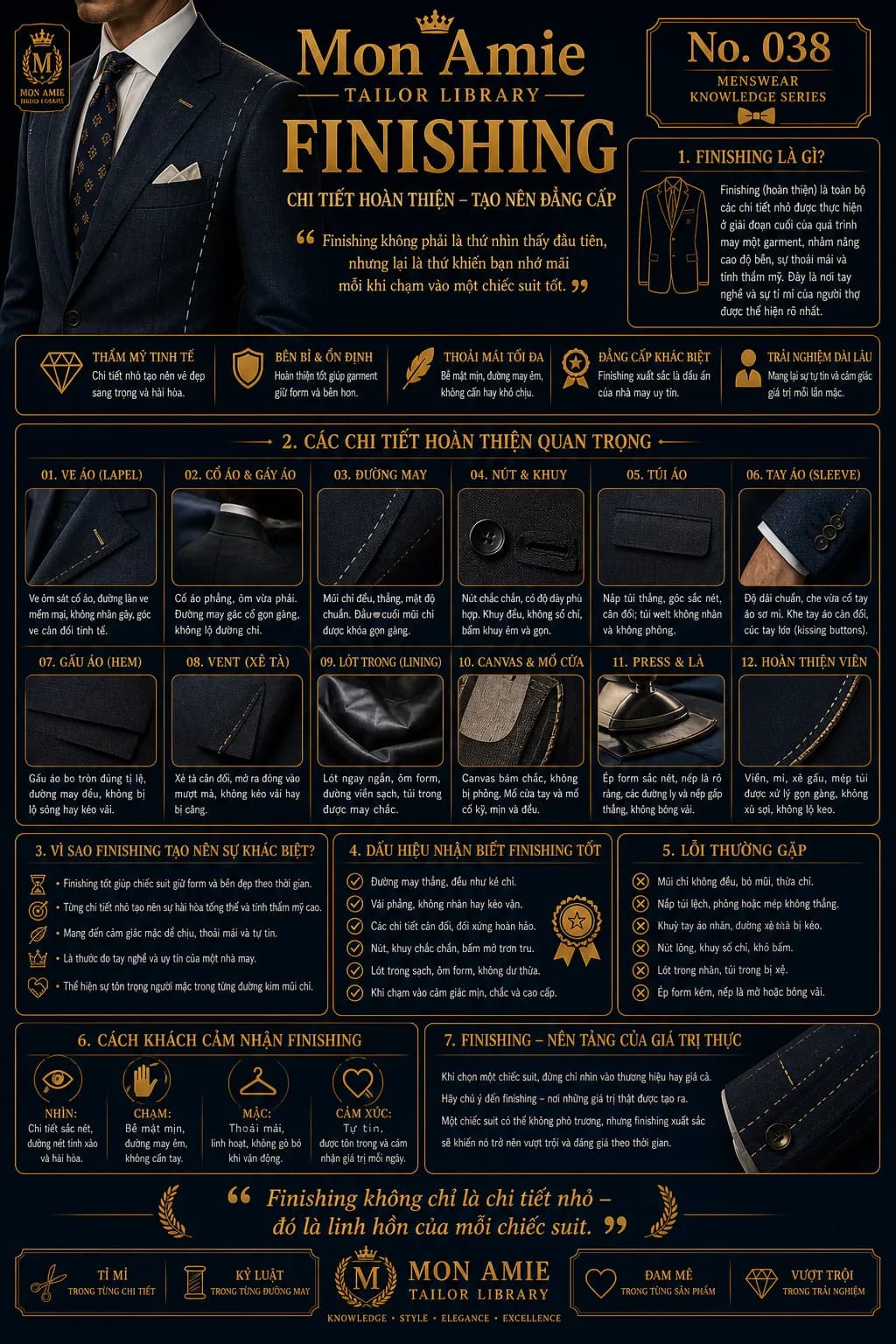
Finishing is the whole body of small details carried out in the closing stages of making a suit, raising its durability, its comfort and its refinement. Finishing is not the first thing you notice, but it is what stays with you every time you handle a good suit — this is where a tailor's skill and patience show most clearly.
Why finishing matters in a suit
Many people choosing a suit look only at the cloth and the cut, yet it is the finishing that decides how long that jacket will live with you. A good finishing process delivers five clear benefits:
- Refined aesthetics: small details create the luxury and harmony of the whole.
- Durability and stability: sound finishing helps the garment hold its shape and last longer.
- Maximum comfort: smooth surfaces and easy seams that never chafe or restrict movement.
- A distinct level of quality: outstanding finishing is the signature of a reputable house.
- A lasting experience: confidence and a sense of value in every wearing.
Put another way, finishing is the measure of a house's craft and reputation, and its way of showing respect for the wearer in every stitch.
The 12 finishing details worth checking
With a suit in your hands, you can judge the quality of the finishing yourself through these twelve points:
- Lapel: sitting close to the collar with a soft roll, never creased or broken, with balanced, refined points.
- Collar and neckline: flat and closely fitted; the collar seam neat, with no thread showing.
- Seams: even, straight stitching at the correct density, with the beginning and end neatly locked.
- Buttons and buttonholes: secure buttons of appropriate thickness; even buttonholes, no fraying, fastening smoothly and cleanly.
- Pockets: straight flaps with crisp, balanced corners; welt pockets neither puckered nor gaping.
- Sleeves: correct length, leaving the shirt cuff just visible; balanced sleeve openings with kissing buttons.
- Hem: correctly proportioned curve, even stitching, no rippling or pulling of the cloth.
- Vents: balanced, opening and closing smoothly, with no pulling or strain.
- Lining: neatly set and following the shape, with clean edges and firmly sewn inner pockets.
- Canvas and openings: canvas sitting firmly with no bubbling; sleeve and collar openings carefully worked, smooth and even.
- Pressing: crisply pressed shape, clear creases, straight pleats and folds, with no shine on the cloth.
- Edge finishing: edges, topstitching, hem vents and pocket mouths handled neatly, with no fraying and no adhesive showing.
The signs of good finishing
You need not be a tradesman to recognise a carefully finished suit; look for these signs:
- Stitching as straight and even as a ruled line.
- Cloth lying flat, with no puckering or twisting.
- Details balanced and perfectly symmetrical.
- Buttons and buttonholes secure, fastening smoothly.
- Lining clean, following the shape, with no excess.
- A hand that feels smooth, firm and refined.
Common finishing faults
Conversely, a poorly finished suit gives itself away at these points — check them carefully before you accept the garment:
- Uneven stitching, skipped stitches, loose threads.
- Crooked, gaping pocket flaps or edges that are not straight.
- Puckered sleeve buttonholes and vents that pull.
- Loose buttons, frayed buttonholes, difficult fastening.
- Wrinkled lining and sagging inner pockets.
- Poor pressing, with faint creases or shine on the cloth.
These faults look minor, but they accumulate into a feeling of dissatisfaction every time you dress, and more importantly they cause the jacket to lose its shape quickly after a few cleanings.
How a client experiences finishing
Finishing is felt across all four dimensions of wearing a suit:
- Sight: crisp details, delicate and harmonious lines.
- Touch: smooth surfaces and easy seams that never catch.
- Wear: comfortable and flexible, never restrictive in movement.
- Emotion: confidence, a sense of being respected, and value felt every day.
When choosing a suit, do not look only at the label or the price. Pay attention to the finishing — that is where real value is made. A suit may be quiet in its manner, yet outstanding finishing will make it exceptional and worth more with time.
A word from Mon Amie's artisans
Before you take delivery, spend two minutes turning the jacket inside out: look along the lining edges, pull the vent gently to see whether the cloth catches, and fasten each sleeve button in turn. Those three points reveal a tailor's skill faster than anything else, and the eye rarely thinks to check them. At Mon Amie, every suit carries an alteration guarantee after delivery and a lifetime record of your measurements, so if any detail is not quite right, simply bring the jacket back to any of our five showrooms in Ho Chi Minh City.
Finishing is not merely a matter of small details — it is the soul of every suit. If you would like to feel the difference a meticulously finished suit makes, from the Kevinlli line with full suits from VND 4.8 million to the Canonico, Holland & Sherry, Dormeuil and Scabal collections, we invite you to book an appointment or read about the tailoring process at Mon Amie — hotline 0888.111.118.