
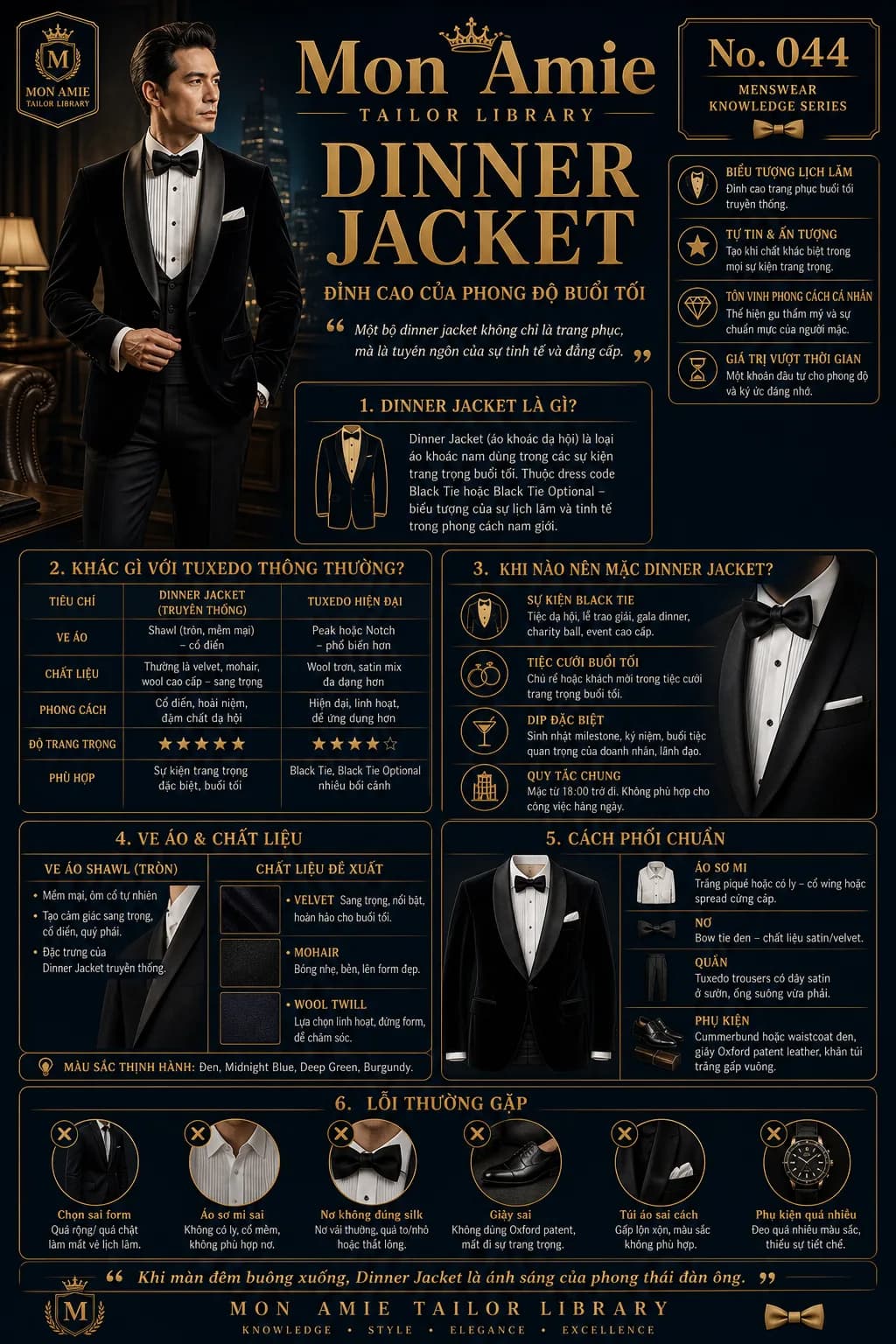
A dinner jacket is the jacket a man wears to formal evening occasions under a Black Tie or Black Tie Optional dress code — a symbol of polish and restraint in menswear. A dinner jacket is not merely clothing; it is a statement of refinement and standing. In this article, Mon Amie takes you through the essentials of this particular garment.
What is a dinner jacket?
The dinner jacket — sometimes described as evening dress — is the British name for the garment Americans habitually call a tuxedo. It is reserved for formal occasions held after dark: evening receptions, award ceremonies, gala dinners. Its signature is a lapel faced in silk or satin, worn with a white shirt, black bow tie and trousers braided with satin down the outseam.
For a grown man, a dinner jacket carries four essential values:
- A symbol of polish — the summit of traditional evening dress.
- Confidence and presence — a distinct bearing at any formal occasion.
- A tribute to personal style — evidence of taste and of standards.
- Value beyond fashion — an investment in your bearing and in memorable evenings.
How does a dinner jacket differ from an ordinary tuxedo?
Today the two terms are used interchangeably, but within the trade a subtle distinction remains between the traditional dinner jacket and the modern tuxedo:
- Lapel: the traditional dinner jacket favours the shawl lapel — rounded, soft, thoroughly classical; the modern tuxedo more often carries a peak or notch lapel.
- Cloth: the dinner jacket tends towards velvet, mohair or fine wool, all distinctly luxurious; the modern tuxedo leans on plain wool or satin blends, with wider variety.
- Character: the dinner jacket is classical, nostalgic, deeply of the evening; the modern tuxedo is more adaptable and easier to use.
- Formality: the dinner jacket sits at the highest level, for particularly formal evening occasions; the tuxedo suits both Black Tie and Black Tie Optional across many settings.
Put simply: every dinner jacket belongs to the world of Black Tie, but the traditional dinner jacket is the most classical and ceremonial version of that world.
When should you wear a dinner jacket?
- Black Tie events: evening receptions, award ceremonies, gala dinners, charity balls, high-end occasions.
- Evening weddings: for the groom or a male guest at a formal wedding held after dark.
- Special occasions: milestone birthdays, anniversaries, significant gatherings among business leaders.
The general rule of evening dress: a dinner jacket is worn from 18:00 onward and is never right for daily work. That is what separates it entirely from a business suit — the dinner jacket was made for lamplight, not office light.
Lapel and cloth — the soul of a dinner jacket
The shawl lapel is the mark of the traditional dinner jacket: soft, following the neck naturally, and unmistakably classical and refined. Its unbroken curve makes the wearer's face and chest read cleanly under the lights of a reception.
As for cloth, three options are held in high regard among tailors:
- Velvet: luxurious and striking, perfect after dark — its pile catches light and creates a depth all its own.
- Mohair: lightly lustrous, durable, beautifully shaped — it holds its line through a long evening.
- Wool twill: adaptable, structured, and easy to care for.
In colour, the prevailing choices are black, midnight blue, deep green and burgundy. Black and midnight blue are the safe standards; deep green and burgundy are for the man who wants to leave a mark while remaining measured.
How to style a dinner jacket correctly
- Shirt: white piqué or with a pleated front, and a wing or firm spread collar.
- Bow tie: black, in satin or velvet — never substituted with a necktie under a Black Tie dress code.
- Trousers: tuxedo trousers with satin braid down the outseam and a moderately straight leg.
- Accessories: a black cummerbund or waistcoat, patent leather Oxfords, and a white pocket square in a square fold.
Common mistakes to avoid
- The wrong fit: a jacket that is too loose or too tight loses all its polish.
- The wrong shirt: no pleated front, a soft collar, unsuited to a bow tie.
- The wrong bow tie: ordinary cloth, too large or too small, or knotted loosely.
- The wrong shoes: anything other than patent Oxfords lowers the formality of the whole.
- A poorly handled pocket square: untidy folds and unsuitable colours.
- Too many accessories: too many pieces in too many colours, missing the restraint that defines Black Tie.
A word from Mon Amie's artisans
With a dinner jacket, what decides the result is not the price of the cloth but the fit through the shoulder and chest — under reception lighting, every excess wrinkle shows. Mon Amie recommends having one made to measure rather than bought ready-made, choosing a velvet shawl lapel if this is your first, and attending the fitting in the exact shoes and shirt you intend to wear on the night. Your measurements are kept for life with Mon Amie, so each subsequent commission will be more precise still.
When night falls, the dinner jacket is the light in which a man's bearing is seen. If you are preparing for a Black Tie event or an evening wedding, book an appointment with Mon Amie at one of our five showrooms in Ho Chi Minh City, or read about the tailoring process to see how the journey from first measurement to finished dinner jacket unfolds.