
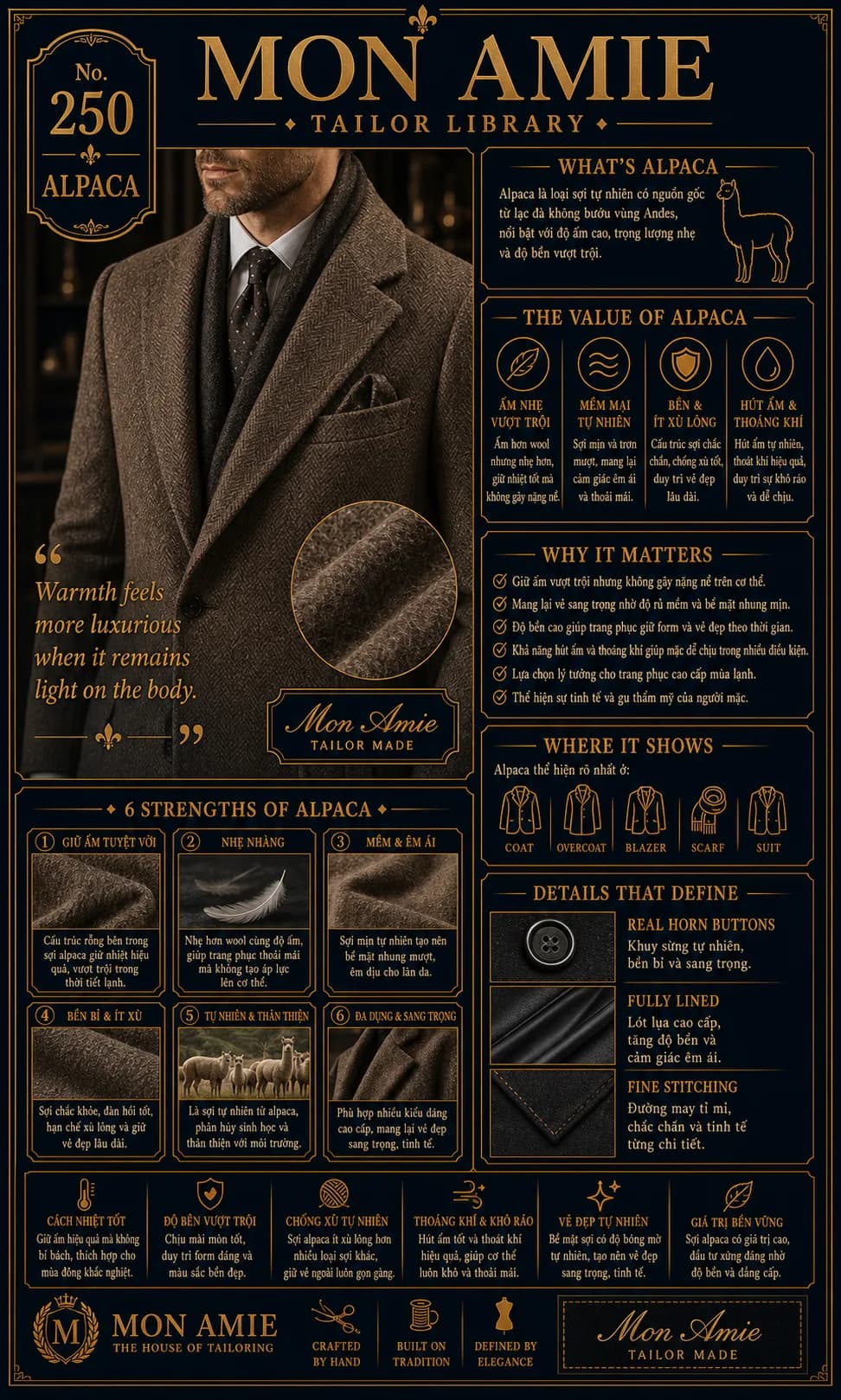
Alpaca is a natural fibre taken from the Andean camelid of the same name, prized for its exceptional warmth, light weight and remarkable durability. If you are looking for a cloth for a winter coat or overcoat that is warm without being heavy, alpaca deserves to be the first name you consider. Mon Amie shares what the tailoring trade has learned about this singular fibre.
What alpaca is, and why tailors hold it in such regard
The alpaca is a camelid of the South American Andes, found chiefly in Peru, where altitudes above 3,500 metres bring hot days and bitterly cold nights. That environment produced a fleece with hollow fibre cores — a natural insulating layer that holds warmth efficiently while remaining extraordinarily light. The Incas once called alpaca "the fibre of the gods", reserved for the nobility; today Europe's finest mills still seek out this fleece for their top coating cloths.
The fundamental difference from sheep's wool: alpaca fibre is smoother, with fewer scales, so the cloth carries a soft natural lustre and rarely prickles against the skin.
Four core qualities of alpaca fibre
- Warm yet light: warmer than wool but lighter, holding heat without weighing on the shoulders.
- Naturally soft: fine, smooth fibre that feels gentle and comfortable through a long day.
- Durable and pill-resistant: a sturdy fibre structure that resists pilling and keeps its beauty season after season.
- Moisture-wicking and breathable: it absorbs moisture naturally and breathes well, keeping you dry and at ease.
These four qualities rarely converge in a single fibre. Cashmere is soft but pills easily; wool is durable but heavier for the same warmth. Alpaca sits at a point of balance few materials reach.
Why that matters for what you wear
A good winter coat must resolve an inherent contradiction: the warmer it is, the heavier it tends to be. Alpaca dissolves that contradiction — outstanding warmth without weight, as the trade saying goes: warmth becomes luxurious when it still rests lightly on the wearer.
Beyond that, alpaca's soft drape and velvety surface give an unmistakable sense of refinement. Its durability keeps a garment's shape and appearance over the years, while its moisture handling and breathability keep you comfortable in varied conditions, including moving between cold streets and heated rooms. For a man who values taste, an alpaca coat is a quiet statement that never needs to raise its voice.
Six strengths alpaca brings to the cutting table
- Superb insulation — the hollow fibre core traps heat efficiently, excelling in cold weather.
- Lightness — lighter than wool at equal warmth, so the garment sits comfortably without pressure.
- Soft and gentle — naturally fine fibre creates a velvety surface that is kind to the skin.
- Durable, pill-resistant — strong, resilient fibre limits pilling and preserves beauty over time.
- Natural and responsible — an animal fibre that is biodegradable and environmentally sound.
- Versatile and refined — suited to many fine silhouettes, with an elegant, understated character.
Where alpaca shows at its best
Alpaca gives its full measure in cold-weather pieces and outerwear:
- Coats and overcoats — where light warmth and soft drape shine brightest
- Blazer — alpaca blends give the cloth depth of surface, rich without shine
- Scarf — an alpaca scarf is soft and warm, never prickly at the neck
- Suit — alpaca-blend cloths give autumn and winter suits a distinctive texture
When an alpaca coat is made properly, the accompanying details must match: natural horn buttons that are durable and refined, fine silk lining that adds strength and comfort, and meticulous, sturdy stitching throughout. That is how Mon Amie finishes every garment made from this precious material.
A word from Mon Amie's artisans
In the workshop we find alpaca demanding of the cutter: the cloth is soft with a drape of its own, so the shoulder line and lapel require considerably more handwork than ordinary wool. In return, the finished garment falls with a naturalness industrial machinery struggles to reproduce. For clients who travel often to cold climates, or who want an overcoat to last a decade and more, Mon Amie places alpaca firmly among the materials worth investing in seriously.
If you would like to feel the softness and warmth of alpaca alongside cloths from Canonico, Holland & Sherry, Dormeuil or Scabal, you are welcome at any of Mon Amie's five showrooms in Ho Chi Minh City, or on 0888.111.118. You may book an appointment for a private consultation with our artisans, and read about the tailoring process at Mon Amie — where your measurements are kept for life, ready for every commission to come.