
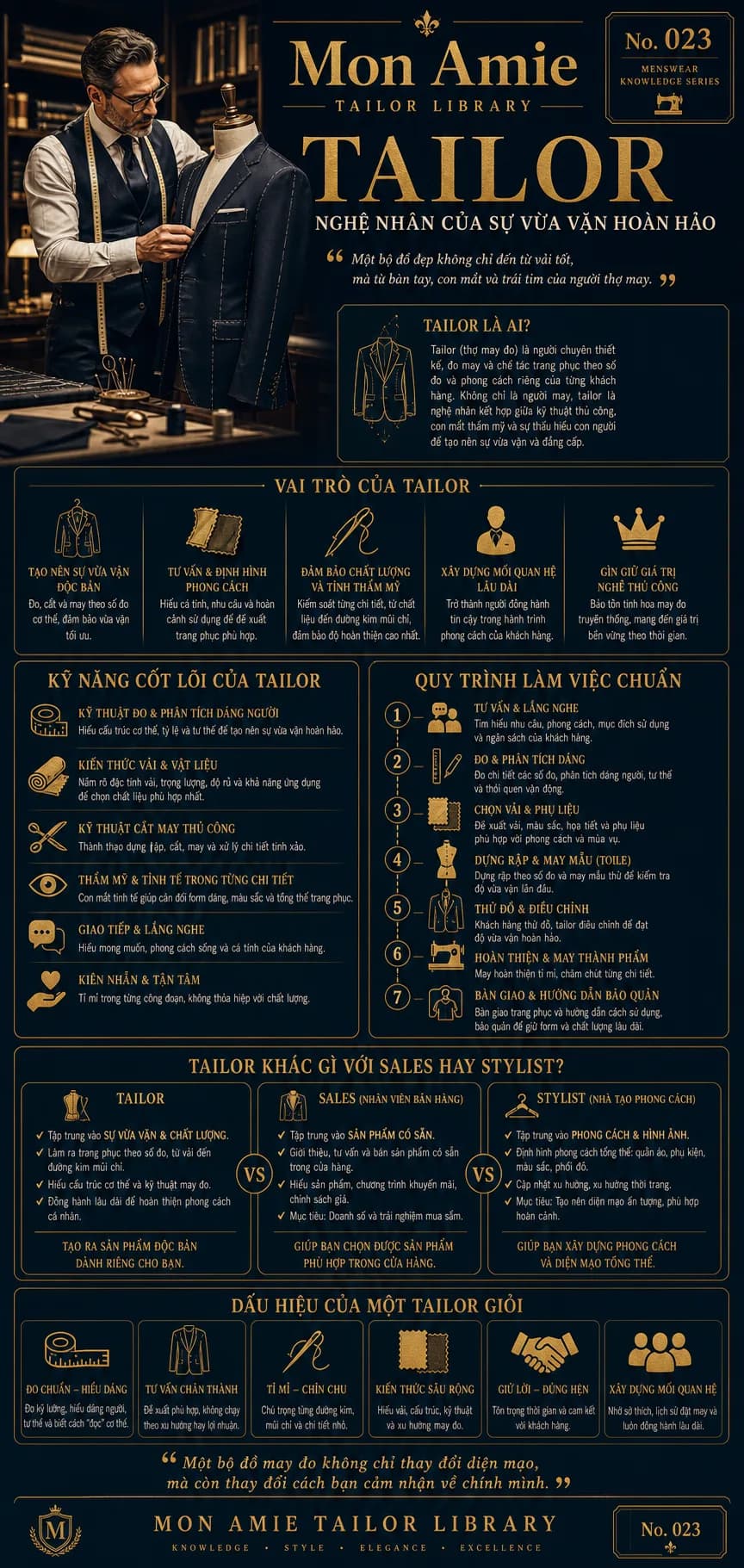
What is a tailor? A tailor is the craftsman who designs, measures, cuts and makes garments to each client's own measurements and personal style. More than someone who sews, a tailor is an artisan who combines hand skill, an eye for proportion and an understanding of people to produce fit and distinction. As the old saying in the trade goes: a fine garment comes not from good cloth alone, but from the hands, the eye and the heart of the person who makes it.
What a true tailor actually does
Many people imagine a tailor as someone with a pair of scissors seated at a sewing machine. The role is considerably wider:
- Creating a fit that exists only for you: measuring, cutting and sewing to each client's body, achieving a fit no ready-to-wear garment can match.
- Advising and shaping style: understanding your character, your needs and where the garment will be worn, then proposing the right cut and cloth.
- Guarding quality and proportion: controlling every detail, from cloth to stitch, so the finishing reaches its highest level.
- Building a long relationship: becoming a trusted companion in your style over many years and many garments.
- Preserving the craft: keeping the traditions of hand tailoring alive and delivering value that lasts.
The core skills that make a tailor
To do all of that, a tailor needs both technique and temperament:
- Measuring and reading the figure: understanding body structure, proportion and posture in order to create a perfect fit. Two men with the same chest measurement may still need two different patterns because of sloping shoulders, a rounded back or a different stance.
- Knowledge of cloth and materials: knowing the character, weight, drape and use of each fabric in order to choose the right one for the purpose.
- Hand cutting and sewing: mastery of pattern drafting, cutting, sewing and fine detail work — from lapels and pockets to sleeve buttons.
- An eye for detail and proportion: a refined eye that balances silhouette, colour and the garment as a whole.
- Listening and conversation: understanding the client's wishes, way of life and character — because the finest garment is the one that is true to the man wearing it.
- Patience and dedication: meticulous at every stage, never compromising on quality.
How a tailor works, step by step
A proper tailoring process usually runs through seven stages:
- Consultation and listening: understanding needs, style, intended use and budget.
- Measuring and figure analysis: taking detailed measurements and studying the figure, posture and habitual movement.
- Choosing cloth and trimmings: proposing fabrics, colours, patterns and trimmings that suit the style and the season.
- Pattern drafting and the toile: drafting a pattern to measure and making a trial garment to check the fit from the outset.
- Fitting and adjustment: the client tries the garment on and the tailor adjusts it toward a perfect fit.
- Finishing and final making: careful final construction, with attention to every detail.
- Handover and care guidance: explaining how to wear and care for the garment so it holds its shape and quality for years.
At serious tailoring houses, the fitting stage may be repeated two or three times for a new client, until both tailor and client are satisfied.
How a tailor differs from a salesperson or a stylist
The three roles are often confused, but their aims are quite different:
- The tailor is concerned with fit and quality: making a garment to your measurements, from cloth to stitch, with a working knowledge of body structure and tailoring technique, and staying with you over the years as your style develops. The result is a garment made for you alone.
- The salesperson is concerned with existing products: presenting, advising on and selling what the shop has in stock, with a grasp of promotions and policies. The aim is sales and a pleasant shopping experience.
- The stylist is concerned with overall image: clothes, accessories, colour and combinations in line with current taste, so that you look striking and appropriate for the occasion.
In short: a salesperson helps you choose from the shop, a stylist helps you build a look, and a tailor makes the garment that belongs to you alone.
How to recognise a good tailor
When looking for a tailoring house, watch for these signs:
- Accurate measuring, real understanding of the figure: careful measurement and the ability to read a body, not merely write down numbers.
- Honest advice: recommending what suits you, rather than what is fashionable or profitable.
- Meticulous finishing: attention to every stitch and every small detail.
- Deep knowledge: of cloth, construction, technique and the direction of tailoring.
- Keeping promises and dates: respecting your time and their commitments.
- Building a relationship: remembering your preferences and your order history, and staying with you — rather than selling once and moving on.
A word from Mon Amie's artisans
From Mon Amie's years at the cutting table: judge a tailor by the first consultation. Anyone who asks carefully about your work, your dressing habits and the occasions you have in mind before talking about cloth is practising the craft properly. Never hesitate to ask for another fitting or another adjustment until you are genuinely comfortable; a good tailor treats that as part of the work. At Mon Amie your measurements are kept for life and every garment carries an alteration guarantee after delivery, so the relationship between you and your tailor does not end at the first order.
A tailored garment changes more than your appearance; it changes how you feel about yourself. If you are looking for a tailor to accompany you over the long term, we invite you to book an appointment at one of Mon Amie's five showrooms in Ho Chi Minh City, or to read about the tailoring process first — hotline 0888.111.118.