
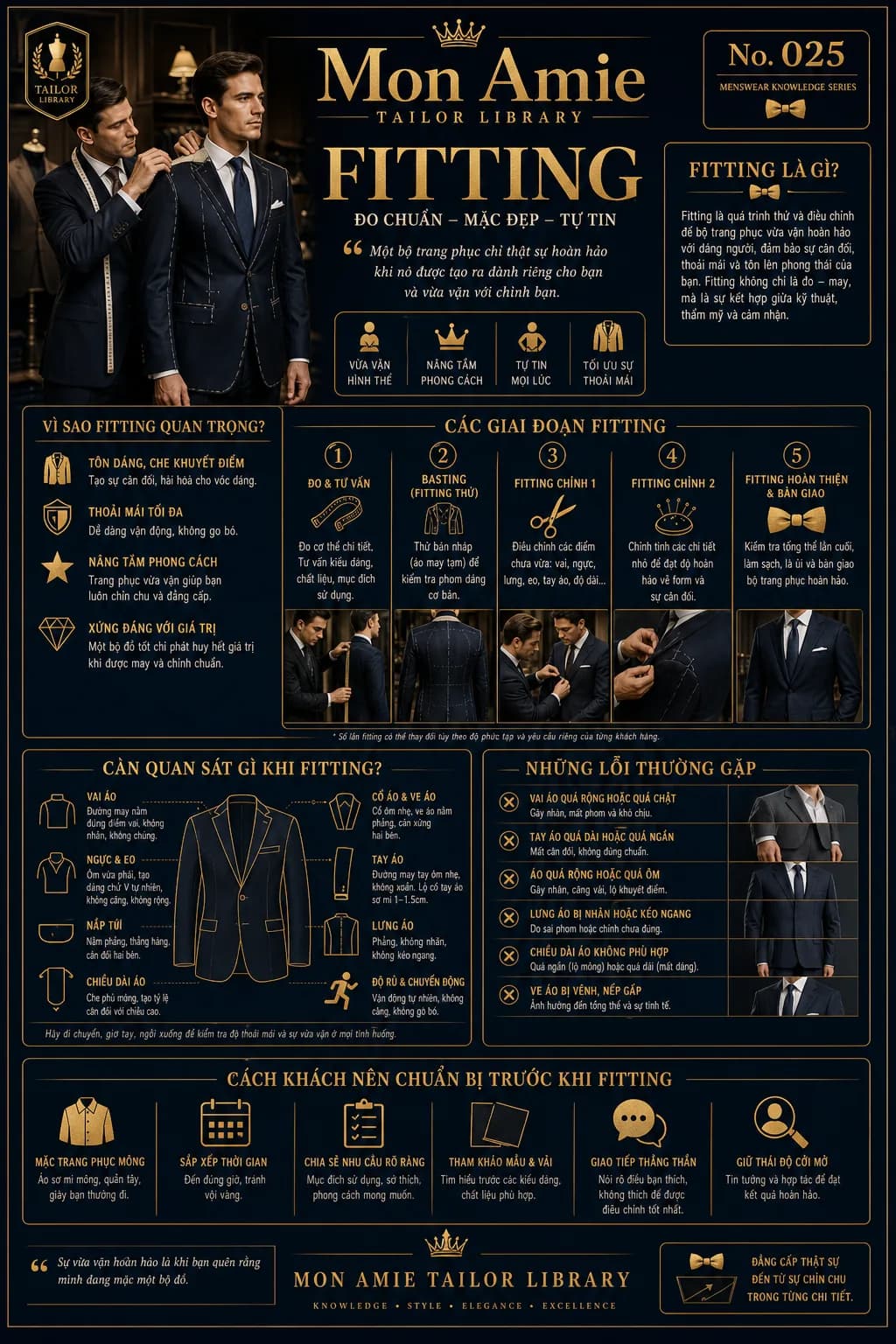
A fitting is the process of trying on and adjusting a garment until it sits perfectly on your figure — balanced, comfortable, and flattering to the way you carry yourself. Put another way, a fitting is not simply measuring and sewing; it is where technique, proportion and judgement meet. With a tailored suit, the quality of the fittings largely decides whether the garment truly becomes yours.
Why the fitting matters so much
A garment is only perfect when it is made for you and fits you alone. The fitting is where that happens, and it delivers four things:
- Flattering the figure: creating balance and harmony. Slightly sloping shoulders, a slightly rounded back or a fuller waist can all be handled gracefully through successive adjustments.
- Complete comfort: a jacket that follows the body yet moves easily, never restricting you when you sit, reach or walk.
- Elevating your style: a well-fitted garment keeps you looking considered and distinguished — fit matters more than the price of the cloth.
- Honouring the value: a fine garment only shows its worth when it is made and adjusted properly. Expensive Canonico or Dormeuil cloth in the wrong shape is still a failed suit.
The five stages of a proper fitting process
At serious tailoring houses, a fitting is not a single session but a sequence:
- Measuring and consultation: the tailor takes detailed measurements while advising on cut and cloth for the intended use — work, formal occasions or a wedding.
- Basting fitting: trying on the basted garment, loosely stitched together, to check the fundamental shape before final making. This step is the signature of high-level tailoring.
- First adjustment fitting: correcting whatever does not yet sit right — shoulder, chest, back, waist, sleeves, length.
- Second adjustment fitting: refining the smaller details to reach a settled, balanced silhouette.
- Final fitting and handover: a last overall check, cleaning, pressing and delivery of the finished garment.
The number of fittings varies with the complexity of the commission and each client's requirements — a wedding suit or a three-piece usually needs more sessions than a simple blazer.
What to look for in the fitting mirror
During the fitting, you and your tailor should review these points together:
- Shoulders: the seam sits exactly on the shoulder point, with no wrinkling or collapse — the hardest area to correct, so it must be right from the start.
- Chest and waist: a moderate embrace, a natural V-shape, neither straining nor loose.
- Collar and lapels: the collar rests lightly at the nape, the lapels lie flat and balanced on both sides.
- Sleeves: the sleeve follows the arm without twisting, showing about 1–1.5 cm of shirt cuff.
- Back: flat, free of wrinkles, with no horizontal pull.
- Pocket flaps: lying flat, level, and even on both sides.
- Jacket length: covering the seat, in proportion to your height.
- Drape and movement: natural in motion, never straining or restricting.
One simple tip: walk, raise your arms and sit down during the fitting itself, so comfort and fit are tested in every position rather than only standing still before the mirror.
What goes wrong when fittings are rushed
Most suits that "just do not look right" fall into one of these faults:
- Shoulders too wide or too narrow: wrinkling, lost shape and discomfort.
- Sleeves too long or too short: proportions thrown off.
- A jacket too loose or too tight: wrinkling, straining cloth and exposed flaws.
- A back that wrinkles or pulls across: a shape error, or an adjustment not carried through.
- The wrong jacket length: too short exposes the seat, too long shortens the figure.
- Lapels that buckle or crease: undermining the whole garment.
What these faults share is that all of them can be spotted and corrected during the fittings — provided both tailor and client take the time to look and speak plainly.
How to prepare for your fitting
An effective fitting needs cooperation from both sides. Before you arrive:
- Wear thin clothing: a lightweight shirt, dress trousers and the shoes you usually wear with a suit — the fit changes with both the layer underneath and the height of the heel.
- Allow enough time: arrive punctually and unhurried, so the session can be completed properly.
- Be clear about your needs: intended use, preferences, the style you have in mind.
- Look at models and cloths beforehand: some idea of the cuts and fabrics you like keeps the consultation focused.
- Speak frankly: say clearly what you like and dislike so your tailor can adjust accordingly.
- Stay open: trust and work with the artisan to reach the best result.
A word from Mon Amie's artisans
A perfect fit is when you forget you are wearing anything at all. That is why, at every Mon Amie fitting, we invite you to move naturally — shake hands, sit down, button and unbutton the jacket — rather than standing at attention before the mirror. And never hesitate to mention anything that feels off or unresolved; every Mon Amie garment carries an alteration guarantee after delivery, and your measurements are kept for life for the garments that follow.
Real distinction comes from care taken in every detail — and the fitting is where that care is proved. If you would like to experience a properly conducted fitting at one of Mon Amie's five showrooms in Ho Chi Minh City, please book an appointment or read about the tailoring process first, hotline 0888.111.118.