
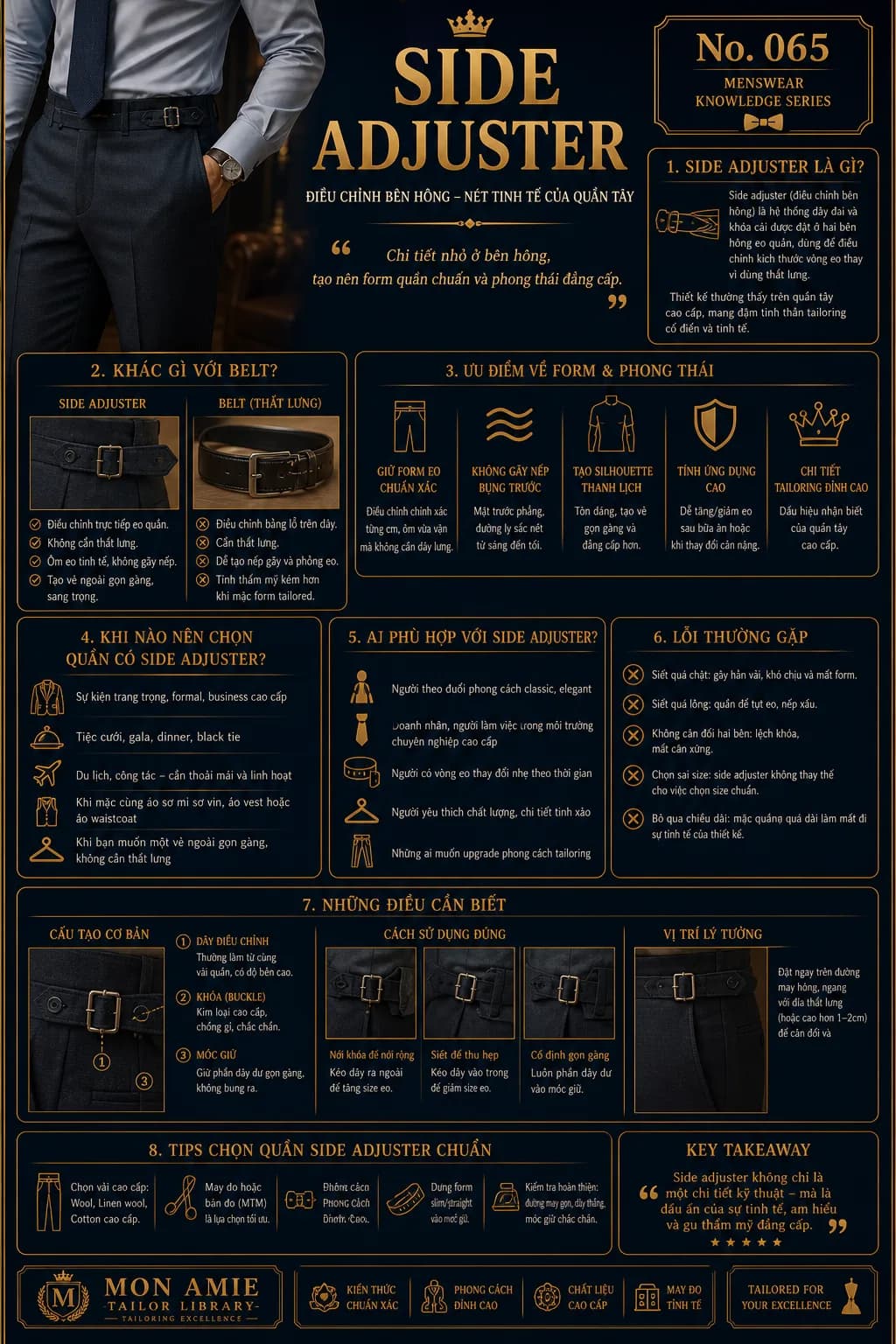
A side adjuster is a system of straps and buckles set at either side of the trouser waist, used to adjust the waist measurement in place of a belt. It is a design found on fine trousers, deeply rooted in classic and refined tailoring. For many well-dressed men, this small detail at the hip is the mark of a properly made pair of trousers.
How does a side adjuster differ from a belt?
Both hold the waist of the trousers, yet a side adjuster and a belt give very different results:
- A side adjuster tunes the waist directly in small increments, needs no belt, and lets the trousers sit close without breaking the line, giving a clean and refined appearance.
- A belt adjusts only to the holes punched in the strap, obliges you to wear an extra accessory, tends to create folds and bunching at the waist, and reads less well with a tailored fit.
Put another way, a belt cinches the trousers to the waist from the outside, while a side adjuster makes the trousers fit from within their own structure. That is why the bespoke houses of Savile Row have long preferred side adjusters on suit trousers.
What it does for line and bearing
A side adjuster brings five clear benefits:
- A precise waist: adjustable to the centimetre, close-fitting without a belt.
- No folding at the front: the front of the trousers stays flat and the pleats crisp from morning to evening.
- An elegant silhouette: flattering, clean and more distinguished.
- Real practicality: the waist can be eased or taken in after a meal or as your weight shifts.
- A high point of tailoring: the recognised hallmark of fine trousers.
When should you choose trousers with side adjusters?
Favour them in these situations:
- Formal occasions, and senior business settings.
- Weddings, galas, dinners and black tie — occasions where every detail is seen.
- Travel and business trips, where you want comfort and flexibility without losing polish.
- With a tucked-in shirt, a jacket or a waistcoat: a flat waist keeps the whole line unbroken, and this matters especially under a waistcoat, where a bulky belt buckle spoils the shape.
- Whenever you want a clean look without a belt.
Side adjusters suit the man who pursues a classic, elegant style; the businessman working in a demanding professional environment; the man whose waist shifts slightly over time; and anyone who values quality and fine detail and wants to raise the level of his tailoring.
Construction and correct use
A basic side adjuster has three parts:
- The strap: usually made from the same cloth as the trousers, and hard-wearing.
- The buckle: fine, rust-resistant, solidly made metal.
- The keeper: holding the surplus strap neatly so it does not work loose.
Using them is simple: loosen the buckle and draw the strap outwards to let out the waist; tighten the buckle and draw the strap inwards to take it in; then tuck the surplus strap into the keeper to hold everything neat. The ideal position for a side adjuster is directly on the side seam, level with the belt line or one to two centimetres above it, so both sides sit evenly.
Common mistakes with side adjusters
Small as the detail is, using it badly still spoils the line of the trousers:
- Too tight: the cloth puckers, it becomes uncomfortable and the shape is lost.
- Too loose: the trousers slip at the waist and fold unattractively.
- Uneven sides: mismatched buckles and a lopsided waist.
- The wrong size: a side adjuster only refines within a small range and is no substitute for the correct size or accurate measurements.
- Ignoring the strap length: a long strap left dangling undoes the refinement of the design.
How to choose trousers with side adjusters
- Choose fine cloth: wool, wool-linen, good cotton — only cloth with body reveals the full beauty of a flat waist.
- Bespoke or made-to-measure is the ideal route, since a side adjuster looks best when the waist was correct to begin with.
- Keep the whole coherent: side adjusters suit slim or straight trousers and a classic style.
- Check the finishing: neat stitching, a straight strap, a solid buckle and keeper.
A word from Mon Amie's artisans
When we make trousers with side adjusters, Mon Amie always measures the waist in its natural state and then leaves roughly two to three centimetres of adjustment on each side — enough to keep you comfortable after a dinner while the trousers hold their shape. Treat the side adjuster as a means of fine-tuning, never a rescue for trousers of the wrong size. And if your trousers have side adjusters, leave the belt behind entirely: wearing both at once is the most common stylistic error we see.
A side adjuster is not merely a technical feature — it is a mark of refinement, understanding and considered taste. If you would like trousers with a waist as flat and clean as tailoring intends, do book an appointment with Mon Amie at one of our five showrooms in Ho Chi Minh City, or read about the tailoring process first. Our hotline, 0888.111.118, is always ready to advise you.