
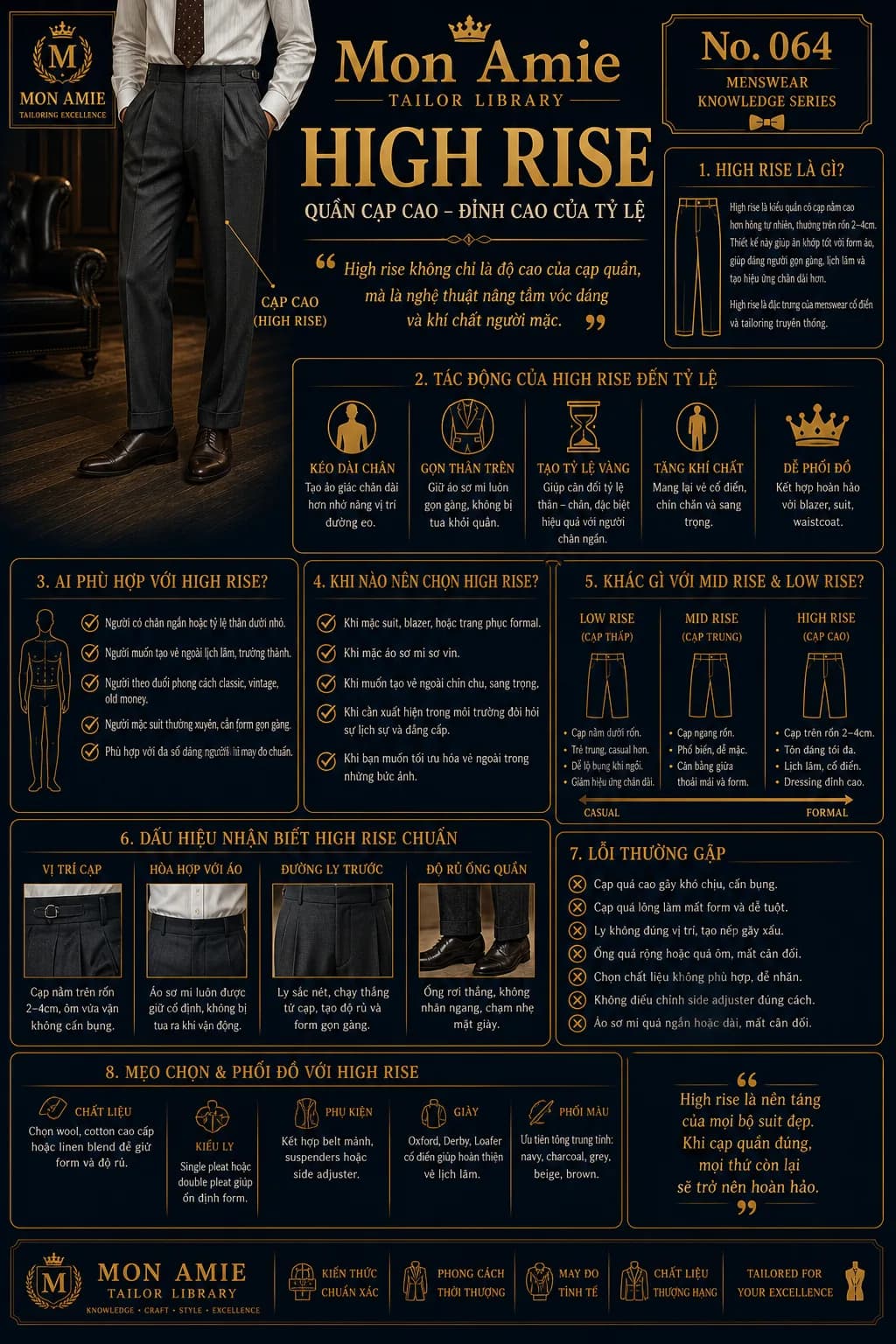
High rise describes trousers whose waistband sits above the natural hip, usually two to four centimetres above the navel. For a man who wears suits, a high rise is not simply a decision about waistband height; it is a tool for balancing the proportions of the body — lengthening the leg, tidying the torso and creating the classic, elegant line that traditional tailoring has always pursued.
What is high rise?
The high waistband is a hallmark of classic menswear. Sitting two to four centimetres above the navel, it allows the trouser to meet the garments above it correctly — shirt, waistcoat or jacket all meet the waistband at the natural waist, with no gap of shirt showing as you move. The result is a tidier, more elegant figure and the impression of longer legs than you actually have.
As Mon Amie often tells our clients: high rise is not merely the height of a waistband, but the art of elevating a man's proportions and his bearing.
What a high rise does for your proportions
- Lengthens the leg: raising the waistline creates the illusion of a longer leg — the simplest and most effective visual principle in tailoring.
- Tidies the torso: the shirt stays neatly tucked and does not pull free as you move.
- Creates golden proportions: it balances torso against leg, particularly effective for shorter legs or a smaller lower half.
- Lifts your bearing: it brings a classic, mature and refined air.
- Combines easily: perfect with a blazer, a suit and a waistcoat — the waistcoat covers the waistband exactly, leaving no gap of shirt between jacket and trousers.
Who suits high rise, and when to choose it
A high rise flatters many builds, but shows its value most clearly here:
- Men with shorter legs or a smaller lower half.
- Men who want an elegant, grown-up appearance.
- Men who pursue a classic, vintage or old money style.
- Men who wear suits regularly and need a clean line.
- In truth, most builds suit it — provided the trousers are properly made to measure.
As for occasions, favour a high rise with a suit, a blazer or formal dress; when wearing a shirt tucked in; when you need to appear in a setting that calls for correctness and standing; or simply when you want to look your best in photographs — a high waist always photographs better thanks to the extended proportions.
How does it differ from mid rise and low rise?
The three rises form a spectrum from casual to formal:
- Low rise: the waistband sits below the navel. Youthful and more casual, but it exposes the stomach when seated and reduces the leg-lengthening effect. It has almost no place in serious tailoring.
- Mid rise: the waistband sits at the navel. Common and easy to wear, balancing comfort and line — a safe choice for semi-formal settings.
- High rise: the waistband sits two to four centimetres above the navel. Maximally flattering, elegant and classic — the summit of formal dressing.
How to recognise a well-made high rise
A properly made pair of high-waisted trousers will show four signs:
- Waistband position: two to four centimetres above the navel, sitting close without pressing on the stomach.
- Harmony with the shirt: the shirt stays put and does not pull free in movement.
- Front pleats: crisp, running straight down from the waistband, creating drape and a clean line.
- Leg drape: the leg falls straight, without horizontal creasing, breaking gently on the shoe.
Common mistakes with high-waisted trousers
- A rise so high it presses uncomfortably on the stomach.
- A waistband too loose, so the line collapses and the trousers slip.
- Pleats placed incorrectly, creating unattractive folds.
- Legs too wide or too close, throwing off the balance.
- Choosing a cloth that creases easily.
- Failing to set the side adjusters correctly.
- A shirt too short or too long, breaking the overall balance.
Choosing and wearing a high rise
- Cloth: choose wool, fine cotton or a linen blend to hold the shape and the drape.
- Pleats: a single or double pleat stabilises the line, especially if you sit for long periods.
- Fastenings: a slim belt, braces or side adjusters — on made-to-measure trousers, side adjusters give the cleanest line.
- Shoes: Oxfords, Derbies or a classic Loafer complete the elegance.
- Colour: favour neutrals — navy, charcoal, grey, beige, brown.
A word from Mon Amie's artisans
With high-waisted trousers, a centimetre wrong at the waistband is a proportion wrong everywhere — which is why Mon Amie always measures each client's natural waist rather than applying a standard figure. If you wear suits regularly, specify side adjusters and front pleats so the trousers hold their shape through a long day without a belt. And remember to adjust your shirt length to match: a high rise only looks right when shirt and trousers are calibrated together.
The rise is the foundation of every good suit — get the waistband right and everything else falls into place. If you would like to experience a pair of high-waisted trousers measured for your own proportions, we invite you to book an appointment at one of Mon Amie's five showrooms in Ho Chi Minh City, or to read about the tailoring process first.