
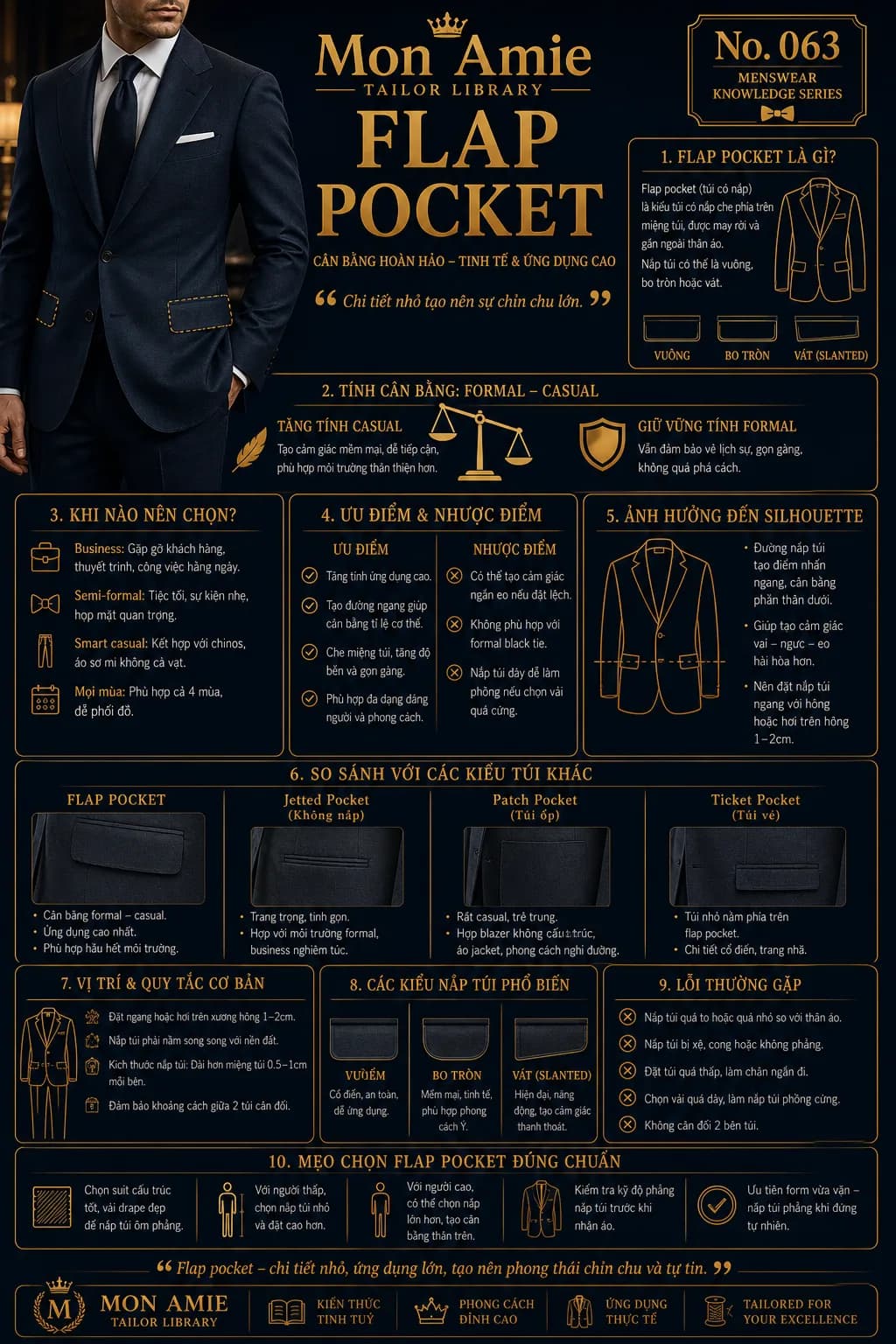
A flap pocket is a pocket topped by a flap that covers the opening, made separately and set onto the outside of the jacket — the most common detail on a modern suit. It is the perfect balance between formality and usefulness: correct enough for work, soft enough for everyday life. For Mon Amie, the flap pocket proves how a small detail creates a large sense of polish.
What is a flap pocket?
A flap pocket is a hip pocket on a suit jacket with an additional panel of cloth covering the opening. The flap is made separately and attached to the outside of the jacket, and it may be:
- Square — classic, safe, the most versatile of all.
- Rounded — soft and refined, suited to Italian tailoring.
- Slanted — modern and lively, with a lighter, more elongated feel.
The flap was originally practical: it kept dust and rain out of the pocket. Today it is an aesthetic detail that sets the level of formality of a suit.
The balance between formal and casual
What distinguishes the flap pocket is where it sits on the scale of formality. Compared with the flapless jetted pocket, which is decidedly serious, the flap pocket adds ease: it feels softer, more approachable, more at home in a friendly environment. Yet it holds its formality all the same, remaining correct, tidy and never unconventional.
That balance is precisely why the flap pocket is the default choice for business suits the world over.
When should you choose a flap pocket?
Favour the flap pocket in these settings:
- Business: client meetings, presentations, everyday work.
- Semi-formal: dinners, lighter events, important gatherings.
- Smart casual: worn with chinos and an open-collar shirt.
- All seasons: appropriate year-round and easy to combine.
Put another way, apart from strictly black tie occasions, the flap pocket is almost always the right answer.
Strengths and limits
The advantages of a flap pocket:
- Highly versatile, appropriate in nearly every environment.
- Creates a horizontal line that balances the proportions of the body.
- Covers the pocket opening, improving durability and neatness.
- Suits a wide range of builds and styles.
Points to keep in mind:
- Can make the waist look short if placed poorly.
- Not appropriate for black tie — a proper tuxedo uses jetted pockets.
- A thick flap will bulge if the cloth chosen is too stiff.
Its effect on the silhouette
Few people notice that pockets directly affect the overall line of a suit. The flap creates a horizontal accent, balancing the lower half of the jacket and helping the shoulder, chest and waist read more harmoniously. The tailor's rule: the flap should sit level with the hip or one to two centimetres above it, run parallel to the ground, and extend half a centimetre to a centimetre beyond the pocket opening on each side. The distance between the two pockets must be perfectly even — even a slight discrepancy is caught by the eye, even when the viewer cannot say why.
Compared with other pocket styles
To choose well, set the flap pocket beside its relatives:
- Jetted pocket (no flap): the most formal and the cleanest; suited to formal and serious business settings, and the standard on a tuxedo.
- Patch pocket: very casual and youthful; suited to unstructured blazers and resort jackets.
- Ticket pocket: a small pocket sitting above the flap pocket, a classic and elegant detail descended from English riding dress.
The flap pocket stands in the middle: balanced between formal and casual, the most versatile of all, appropriate almost anywhere.
Common mistakes and how to get it right
The faults Mon Amie sees most often when clients bring ready-made jackets in for alteration:
- A flap too large or too small for the jacket.
- A flap that droops, curls or will not lie flat.
- Pockets set too low, which shortens the legs visually.
- Cloth too thick, leaving the flap stiff and bulging.
- Pockets that are not level with one another.
To avoid these, choose a well-structured suit in cloth with good drape so the flap lies flat. Shorter men should choose a smaller flap set slightly higher; taller men can carry a larger flap to balance the upper body. Before taking delivery of a jacket, check carefully that the flaps lie flat, and favour a fit in which they fall naturally when you stand.
A word from Mon Amie's artisans
In the Mon Amie workshop, the flap is among the details we check most carefully at the fitting: a single centimetre out of place changes the proportion of leg to torso in the eyes of everyone who sees you. Our advice: if you own only one suit for work, choose square flap pockets in a neutral cloth — a choice that is never wrong. When commissioning a suit, let the tailor set the flap position according to your actual height and leg length, rather than the fixed formula of ready-made clothing.
The flap pocket is a small detail with a large reach, and it lends a bearing that is both polished and assured. If you would like a suit in which every detail is set to your own body, we invite you to book an appointment with Mon Amie at one of our five showrooms in Ho Chi Minh City, or to read about the tailoring process first — hotline 0888.111.118.