
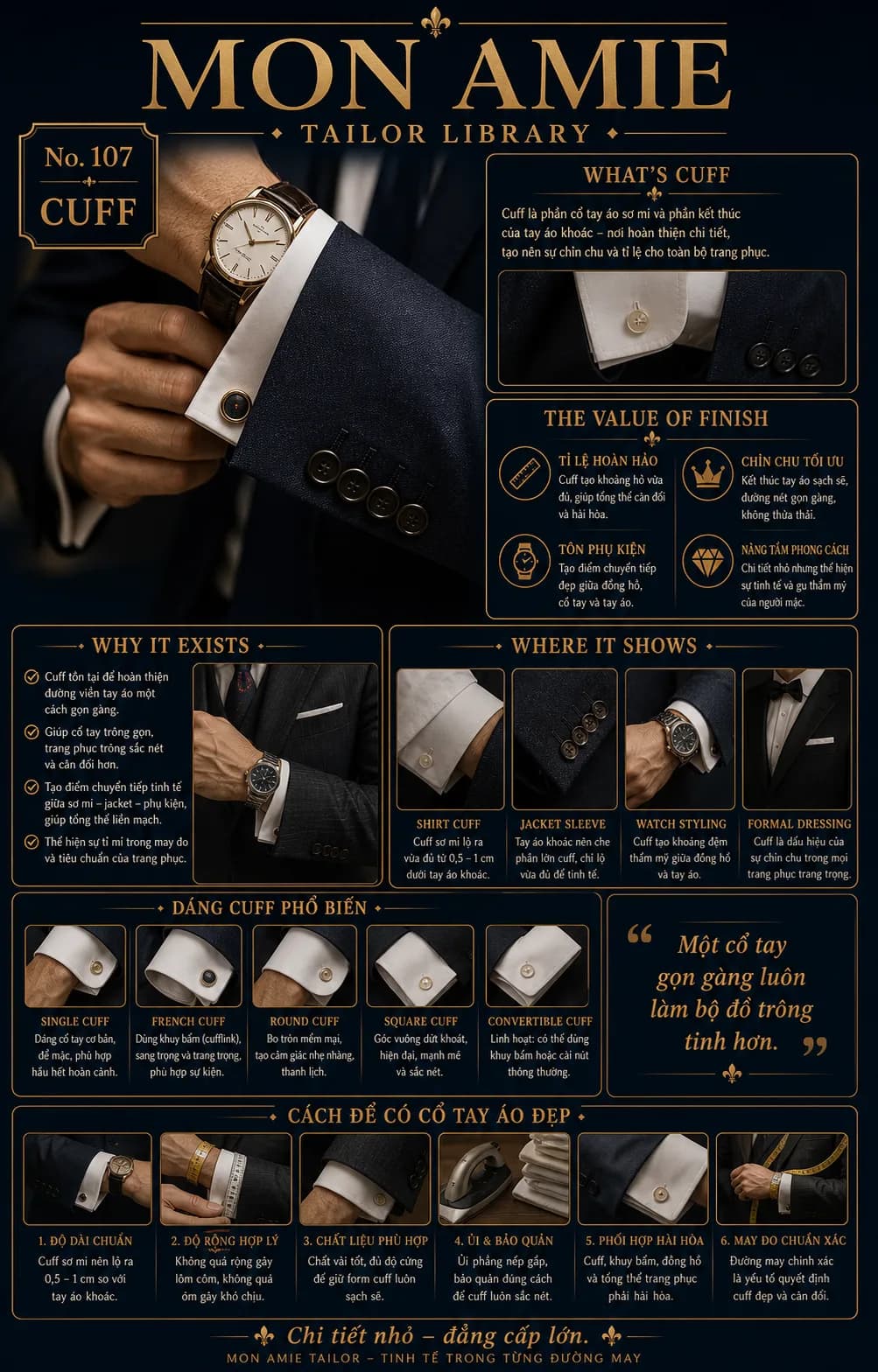
The cuff is the band that closes a shirt sleeve and the finishing edge of a jacket sleeve — the point where detail, polish and proportion come together. A correct cuff shows only 0.5–1 cm of shirt below the jacket sleeve, yet that narrow band of linen is one of the clearest signs of a properly tailored suit. In this article, Mon Amie invites you to look closely at a detail that seems minor and decides a great deal.
What a cuff is and why it exists
In tailoring, the cuff is the finished band at the wrist — both the shirt cuff and the closing edge of the jacket sleeve. It is where three layers meet: shirt, jacket and accessory, whether a watch or a pair of cufflinks. The cuff exists not for decoration but for very practical reasons:
- It finishes the sleeve edge cleanly, concealing raw fabric and closing seams.
- It keeps the wrist looking neat and the whole outfit sharper and better proportioned.
- It creates a refined transition between shirt, jacket and accessories, so the whole reads as one piece.
- It reveals care in the making — a careless cuff is the first sign of a garment made without attention.
The value of a well-finished wrist
Tailors call this the value of finish. A correct cuff delivers four things:
- Perfect proportion: the cuff leaves just enough shirt showing beneath the jacket sleeve, balancing the line from shoulder to hand.
- Complete polish: a clean sleeve ending, precise and without excess.
- A setting for accessories: the cuff is the transition between watch, wrist and sleeve — a fine watch deserves a frame worthy of it.
- Elevated style: a small detail that nonetheless conveys refinement and taste.
Where the cuff makes itself felt
You will notice the cuff at four familiar points:
- Shirt cuff: the shirt should show 0.5–1 cm below the jacket sleeve — the classic standard of tailoring.
- Jacket sleeve: the jacket sleeve should cover most of the cuff, revealing only enough to keep things refined.
- Watch styling: the cuff creates a visual buffer between watch and sleeve, so the watch never sits bare on the wrist.
- Formal dressing: in formal wear, and especially black tie, the cuff signals care in every detail.
Common cuff styles
When commissioning a shirt, you may choose from several cuff styles, each with its own character:
- Single cuff (barrel cuff): the basic buttoned cuff, easy to wear and appropriate almost anywhere, from the office to weekends.
- French cuff (double cuff): folded back and fastened with cufflinks, refined and formal — for events, evening occasions and weddings.
- Round cuff: softly rounded corners for a lighter, more elegant impression.
- Square cuff: decisive square corners, modern and crisp.
- Convertible cuff: flexible, taking either cufflinks or a button — one shirt for two occasions.
How to achieve a well-made cuff
A good cuff does not happen by accident. Six factors decide it:
- Correct length: the shirt cuff should show 0.5–1 cm beyond the jacket sleeve. Less loses the proportion; more looks untidy.
- Sensible width: neither loose enough to slide about nor tight enough to be uncomfortable, and wide enough for a watch to sit inside.
- The right cloth: good fabric with enough body to keep the cuff crisp rather than creased after a few hours of wear.
- Pressing and care: press the folds flat and store shirts properly so the cuff stays sharp.
- Coherent pairing: cuff, cufflinks, watch and the outfit as a whole should agree in colour and in spirit.
- Precise tailoring: stitching worked to your true wrist measurement is what makes a cuff sit well — something ready-to-wear rarely manages.
A word from Mon Amie's artisans
Mon Amie's advice is to have your wrist measured while wearing the watch you actually use each day. The cuff must accommodate both wrist and watch, or it will catch and twist as you move. If you attend formal events often, keep at least one French cuff shirt in the wardrobe; for daily work, a single cuff with square or rounded corners is the most durable choice. And when trying on a jacket, let your arms hang naturally and look in the mirror: if you cannot see 0.5–1 cm of shirt, the jacket sleeve needs adjusting.
A neat wrist always makes an outfit look finer — a small detail with large consequences. If you would like a suit and shirts with cuffs correct to the millimetre, your measurements kept for life and alteration cover after delivery, book an appointment at one of Mon Amie's five showrooms in Ho Chi Minh City, or read about the tailoring process first. Hotline 0888.111.118.