
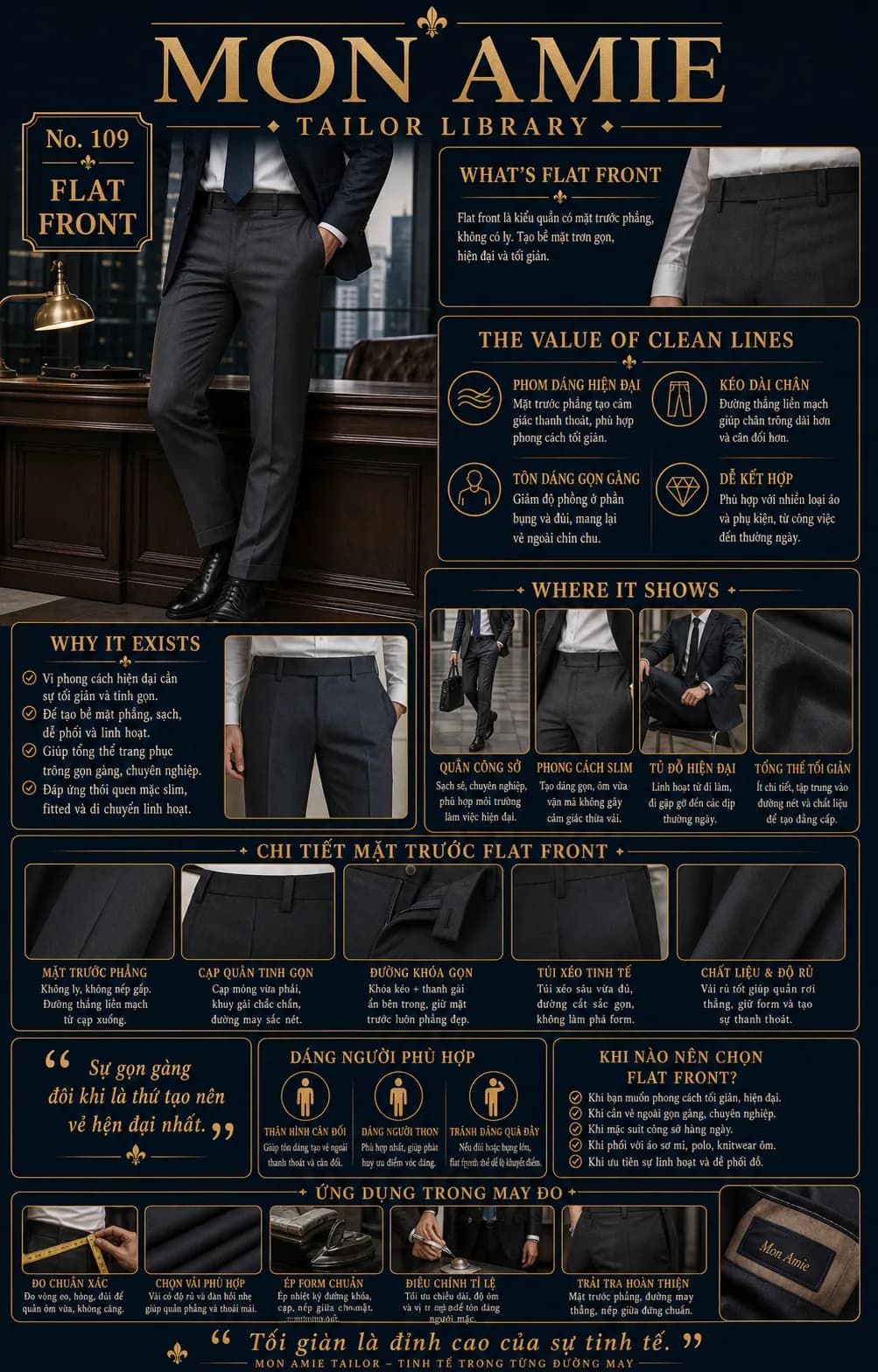
Flat front trousers have a completely plain front with no pleats. That clean, uninterrupted surface reads as modern and minimal, and it has become the default choice for most business suits today. In this article, Mon Amie walks you through what flat front trousers really are, the value of clean lines, and how an artisan handles this cut in tailoring.
What flat front means
Flat front describes a trouser with no pleats at the front, unlike a pleated trouser with one or two folds per side. Without pleats, the cloth runs straight from the waistband down the leg in one smooth, unbroken plane.
The cut exists for very practical reasons:
- Modern style prizes restraint and clean lines, and the flat front answers that directly.
- A plain, uncluttered surface pairs easily with a wide range of jackets and shirts.
- The outfit as a whole reads as neater and more professional.
- The cut suits the slim, fitted way men dress today and the mobility they expect.
The value of clean lines
The appeal of the flat front lies in what tailors call clean lines. In practice, a plain front delivers four things:
- A modern silhouette: the flat surface reads as light and uncluttered, suited to a minimal wardrobe.
- A longer leg: an unbroken line from waistband to hem makes the leg look longer and better proportioned.
- A trimmer look: less volume through the stomach and thigh, for a more polished appearance.
- Easy pairing: it works with a wide range of jackets and accessories, from the office to everyday wear.
Where you will find flat front trousers
You will meet this cut in almost every corner of the modern man's wardrobe:
- Business trousers: clean and professional, at home in a contemporary workplace.
- Slim styling: a trim shape that fits close without any excess cloth.
- The everyday wardrobe: versatile from work to meetings to weekends.
- A minimal look: few details, with line and cloth doing the work.
The front of a well-made flat front trouser
A good flat front trouser is more than the absence of pleats. It is the sum of several details handled with care:
- A plain front: no pleats, no folds, an unbroken line from the waistband down.
- A refined waistband: moderate in depth, securely fastened, cleanly stitched.
- A clean fly: zip and closure concealed inside so the front stays flat.
- Well-judged slant pockets: deep enough to be useful, cut cleanly so they never disturb the line.
- Cloth and drape: fabric with good drape lets the trouser fall straight, holding its shape and its lightness.
Who should choose flat front, and when
In terms of build, the flat front suits:
- A balanced figure: it flatters naturally and keeps the silhouette light.
- A lean build: the ideal candidate, making the most of the wearer's proportions.
- If you carry more around the waist, consider carefully — a front cut too close can emphasise what you would rather not, and pleated or fuller trousers will be both more comfortable and more flattering.
By occasion, favour the flat front when you:
- Want a minimal, modern look.
- Need a neat, professional appearance for work.
- Wear a business suit daily.
- Pair trousers with a shirt, polo or fitted knitwear.
- Value versatility and easy pairing above all.
The flat front in tailoring
With ready-to-wear, whether the front lies flat is largely down to the pattern. In tailoring, it is the result of a whole process:
- Accurate measuring: waist, seat and thigh measured so the trouser fits close without straining.
- The right cloth: fabric with good drape and a little give, so the front stays flat and comfortable.
- Proper pressing: the fly, waistband and centre crease pressed thoroughly for an entirely flat front.
- Adjusted proportions: length, closeness of fit and rise optimised for the wearer's figure.
- Final inspection: the front checked for flatness, the seams for straightness and the crease for accuracy before delivery.
A word from Mon Amie's artisans
Restraint is sometimes exactly what makes a garment look most modern. Mon Amie's experience with flat front trousers is this: do not chase the closest possible fit. Let the artisan balance it so the front lies flat when you stand and remains comfortable when you sit. Cloth with good drape and a properly pressed crease will lengthen the leg far more than simply cutting the trouser narrower. And if you carry more weight, speak plainly with your artisan: a little ease in the right place looks better than a straining front.
Restraint is the height of refinement, and a precisely tailored pair of flat front trousers is the most direct route to it. Mon Amie invites you to book an appointment at one of our five showrooms in Ho Chi Minh City, or to read about the tailoring process first. For any question, call our hotline on 0888.111.118.