
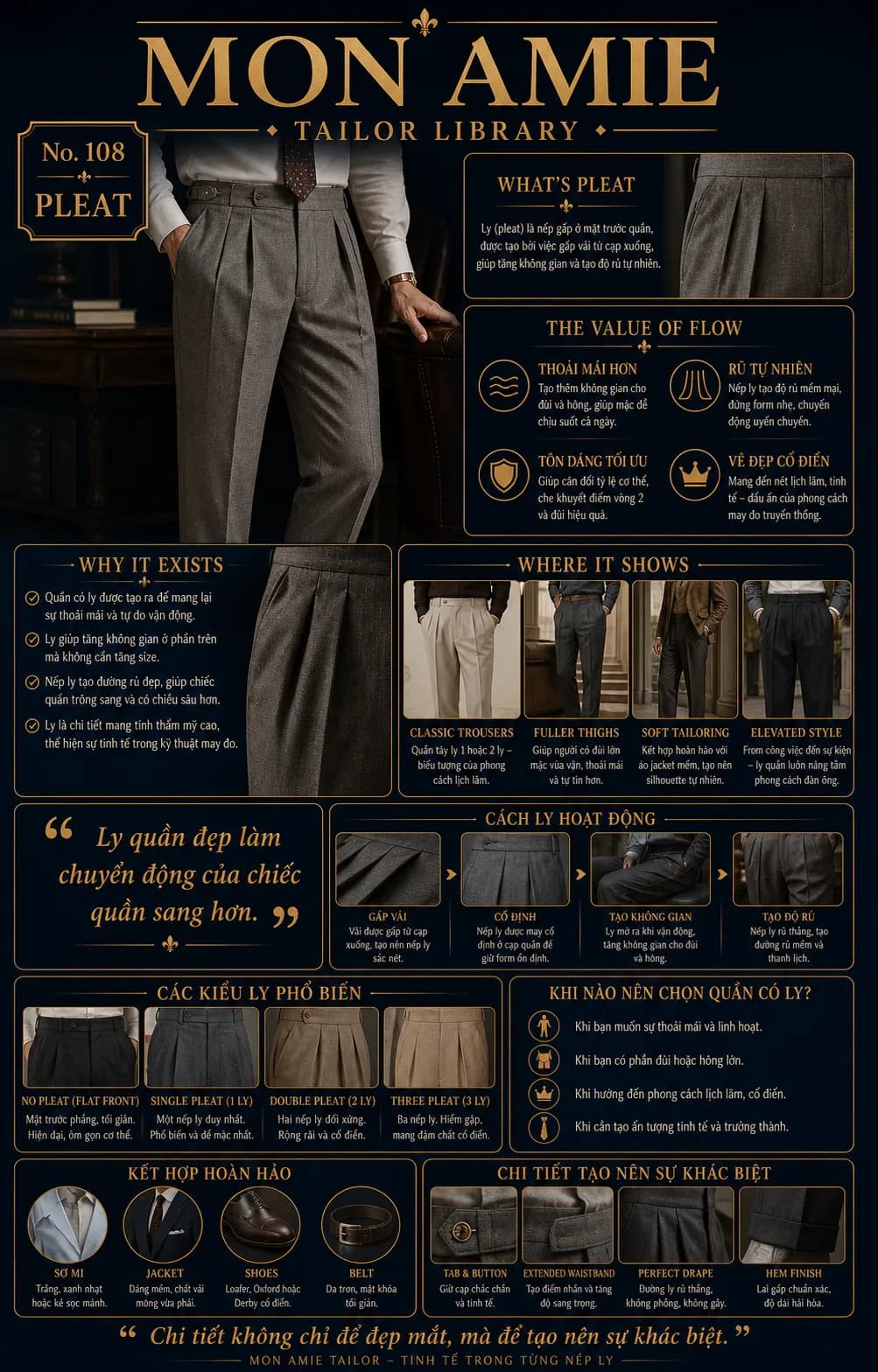
A pleat is a fold at the front of a pair of trousers, formed by folding the cloth down from the waistband. It adds room through the thigh and seat while giving the leg a natural drape. For a man who wears a suit regularly, trouser pleats are more than decoration: they decide whether you are comfortable sitting all day, and whether the trousers look elegant or merely flat when you stand. In this article, Mon Amie shares how to understand pleats and choose the right ones for your build and your style.
What pleats bring to a pair of trousers
Tailors speak of the value of flow. A properly made pleat delivers four things:
- Greater comfort: pleats add room through the thigh and seat, so you stay comfortable all day, especially seated at a desk or behind the wheel.
- Natural drape: the fold gives the cloth a soft fall and a light structure that moves gracefully with every step.
- A flattering line: pleats balance the proportions of the body and disguise the waist and thighs effectively, without going up a size.
- Classic elegance: pleats carry an air of refinement, the signature of traditional tailoring from Savile Row to the Italian houses.
Why pleats came about
Pleats are not an arbitrary detail. They exist for very practical reasons:
- Pleated trousers were made for comfort and freedom of movement, unlike slim trousers that only look right standing still.
- Pleats add room in the upper part of the trouser without increasing the size, so the waist and leg stay clean.
- The fold creates a beautiful line, giving the trouser depth and richness — light falling across a pleat creates a dimension that flat cloth cannot.
- Pleats are a highly aesthetic detail and a test of technique: a crooked, gaping or uneven pleat betrays the maker's hand immediately.
How a pleat works
You can picture the mechanics in four steps:
- Folding the cloth: the fabric is folded down from the waistband, forming a crisp pleat at the front.
- Securing it: the pleat is stitched down at the waistband so it holds its shape through repeated wear and pressing.
- Creating room: as you move — sitting, striding, bending — the pleat opens, giving the thigh and seat room to work.
- Creating drape: standing, the pleat falls straight, running into the pressed crease of the leg in one continuous, elegant line.
Common pleat styles, from flat front to triple pleat
- No pleat (flat front): a plain, minimal front. Modern and close to the body, suited to a lean build and contemporary slim tailoring.
- Single pleat: one pleat per side. The most common and most wearable style, balanced between classic and modern.
- Double pleat: two symmetrical pleats, roomy and distinctly classic. Associated with high-rise trousers and the 1930s–1950s look now firmly back in favour.
- Three pleat: three pleats, rarely seen, thoroughly vintage in spirit — for the man genuinely committed to classic style.
Beyond the number, there are two directions: the forward pleat, folded towards the fly in the English manner, and the reverse pleat, folded towards the pocket in the Italian manner, now more common because it lies flatter.
When to choose pleated trousers
- When you want comfort and freedom through a long day.
- When you carry more through the thigh or seat — pleats give a better fit and more confidence without widening the whole leg.
- When you are after an elegant, classic look: single or double pleat trousers pair beautifully with a soft jacket for a natural silhouette.
- When you want to read as refined and mature — from the office to formal occasions, pleated trousers always lift a man's style.
For pairing, pleated trousers work best with white, pale blue or finely striped shirts; soft-shouldered jackets in a lighter cloth; loafers, Oxfords or classic Derbies; and a plain leather belt with an understated buckle. Accompanying details such as a waistband tab for security, an extended waistband for a point of interest and a precisely judged hem length all combine to distinguish a properly tailored trouser.
A word from Mon Amie's artisans
From experience, Mon Amie suggests this: if pleated trousers are new to you, start with a single pleat at a regular or slightly higher rise — easy to wear, easy to pair and flattering on most builds. What matters most is that the pleat falls straight without bulging or breaking when you stand. If it gapes open even at rest, the trousers are tight through the seat and need adjusting. At Mon Amie, every pair we deliver comes with alteration cover and your measurements are kept for life, so the drape of a pleat can always be refined until it is right.
A well-made pleat makes the movement of a trouser look finer — and detail is not there simply to please the eye, but to make a difference. If you would like to experience properly tailored pleated trousers, from the Kevinlli line at VND 4.8 million for a full suit to our Canonico, Holland & Sherry, Dormeuil and Scabal collections, book an appointment at one of Mon Amie's five showrooms in Ho Chi Minh City or read about the tailoring process. Our hotline 0888.111.118 is always at your service.