
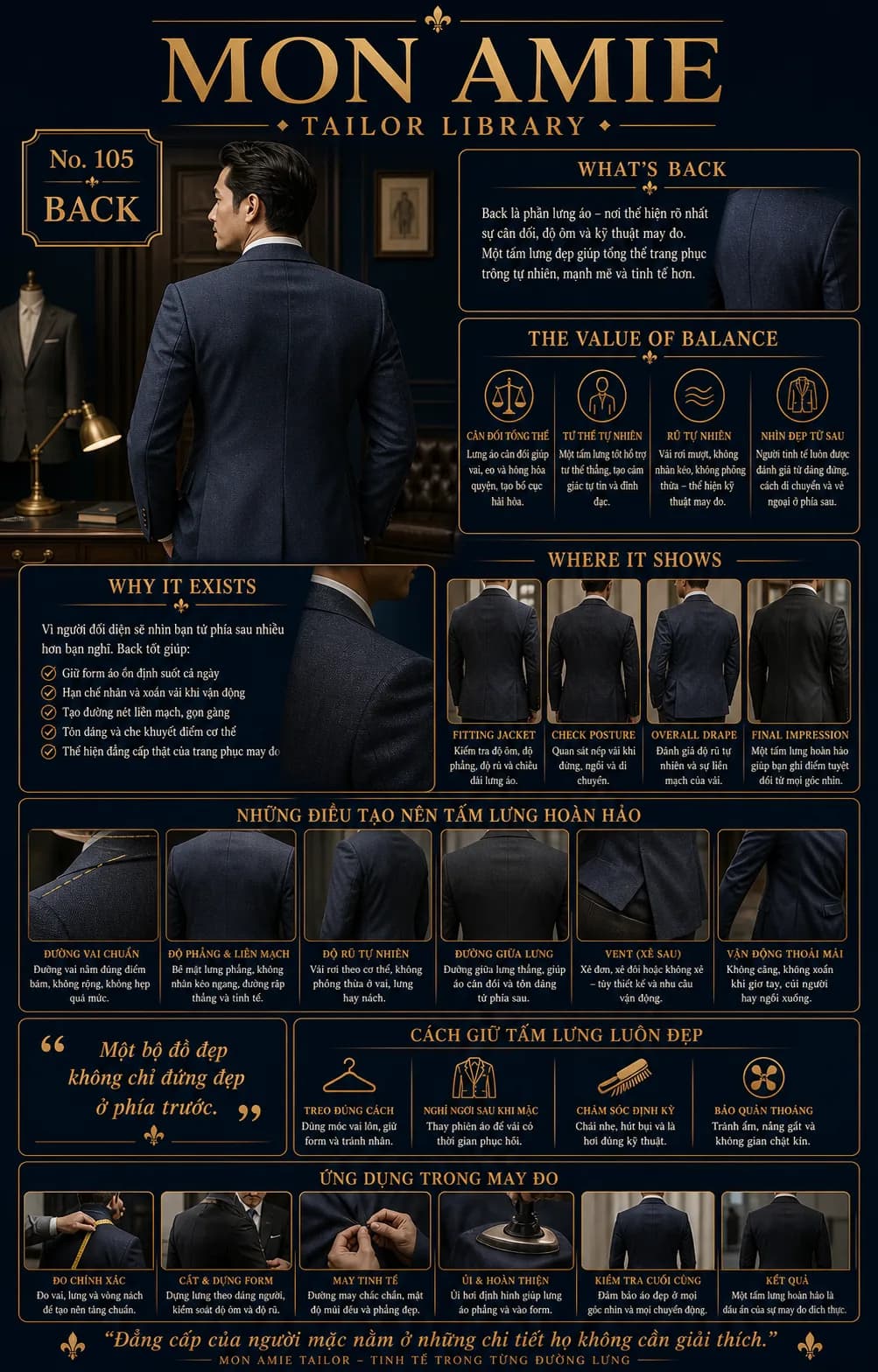
The back of a jacket is the rear of the garment, and it is where balance, closeness of fit and tailoring skill show most clearly. A well-made back makes the whole outfit look natural, strong and refined. When Mon Amie assesses a maker's craft, the back is usually the first place we look, because the front can be covered by a tie and a fastened button, while the back hides nothing.
The value of a well-balanced back
Many men judge a fitting facing the mirror, while the people around them see them from behind far more often than they realise. A properly cut back offers four distinct benefits:
- Overall balance: a balanced back brings shoulders, waist and hips into agreement, giving the whole suit a harmonious composition.
- Natural posture: a good back supports an upright stance, lending confidence and composure whether you stand or sit.
- Natural drape: the cloth falls smoothly, with no pulling creases and no excess billowing — this is the true measure of tailoring.
- Looking good from behind: a refined man is always judged by his stance, his movement and how he looks from the back.
Why the back matters so much
A good back is not only a matter of appearance. It performs several jobs at once:
- It keeps the jacket's shape stable all day, from the morning through to an evening reception.
- It limits creasing and twisting in movement — reaching, turning, driving.
- It creates a clean, continuous line from collar to hem.
- It flatters the figure and softens physical asymmetries, especially for uneven shoulders or a slightly rounded back.
- It reveals the real quality of made-to-measure clothing — something ready-to-wear rarely achieves.
When the back speaks loudest
Through fitting and wear, the back reveals its quality at four moments:
- At the fitting: the tailor checks closeness of fit, flatness, drape and back length on your own body.
- When observing posture: how the cloth folds standing, seated and moving tells you whether the jacket truly follows the body.
- When judging overall drape: how naturally the fabric falls and how continuous the line runs from shoulder to hem.
- In the final impression: a flawless back earns you full marks from every angle.
What makes a perfect back
Examining a back, connoisseurs look at six details:
- A correct shoulder line: it sits exactly on the shoulder point, neither too wide nor too narrow — the foundation of the whole jacket.
- Flatness and continuity: a smooth back surface with no horizontal pulling, and straight, discreet seams.
- Natural drape: the cloth follows the body without bunching at shoulder, back or armhole.
- The centre back seam: straight and true, keeping the jacket balanced and flattering from behind.
- The vent: single, double or none — the choice depends on the design and how much you move; the English double vent gives ease when seated, the American single vent stays neat.
- Freedom of movement: no pulling or twisting when you raise an arm, lean forward or sit down.
Keeping the back looking its best
A fine suit does not only stand well from the front, and the back needs proper care too:
- Hang it correctly: use a broad hanger shaped to the shoulder curve to hold the form and prevent creasing across the back.
- Rest it after wear: rotate your suits so the cloth can recover, and avoid wearing one for several days running.
- Care for it regularly: brush gently, lift dust from the cloth and steam it properly rather than cleaning it often.
- Store it with air: avoid damp, harsh sunlight and a crowded wardrobe that presses creases into the fabric.
How the workroom builds it
Achieving a correct back takes six steps: measuring shoulders, back and armhole precisely to set the foundation; cutting and building the back to the client's actual posture, controlling closeness and drape; sewing finely, with firm seams, even stitch density and a flat, clean surface; pressing and finishing with steam so the back lies flat and takes its shape; a final inspection from every angle and in every movement; and the result — a seamless, continuous back, the hallmark of genuine tailoring.
A word from Mon Amie's artisans
At a fitting, do not only look at the mirror in front of you — turn around and ask your tailor to take a photograph from behind. If you see horizontal creases below the collar or cloth pulling diagonally across the centre, the shoulders or the back length need adjusting; it is not the fabric's fault. Mon Amie builds every back to the individual's posture and warranties alterations after delivery, because a back is only right when it looks well in movement, not merely standing still. A man's standing lies in the details he never has to explain.
The back is the most honest test of a made-to-measure suit. If you would like to feel for yourself what a properly built back does, we invite you to book an appointment at one of Mon Amie's five showrooms in Ho Chi Minh City, or to read about the tailoring process — hotline 0888.111.118.