
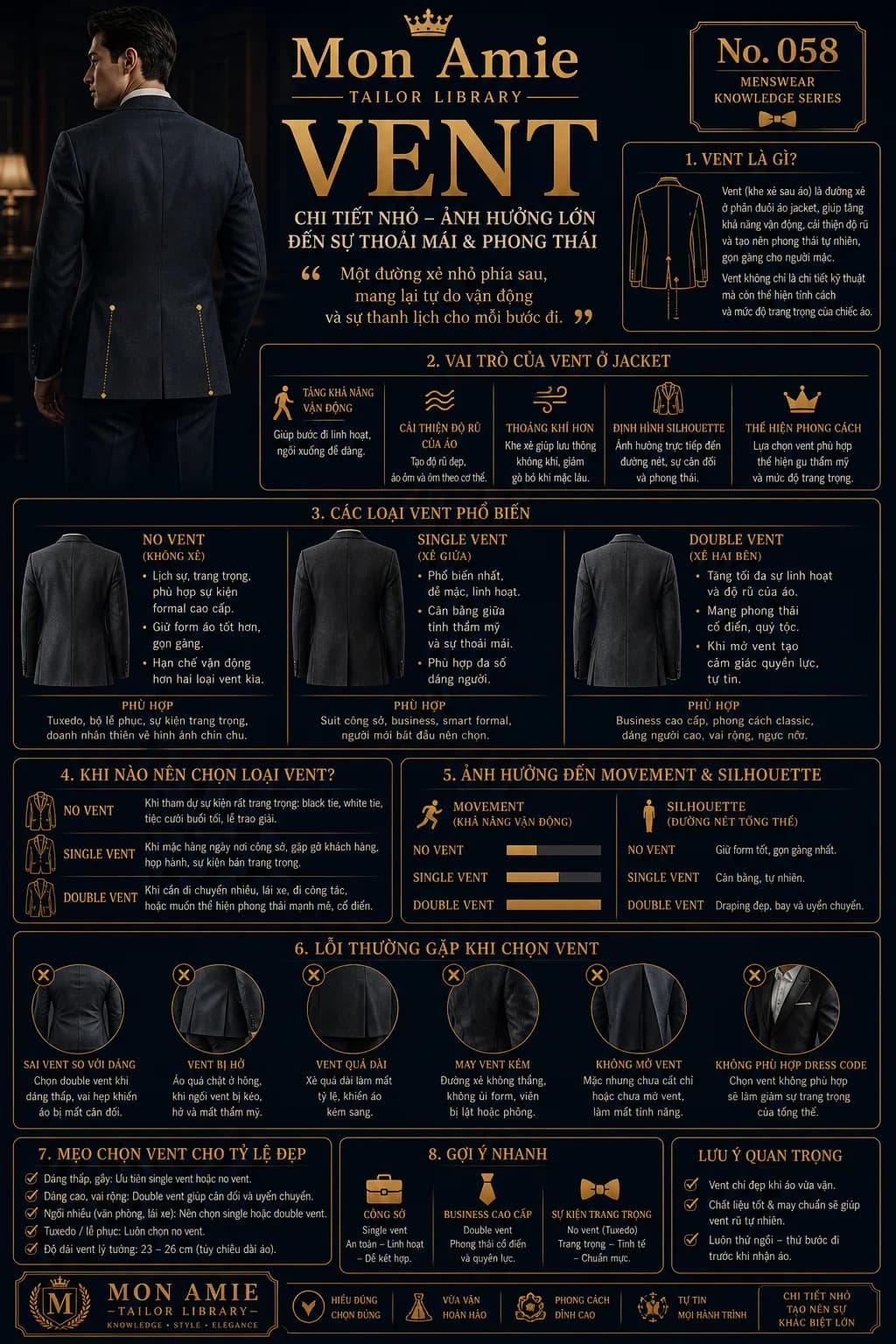
What is a vent? A vent is the opening cut into the back skirt of a jacket, allowing freer movement, improving the drape and giving the wearer a natural, uncluttered line. It is a small opening at the back, yet it grants freedom of movement and elegance to every step — which is why Mon Amie always asks about the vent before cutting a single coat.
What the vent does for a jacket
A vent is not only a technical detail; it also expresses the character and the formality of the coat. Specifically, it serves five purposes:
- Freedom of movement: you walk easily and sit down without the body of the coat pulling.
- Better drape: the cloth falls handsomely and follows the body rather than standing stiff.
- Ventilation: the opening lets air circulate, easing the confined feeling over long hours.
- Silhouette: it directly affects line, balance and overall bearing.
- Style: the vent you choose reveals your eye and the formality you intend.
The three common vents
No vent — the back is a single unbroken panel: refined, formal, and suited to the most ceremonial occasions. A ventless coat holds its shape best and reads cleanest, though it allows less movement than the alternatives. It is the standard choice for a tuxedo, for full dress, for formal events, and for the businessman who prizes an immaculate outline.
Single vent — one opening at the centre of the back, the most common and the easiest to wear. The single vent balances line against comfort and suits most figures. Mon Amie usually recommends it to those buying their first suits for the office, for business and for smart formal wear.
Double vent — two openings at the sides, giving maximum freedom and the finest drape. The double vent carries a classic, aristocratic English air; open, it lends an impression of authority and ease. It suits senior business dress and classic style, and looks particularly fine on tall men with broad shoulders and a full chest. One practical advantage: when you put your hands in your trouser pockets, the back skirts stay flat rather than riding up as they do with a single vent.
When to choose which vent
- No vent: for the most formal occasions — black tie, white tie, evening weddings, award ceremonies.
- Single vent: for daily office wear, client meetings, conferences and semi-formal events.
- Double vent: when you move a great deal, drive, travel for work, or want a strong, classic bearing.
In terms of freedom of movement, the order runs no vent, then single vent, then double vent. In terms of silhouette: no vent holds shape best and reads cleanest, single vent strikes a natural balance, and double vent gives the finest drape, moving fluidly with every step.
Common mistakes when choosing a vent
- The wrong vent for the figure: a double vent on a shorter man with narrow shoulders can unbalance the coat.
- A gaping vent: a coat too tight through the hips pulls the vent open, spoiling the line — a sign the back needs letting out.
- An over-long vent: too much length throws off the proportions and cheapens the coat.
- Poor vent work: an opening that is not straight, does not hold its shape, or has edges that curl or bubble — a workmanship fault immediately visible from behind.
- Leaving the vent closed: wearing a new jacket without cutting the basting threads, so the vent cannot do its work at all.
- Ignoring the dress code: the wrong vent in the wrong setting undermines the formality of the whole.
Choosing a vent for good proportion
- Shorter, slighter figures: prefer a single vent or no vent for an unbroken, tidy back.
- Tall figures with broad shoulders: a double vent brings balance and fluidity.
- Long hours seated (office work, driving): choose a single or double vent so the coat neither creases nor binds.
- Tuxedos and formal dress: always no vent, in keeping with the classical standard.
- Ideal vent length: roughly 23–26 cm, depending on the length of the coat — your tailor will judge it against the whole.
A quick guide: for the office, choose a single vent — safe, flexible, easy to combine; for senior business dress, a double vent — classic and commanding; for formal occasions, no vent with a tuxedo — ceremonial, refined, correct.
A word from Mon Amie's artisans
A vent only looks right on a coat that fits: a jacket tight through the hips will gape whichever vent it has. Good cloth and clean sewing are what let a vent hang naturally, so do not fix on the style of the opening and overlook the quality of the finishing. At a fitting, always sit down and walk a few steps before accepting the coat: those two movements reveal, better than anything else, whether the vent has been cut correctly.
It is a small detail at the back, yet the vent decides much of the comfort and bearing of an entire suit. At Mon Amie's five showrooms in Ho Chi Minh City, our artisans will advise on the vent that suits your figure and the rhythm of your life, across made-to-measure ranges from VND 4.8 million (Kevinlli) up to Canonico, Holland & Sherry, Dormeuil and Scabal — with alteration coverage after delivery and your measurements kept for life. We invite you to book an appointment or to read about the tailoring process at Mon Amie, hotline 0888.111.118.