
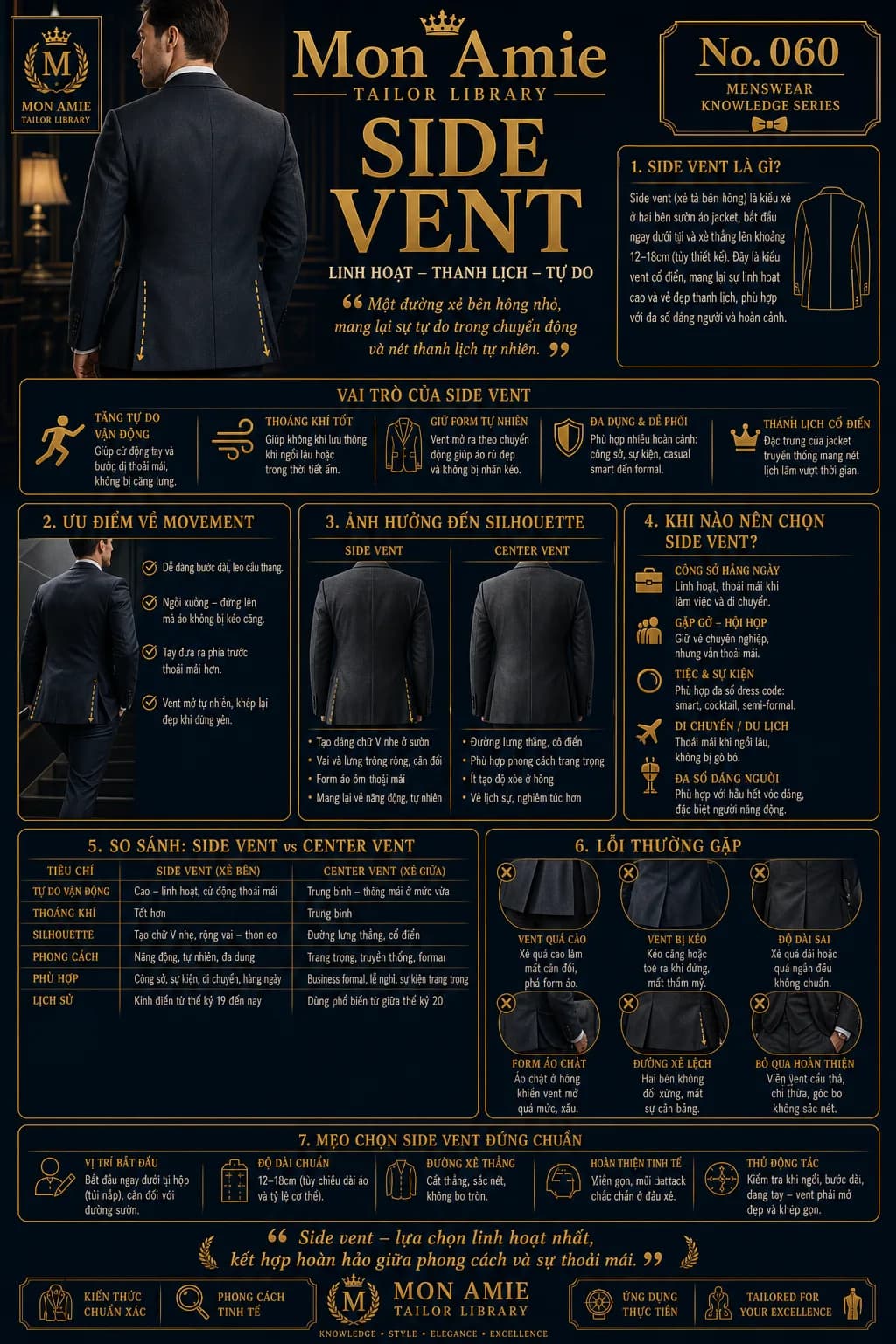
Side vents are the openings cut at both hips of a jacket, beginning just below the pocket and running upward some 12–18 cm depending on the design. This is the classic arrangement, offering considerable freedom of movement and a naturally elegant line that suits most figures and most occasions. If you are undecided about the vent for your next suit, side vents are very nearly the safest and most versatile answer.
What side vents are, and why they matter
At the back of a jacket, the lower skirt may be treated in three ways: no vent, a centre vent, or side vents. With side vents, the two openings sit at the hips, directly below the pockets, allowing the skirts to open and close with every movement of the body.
Small openings, but they do a great deal:
- Freedom of movement: arms and stride move easily, with no strain across the back.
- Ventilation: air circulates during long hours seated or in warm weather — worth considering in Ho Chi Minh City's climate.
- Natural shape: opening with the body's movement, the vents let the coat drape well rather than pull and crease.
- Versatility: suitable across settings, from the office and events to smart casual and formal dress.
- Classic elegance: the signature of the traditional jacket, and timelessly refined.
The advantage in movement
The chief reason tailors favour side vents is freedom of movement. In a jacket with correctly cut side vents, you will notice:
- Long strides and stairs present no restriction at the skirts.
- Sitting down and standing up leave no strain across the back and hips.
- Reaching forward is easier — useful when shaking hands, signing papers or driving.
- The vents open naturally in movement and close cleanly when you stand still.
Another practical point: when you put your hands in your trouser pockets, the rear skirts of a side-vented jacket still hang straight rather than riding up to expose the seat as a centre vent does — which is why side vents are always considered the safer choice in formal company.
How side vents shape the silhouette
The openings serve more than movement; they also define how the coat reads from behind:
- Side vents create a soft V at the flanks, making the shoulders and back appear broader and better balanced.
- The coat sits comfortably close, with an easy, athletic air.
- A centre vent keeps the back line straight and classic, with less flare at the hips, suiting a more formal and rather more serious manner.
Put differently, side vents flatter in an athletic, elegant direction, while the centre vent leans toward traditional correctness. Historically, side vents have been the classic standard since the nineteenth century, whereas the centre vent became widespread from the mid-twentieth century, particularly in ready-to-wear.
When to choose side vents
Side vents suit almost every situation in a modern man's life:
- Daily office wear: easy and comfortable at work and on the move.
- Meetings and conferences: professional yet unrestrictive.
- Parties and events: appropriate for most dress codes — smart, cocktail, semi-formal.
- Travel and commuting: comfortable over long periods seated, with no binding.
- Most figures: flattering on nearly every build, particularly for active men.
If you are having a single suit made to serve many purposes, side vents are almost always the sensible answer.
Common faults with side vents
A fine vent depends on workmanship. These are the faults Mon Amie sees when clients bring older jackets in for alteration:
- Vents cut too high: they unbalance the coat and spoil its shape.
- Straining vents: a tight coat makes the vents splay open when you stand — a sign the jacket is too close through the hips.
- The wrong length: too long or too short is equally out of proportion with the body.
- Uneven openings: the two sides are not symmetrical, and the balance is lost.
- Careless finishing: rough vent edges, loose threads, corners that are not crisp.
A quick check: a correct vent begins just below the flap pocket, runs roughly 12–18 cm depending on the length of the coat, is cut cleanly straight, and has a firm bar tack at the top of the opening. At a fitting, sit down, take a long stride and spread your arms — the vents should open handsomely and close neatly again.
A word from Mon Amie's artisans
To a tailor, the vent is a small detail that reveals the standard of finishing across the whole coat. Mon Amie usually recommends side vents for office suits and for suits meant to do many jobs, and considers a centre vent only when you are pursuing a genuinely traditional business formal look. More important than the style of vent is having enough room through the hips — a vent only looks right when the coat fits, and that is the work of the person measuring, not of the opening itself.
Side vents are the most versatile choice, balancing style and comfort in equal measure — a detail worth keeping in mind for your next commission. We invite you to book an appointment at one of Mon Amie's five showrooms in Ho Chi Minh City, or to read about the tailoring process beforehand, so your first fitting is all the more rewarding.