
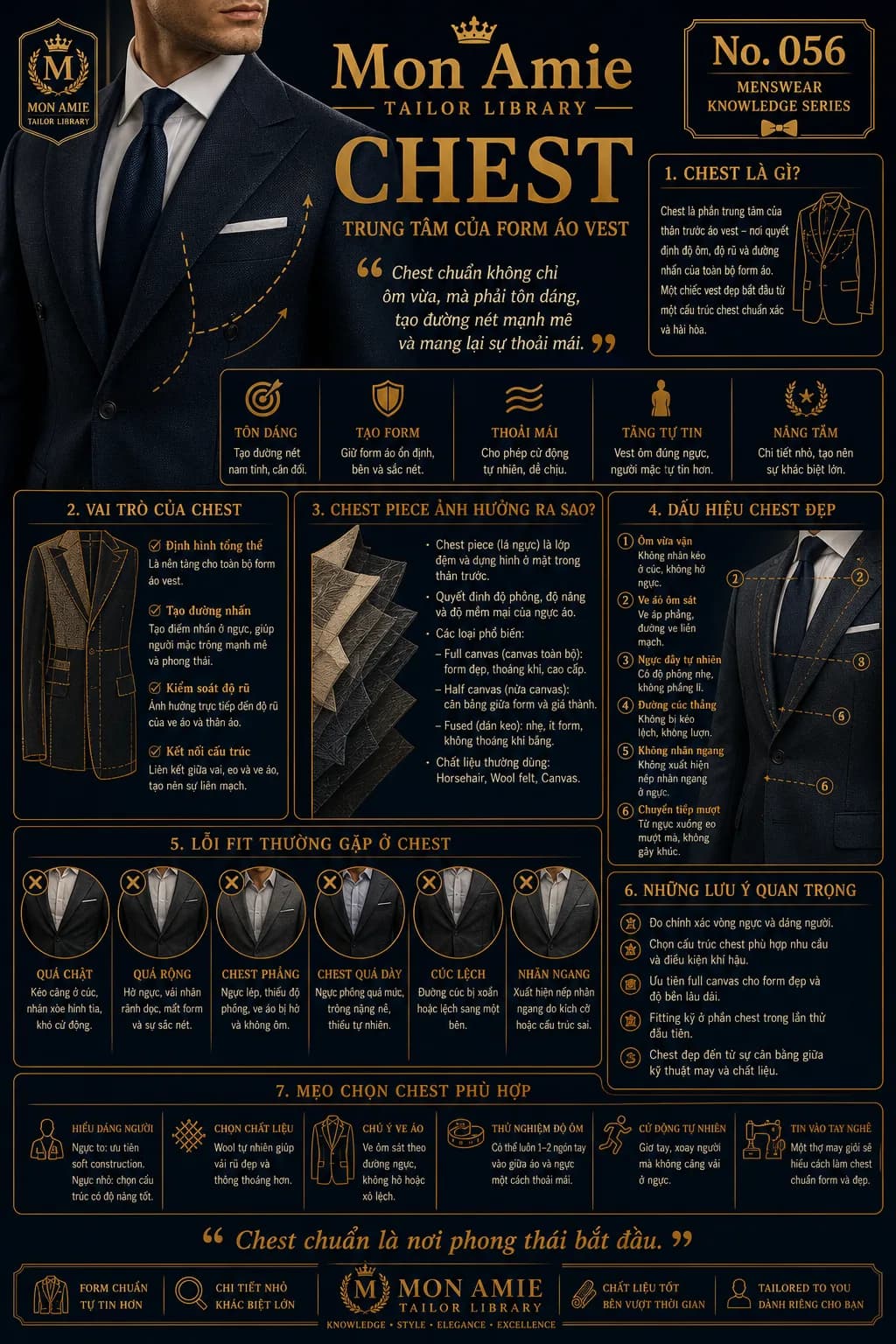
The chest is the centre of a jacket's forepart — the area that decides how closely the coat sits, how the cloth falls, and where the eye lands. A fine suit begins with a chest that is accurately measured and harmoniously built. A proper chest does more than fit; it flatters the figure, draws a strong line, and stays comfortable all day.
The role of the chest in a jacket's form
In bespoke tailoring, the chest is never simply a panel of cloth. It carries four essential responsibilities:
- Setting the overall shape: the chest is the foundation of the entire coat. Shoulder, waist and lapel are all built upon this frame.
- Creating presence: a well-shaped chest makes the wearer look stronger and more composed — which is why experienced tailors spend more time here than anywhere else.
- Controlling the drape: the chest directly governs how the lapel and body of the coat fall. Built correctly, the cloth flows cleanly from shoulder to waist.
- Linking the structure: the chest ties shoulder, waist and lapel together, giving the coat its continuity.
For this reason, anyone who knows the craft looks at the chest first when judging a jacket — before the shoulder, before the length.
How the chest piece shapes the coat
The chest piece is the layer of padding and structure that sits inside the forepart. It determines the fullness, the lift and the softness of the chest. The usual materials are horsehair, wool felt and canvas — all of them resilient, and all of them able to hold shape over years of wear.
Three constructions are common today:
- Full canvas: the canvas runs the whole length of the forepart, giving the finest shape and the best breathability, and moulding to the body the more it is worn. This is the standard for fine tailoring.
- Half canvas: canvas is used through the chest and lapel only, balancing shape against cost.
- Fused: light, with little shape, and less breathable than the other two; typically found in inexpensive ready-to-wear.
The right choice depends on your budget and your needs, but if you want a jacket that holds its shape for years, full canvas is always worth the investment.
Signs of a well-built chest
You can assess your own jacket against six signs:
- A clean, close fit: no pulling at the button, no gaping across the chest when fastened.
- A lapel that lies flat: the lapel hugs the body, running unbroken from the collar to the button.
- Natural fullness: a gentle roundness through the chest, never flat as a board.
- A straight button line: the buttons neither pull to one side nor ripple.
- No horizontal wrinkles: nothing running across the chest area.
- A smooth transition: from chest to waist the cloth flows continuously, without breaking.
If even one of these six is off, the coat loses its polish — however costly the cloth.
Common chest fit faults
These are the faults Mon Amie sees most often when clients bring in older jackets for alteration:
- Too tight: strain at the button, wrinkles radiating outward, restricted movement — a sign of an under-measured chest or a size too small.
- Too loose: the chest gapes, vertical furrows appear, and the coat loses both shape and definition.
- A flat chest: hollow and lacking fullness, with the lapel standing away from the body — usually the result of poor fused construction.
- An over-built chest: excessive fullness that looks heavy and unnatural.
- A twisted button line: buttons pull off-centre because the balance of the forepart is wrong.
- Horizontal wrinkles: creases across the chest caused by the wrong size or the wrong structure.
Most of these faults originate at the measuring and construction stage, so they are difficult to rescue with minor alterations — which is precisely why a thorough fitting from the outset matters so much.
Choosing the right chest for your figure
- Know your figure: a fuller chest is better served by soft construction; a slighter chest benefits from a structure with more lift to build volume.
- Choose the cloth well: natural wool drapes more beautifully and breathes far better.
- Watch the lapel: it should follow the line of the chest closely, never gaping or shifting.
- Test the closeness: with the coat fastened, you should be able to slip one or two fingers comfortably between the coat and your chest.
- Move naturally: raise your arms and turn your body without the cloth straining across the chest.
- Trust the hand of the tailor: a skilled tailor knows how to build a chest that is both correct and handsome — something no machine can replicate.
A word from Mon Amie's artisans
Mon Amie favours full canvas for clients who want lasting shape and durability, and we devote more time to the chest than to any other area during the first fitting. Have your chest measured accurately against your true figure, and choose a chest construction suited to your needs and to Vietnam's hot, humid climate. A beautiful chest comes from the balance between tailoring technique and cloth — without either one, the coat will never reach the standard you deserve.
A well-built chest is where bearing begins. If you would like a jacket with a chest built to the standard of the craft — close, flattering and comfortable through the longest day — we invite you to book an appointment at one of Mon Amie's five showrooms in Ho Chi Minh City, or to read about the tailoring process first, to see how carefully Mon Amie fits the chest.