
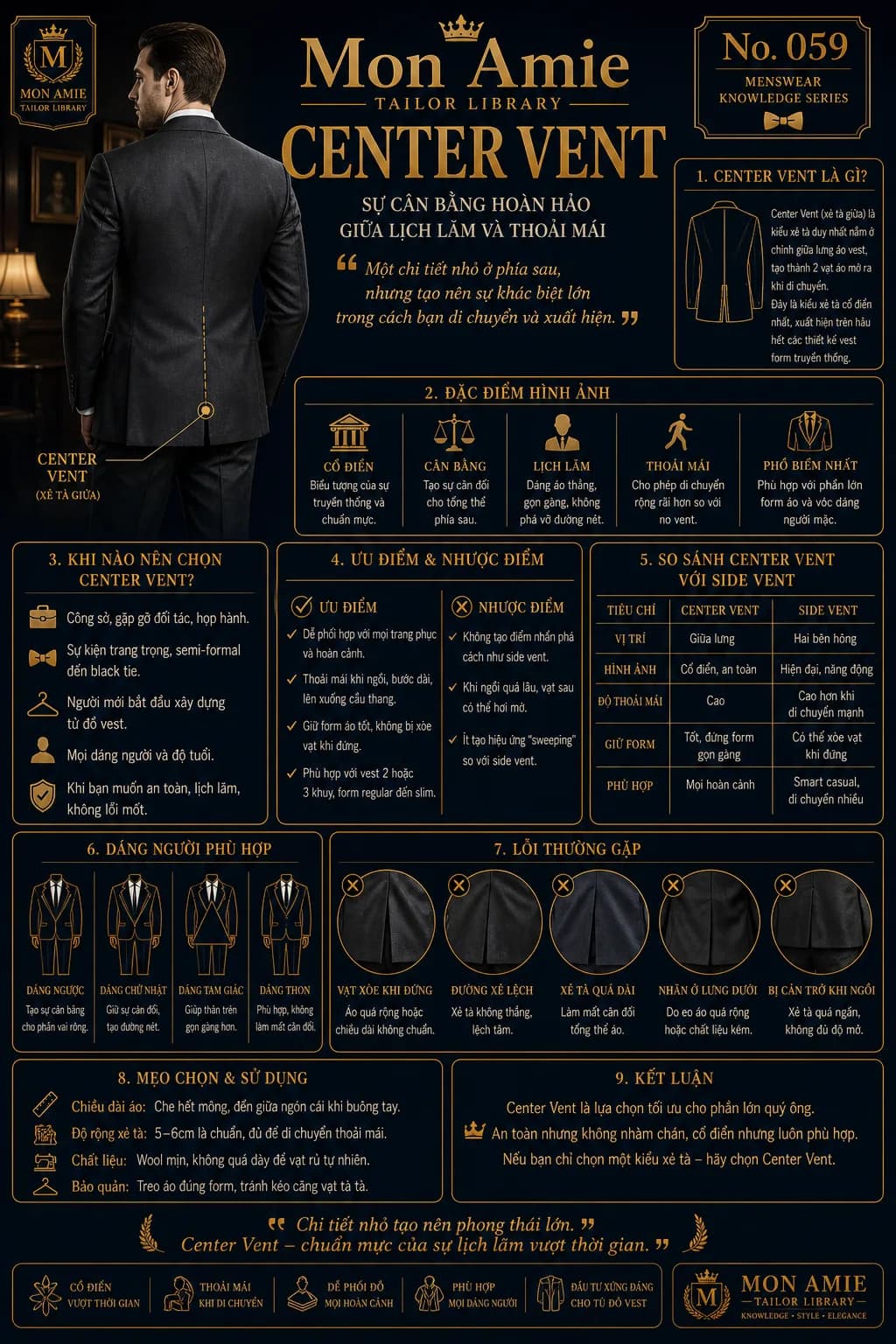
The centre vent is the single opening cut at the middle of a jacket's back, dividing the rear skirt into two panels that part as you move. It is the most classic of the three common choices (no vent, centre vent, side vents) and appears on almost every traditionally cut jacket. A small detail at the back, but one that makes a considerable difference to how you move and how you appear.
What a centre vent is, and why it is so widespread
The centre vent originates in the riding dress of the English gentry: the opening at the back let the skirts fall to either side of the saddle without pulling or creasing. When the jacket entered working life, the detail was kept for its sheer practicality — sitting, striding and slipping a hand into a trouser pocket are all far easier than in a ventless coat.
Visually, the centre vent has five defining qualities:
- Classic: a symbol of tradition and correctness.
- Balanced: it gives the back a settled symmetry, since the opening follows the spine.
- Refined: the coat reads straight and tidy, with nothing to break the line.
- Comfortable: it allows far more movement than a ventless coat.
- The most common: it suits the majority of cuts and the majority of figures.
When to choose a centre vent
If you are weighing up the options, these situations are the centre vent's home ground:
- The office, meetings with partners, everyday business.
- Formal occasions, from semi-formal through to black tie.
- Building a first suit wardrobe — a safe choice, hard to get wrong.
- Almost any figure and any age.
- Whenever you want something dependable, refined and never dated.
Strengths and limitations
No vent is perfect in every respect, and the centre vent is no exception.
Strengths:
- Easy to combine with any outfit and any setting.
- Comfortable when seated, striding, or climbing stairs.
- Holds the shape of the coat, with skirts that stay closed when you stand.
- Suits two- and three-button jackets, from regular to slim cuts.
Limitations:
- It offers none of the flair of side vents.
- After long periods seated, the rear skirt may part slightly.
- It creates less of the sweeping movement — skirts swinging with the stride — that side vents give.
Centre vent versus side vents
Set side by side, the differences fall into a few clear criteria:
- Position: the centre vent is cut at the middle of the back; side vents at the hips.
- Character: the centre vent is classic and safe; side vents modern and lively.
- Comfort: both are high, though side vents have the edge in vigorous movement.
- Shape retention: the centre vent holds a tidy line when standing; side vents may splay a little.
- Suitability: the centre vent works everywhere; side vents suit smart casual dress and men who move a great deal.
In short: side vents are for the man who wants to show some character; the centre vent is the standard that serves most gentlemen.
Common faults with a centre vent
A good vent should stay closed when you stand and open only when needed. These are the faults Mon Amie sees most often on ready-to-wear jackets and poorly executed made-to-measure:
- Skirts parting when standing: the coat is too wide, or the length is wrong.
- An off-centre opening: the vent is not straight and sits away from the spine.
- An over-long vent: it unbalances the coat as a whole.
- Creasing at the lower back: caused by too much room at the waist, or by poor cloth.
- Restriction when seated: the vent is too short and does not open enough.
Alongside these, a few points you can check yourself:
- Jacket length: it should cover the seat and reach roughly the middle of the thumb when your arms hang down.
- Vent opening: 5–6 cm is standard, enough for comfortable movement.
- Cloth: a fine wool, not too heavy, so the skirts fall naturally.
- Care: hang the jacket on a proper hanger and avoid straining the skirts.
A word from Mon Amie's artisans
In Mon Amie's workroom, the centre vent is aligned exactly with the client's spine — a few millimetres out and anyone facing you notices the imbalance at once. For clients with a fuller seat or a pronounced curve to the back, we usually ease the shaping slightly at the rear waist so the skirts stay closed standing and part smoothly when seated. If you are choosing a single vent style for your first suit, choose the centre vent: safe without being dull, classic without ever being out of place.
Small details create great bearing — and the centre vent is the very standard of timeless elegance. We invite you to book an appointment at one of Mon Amie's five showrooms in Ho Chi Minh City, or to read about the tailoring process as you begin your own perfectly cut suit.