
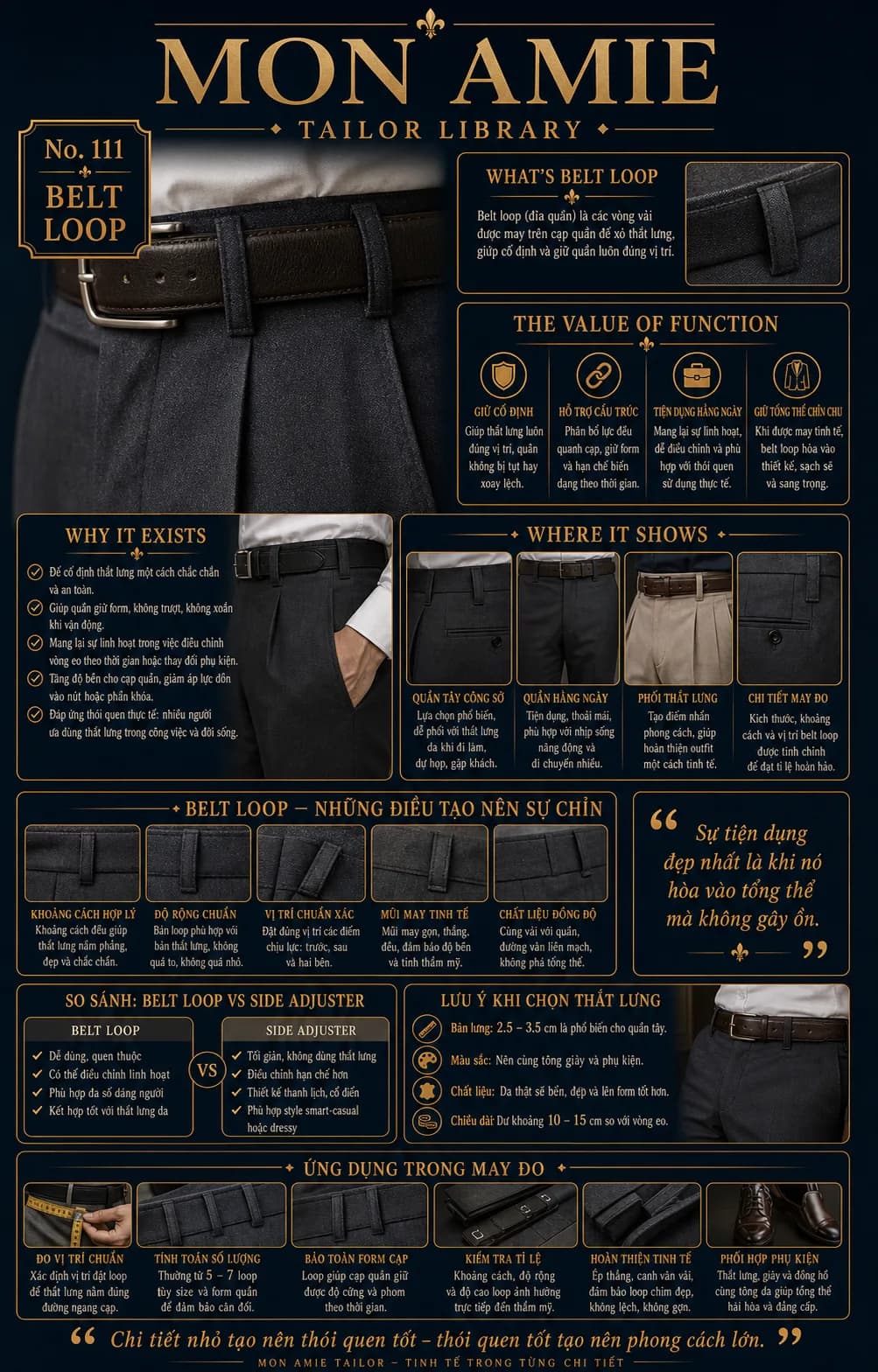
A belt loop is one of the small fabric bands stitched onto a trouser waistband to carry a belt, holding the trousers securely at the right height. On a pair of made-to-measure trousers, this modest detail decides whether the belt sits flat, whether the waistband holds its shape, and whether the whole outfit still looks composed at the end of a long day. Understanding belt loops helps you choose trousers that suit the way you actually dress.
What a belt loop does
Small as they are, belt loops perform several jobs at once:
- Holding position: they keep the belt where it belongs, so the trousers never slip or rotate as you move.
- Structural support: they distribute tension evenly around the waistband, preserving shape and resisting distortion over the years.
- Everyday practicality: they offer flexibility, easy adjustment and a fit that matches real habits of wear.
- A composed whole: when finely made, belt loops disappear into the design — clean, quiet, refined.
Why trousers need belt loops
Belt loops appear on almost all modern trousers for entirely practical reasons. They anchor the belt firmly and securely, so the trousers hold their line and neither slide nor twist as you walk. They also allow for change: your waist shifts over time, or you simply want a different accessory, and a turn of the buckle settles the matter. Technically, belt loops strengthen the waistband as well, easing the strain that would otherwise concentrate on the button and closure. And finally, they answer a near-universal habit — most men wear a belt, at work and at leisure alike.
You will find belt loops everywhere: on business trousers that pair naturally with a leather belt for the office, meetings and client visits; on everyday trousers where comfort and convenience matter; and on outfits where the belt itself becomes a considered accent that quietly completes the look.
What makes a well-made belt loop
In bespoke and made-to-measure work, a proper set of belt loops meets several standards:
- Sensible spacing: so the belt lies flat, handsome and secure.
- Correct width: the loop matched to the belt's width — never too broad, never too narrow.
- Precise placement: set at the points that actually bear load — front, back and both hips.
- Refined stitching: neat, straight and even, for durability as much as appearance.
- Matching material: the same cloth as the trousers, seamlessly joined, never disturbing the whole.
As the trade has it: the best kind of practicality is the kind that blends in without making a sound.
Belt loops or side adjusters?
The two options serve two different sensibilities. Belt loops are familiar and easy, allow flexible adjustment, suit most builds and work handsomely with a leather belt. Side adjusters take the minimal route — no belt at all, an elegant and classic line, well suited to smart-casual or dressy wear, though with a narrower range of adjustment. If a leather belt is part of your daily routine, belt loops are the natural choice; if you prefer the clean line of a plain waistband, side adjusters deserve consideration.
When choosing a belt to go with your loops, a few notes:
- A width of 2.5 – 3.5 cm is standard for tailored trousers.
- The colour should sit in the same family as your shoes and accessories.
- Genuine leather wears longer, looks better and holds its shape.
- Allow roughly 10 – 15 cm of length beyond your waist measurement.
Belt loops in the tailoring process
At the bench, belt loops receive careful attention across several stages. The tailor establishes their placement so the belt runs true along the waistband, then calculates the count — usually five to seven, depending on size and cut, to keep everything balanced. The loops are set so the waistband retains its firmness and shape over time; spacing, width and height all bear directly on appearance, so each proportion is checked. Finally the loops are pressed flat and aligned with the grain so they sit cleanly, without skew or ripple — and you are advised on matching belt, shoes and watch so the whole reads as one.
A word from Mon Amie's artisans
When you try on a pair of trousers, wear the belt you actually use most — only the real width tells you whether the loops are right. If the belt ripples between two loops, the spacing is too wide; if the loops strain, they are too narrow for the belt. At Mon Amie, your measurements and your belt habits are kept on file for life, so every subsequent pair is refined to your preference without starting over.
Small details build good habits, and good habits build real style. A properly made set of belt loops is the quiet foundation of looking composed every day. We invite you to book an appointment at one of Mon Amie's five showrooms in Ho Chi Minh City, or read about the tailoring process beforehand — our hotline 0888.111.118 is always at your service.