
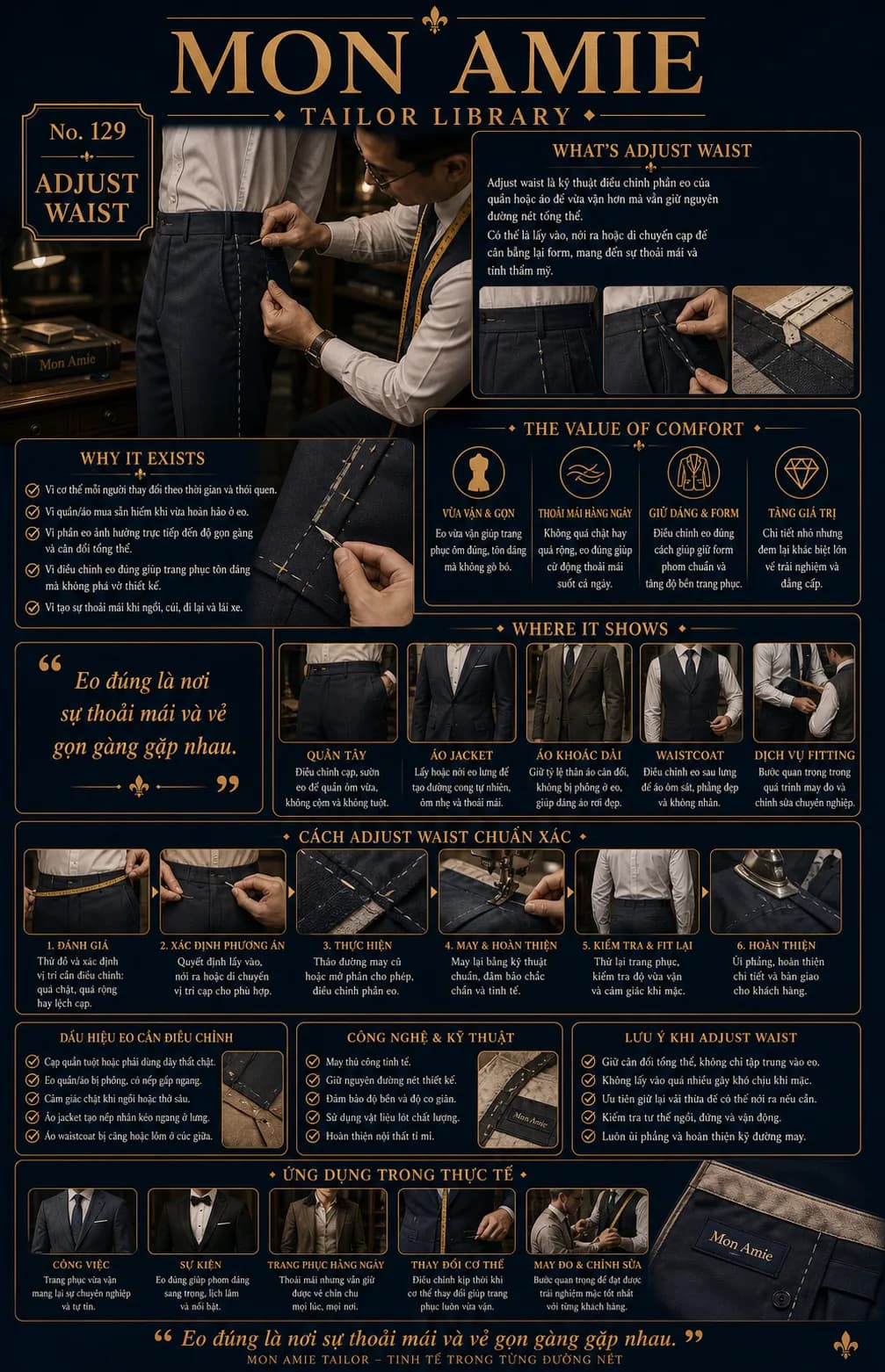
What is a waist adjustment? It is the technique of refining the waist of a pair of trousers or a jacket so it fits better while the overall lines remain untouched. The work may involve taking in, letting out or repositioning the waistband to rebalance the shape, delivering both comfort and a cleaner look — because the waist is where comfort and neatness meet.
Why the waist needs adjusting
The waist is the most sensitive part of any garment, and the part that changes most over time:
- The body shifts with the years and with habit.
- Ready-made trousers and jackets are rarely perfect at the waist.
- The waist directly governs how trim and balanced the whole outfit reads.
- A correct waist flatters the figure without disturbing the design.
- A well-fitted waist keeps you comfortable sitting, bending, walking and driving.
That comfort shows up in four ways: a trim, correct fit (the garment holds close where it should, flattering without constricting), everyday ease (neither tight nor loose, so you can move freely all day), preserved shape (a proper adjustment maintains the silhouette and extends the garment's life) and added value — a small detail that makes a large difference to how a garment feels and how it reads.
Where waist adjustments are made
The technique applies across many garments:
- Trousers: adjusting the waistband and side seams so they hold without bunching or slipping.
- Jacket: taking in or letting out the back waist to create a natural, lightly shaped line.
- Long coat: keeping the body in proportion so it does not balloon at the waist and falls cleanly.
- Waistcoat: adjusting the back waist so the garment lies close and smooth, without rippling.
- Fittings: waist work is a key stage in both bespoke tailoring and professional alteration.
The waist adjustment process
Done properly, the work follows six steps:
- Assess: fit the garment and identify the issue — too tight, too loose, or a waistband sitting off-centre.
- Decide the approach: take in, let out, or reposition the waistband as appropriate.
- Execute: unpick the existing seam or open the available allowance and adjust the waist.
- Stitch and finish: restitch using proper technique, secure and neatly done.
- Refit: try the garment again to confirm the fit and how it feels in wear.
- Complete: press flat, finish the details and return the garment to the client.
Signs your waist needs work, and points to remember
You can spot the signs yourself: a waistband that slips, or needs the belt pulled tight; bunching or horizontal folds at the waist; tightness when you sit or breathe deeply; horizontal drag lines across the back of a jacket; a waistcoat that strains or hollows at the middle button.
Technically, a quality waist adjustment calls for fine handwork, respect for the original design lines, durability with the right amount of give, good-quality interlining and meticulous internal finishing. Alongside that:
- Keep the whole in balance rather than focusing on the waist alone.
- Do not take in so far that the garment becomes uncomfortable.
- Retain the spare cloth so the waist can be let out again later.
- Check the fit seated, standing and in movement.
- Always press flat and finish the seams thoroughly.
In practice, waist adjustments serve every occasion: work (a proper fit reads as professionalism and confidence), formal events (a correct waist gives an elegant, distinguished silhouette), everyday dress (comfort without losing polish), changes in the body (timely adjustment keeps a garment fitting) and bespoke or alteration work generally — an essential step towards the best possible fit for each client.
A word from Mon Amie's artisans
At Mon Amie, waist work is not an afterthought but part of a commitment: the garment should fit you today and in the years to come. Because measurements are kept for life and alterations are guaranteed, each time your body changes we need only a few seams to bring the suit back into shape — rather than having you commission a new one or accept a compromised fit.
If your waistband is slipping or drag lines have appeared across the back of your jacket, visit one of Mon Amie's five showrooms in Ho Chi Minh City (Nguyen Trai, Ho Van Hue, 3/2 Street, Caravelle Hotel District 1, Nguyen Thi Thap) or call 0888.111.118. You are welcome to book an appointment for an assessment in person, and to read more about the tailoring process at Mon Amie.