
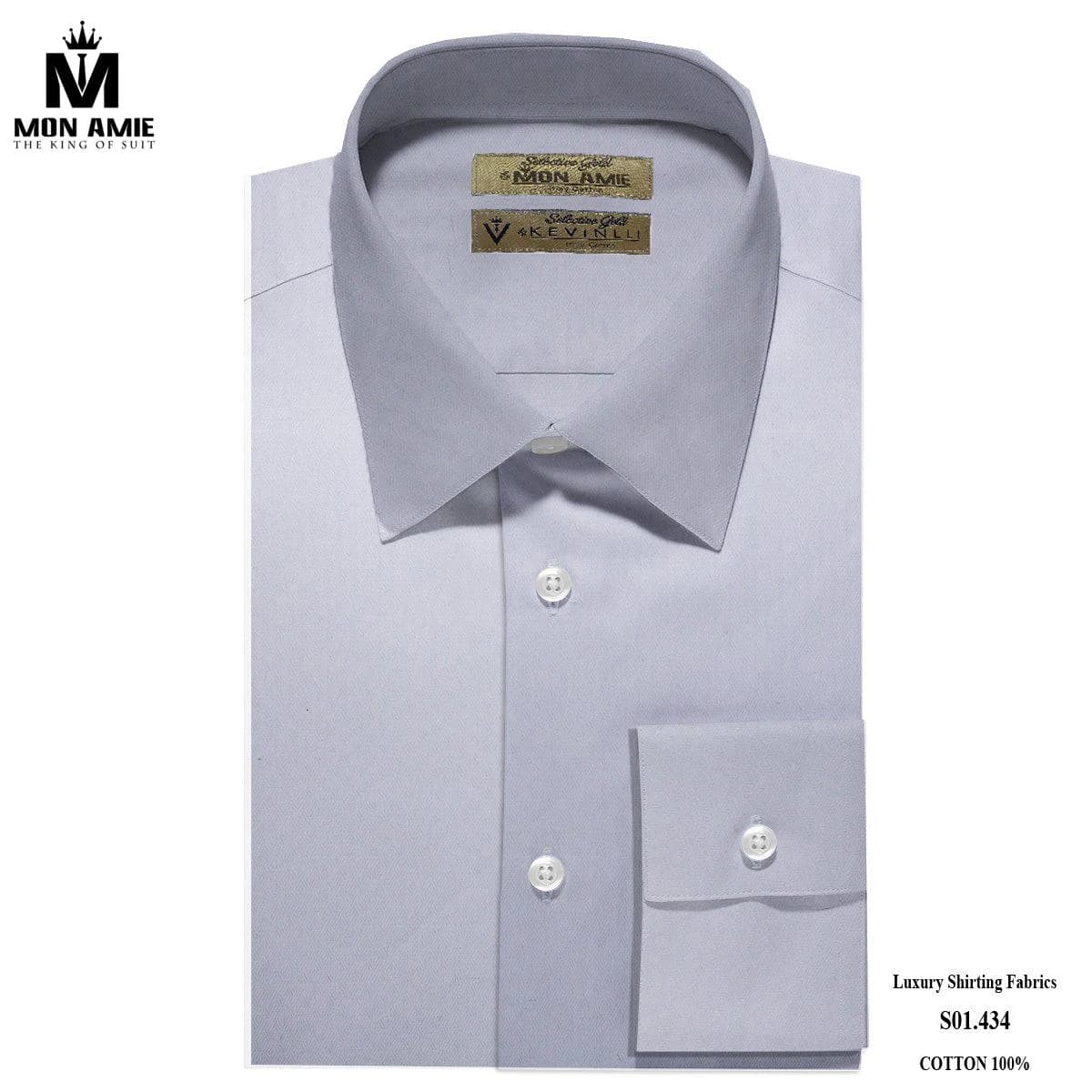
The collar buttons, the shoulders fit, but the sleeve runs two centimetres past your wrist. Roll it up and it creases; let it down and the cuff rides over the back of your hand. Standing in a shop with a size L shirt in your hands, you are facing exactly the problem that ready-to-wear cannot solve.
The short answer
On the made-to-measure or ready-to-wear shirt question: buy a ready-to-wear shirt if your neck, shoulders, stomach and sleeves all match a single size and you wear shirts at a normal rate. Choose made-to-measure when you have a big neck and short arms, a small neck and long arms, a stomach out of step with your chest, or when you wear shirts under a suit all week. A made-to-measure shirt at Mon Amie starts at VND 850,000, excluding VAT.
Where ready-to-wear sizing breaks down
A ready-made size (S, M, L, or neck 39, 40, 41) is a fixed set of proportions. Each step up in neck size raises the chest, stomach, shoulders and sleeve length at the same average rhythm. If your body keeps to that rhythm, off-the-rack fits. If it is out of step, no size will match two places at once.
| Body type | What off-the-rack runs into | How made-to-measure handles it |
|---|---|---|
| Big neck, short arms | Fit the neck and the sleeves are too long; fit the sleeves and the neck chokes | Neck and sleeve are two separate measurements |
| Small neck, long arms | Fit the neck and the sleeves are short, the cuffs riding up the wrist | Sleeves lengthened, neck left as it is |
| Stomach larger than chest | Fit the stomach and the shoulders and chest are loose; fit the shoulders and the buttons pull across the stomach | Body of the shirt cut fuller at the stomach, shoulders kept fitted |
| Sloping or square shoulders | The shoulder seam drops down the arm or gets pulled tight against it | Shoulder slope adjusted from the pattern stage |
| Large upper arms (weightlifters) | The sleeve binds when the elbow bends | Sleeve let out at the upper arm |

Comparison table: made-to-measure or ready-to-wear shirt
| Criterion | Ready-to-wear | Made-to-measure |
|---|---|---|
| Price | Usually lower in the mass-market range | From VND 850,000 (Cotton Modal) to VND 2.5 million (Cotton Premium), excluding VAT |
| Time | Buy it and wear it straight away | You wait 3–7 days for it to be made, or as little as 24 hours when urgent |
| Neck and sleeve | Choose from the few sizes available | Each figure measured separately |
| Buying again later | Every brand has its own size chart, so you have to try on again | Measurements kept for life, so next time there is less to measure from scratch |
| When the ready-made shirt already fits | Choose it and you are done | Gives nothing extra beyond not having to try on again next time |
If a ready-made shirt already fits you, you don't necessarily need made-to-measure.
Just buy off the rack if
- Neck, shoulders, stomach and sleeves all match one size when you try it on.
- You wear the shirt rarely, such as at the weekend, outside the trousers, with the sleeves rolled up. A shirt with rolled sleeves doesn't need the cuff to be right to the centimetre.
- You need it today, because you travel for work tomorrow.
- You are testing a new colour or collar style and don't want to invest yet.
Go made-to-measure if
- Your neck and sleeve are out of step, as in the table above.
- You wear the shirt under a suit. The shirt cuff should show beyond the jacket sleeve by about 1 to 1.5 cm, and a centimetre off is visible to the person facing you. More detail in the article on sleeve length and how much shirt cuff should show.
- You keep the shirt tucked in all day. The body has to be long enough not to pull out when you sit and bend.
- You wear shirts five days a week. A shirt worn that much deserves to be cut for you.
- You already have your own cloth. The making charge for a shirt when the customer brings cloth is VND 800,000.
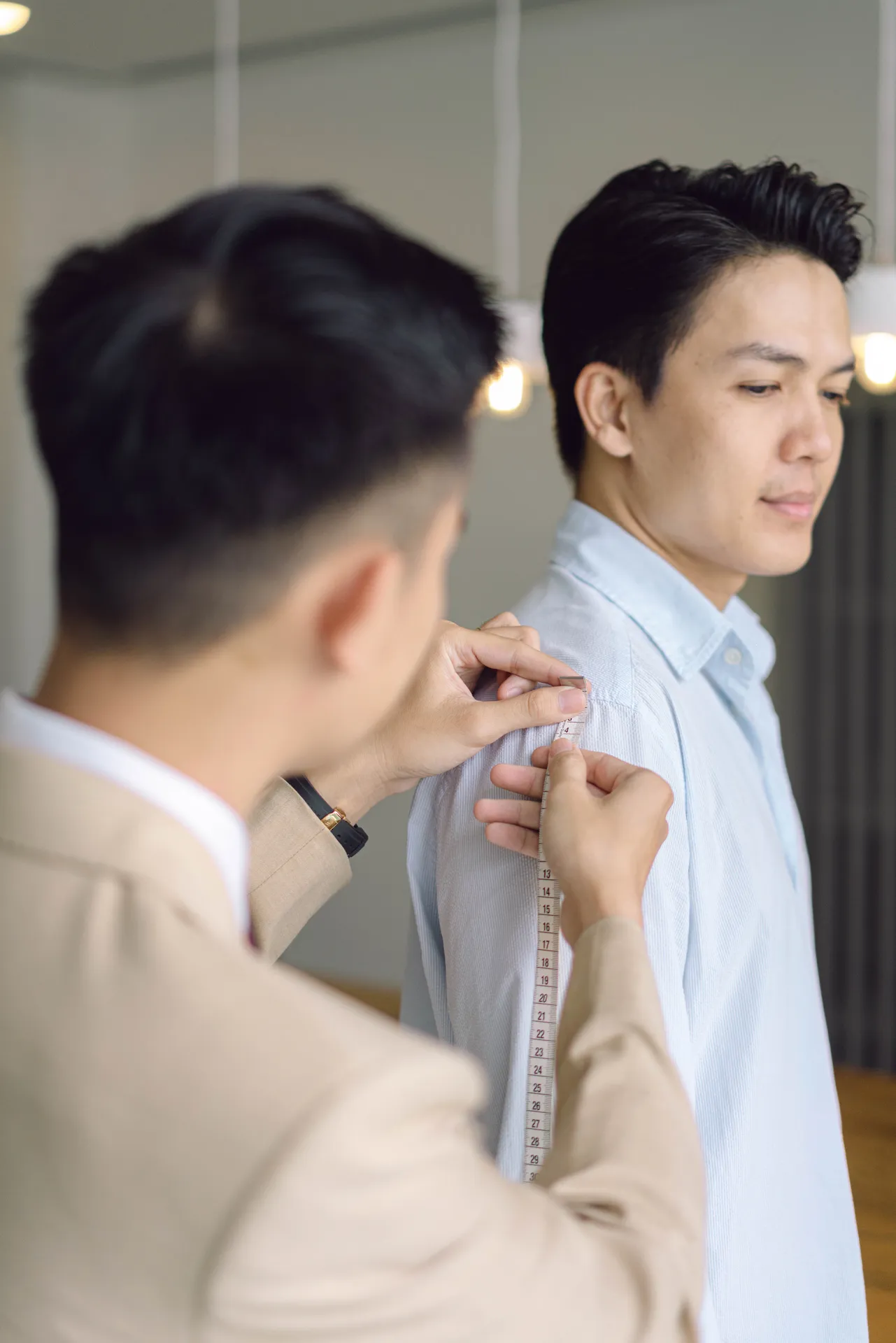
If you still want to buy off the rack with a big neck and short arms
Choose by the neck and shoulders first, since these are the two hardest places to alter. Sleeves that are too long and a body that is too wide can be altered: an alteration shop can take off the cuff and shorten the sleeve by a few centimetres, and take in both side seams to tidy the body. Do it the other way round, choosing by the sleeve and then trying to put up with a tight collar, and you will be loosening the top button all day.
Whether a shirt is made-to-measure or ready-to-wear, the parts that are hard to alter have to fit from the start: neck and shoulders first, sleeves and body second.
Which shirts are worth having made, and which are not
A white or pale blue shirt bought off the rack that fits you well, just buy it, and don't have one made to complete a set. But if you wear a suit three days a week, or you have a big neck and short arms, a made-to-measure shirt is a worthwhile piece in the wardrobe. List prices exclude 8% VAT:
| Cloth | Price |
|---|---|
| Cotton Modal | VND 850,000 |
| Cotton Bamboo | VND 1.2 million |
| 100% Cotton | VND 1.7 million |
| Cotton Premium, Cotton Salford | VND 2.5 million |
A quick calculation to help you decide: a VND 1.7 million shirt plus VAT is VND 1.836 million, and worn 80 times that comes to about VND 23,000 a wear. A cheaper shirt worn a few times and then left in the wardrobe because it doesn't fit costs far more per wear.
To see how to price a work shirt sensibly, read the article on the price of made-to-measure office shirts. If you don't yet know your collar size, the article on what weight a size L men's shirt suits has a neck measurement chart.
Try the ready-made shirt before you decide
If you plan to buy off the rack, run through these six checks in front of the mirror before you pay.
- Button the collar all the way and turn your head from side to side: one to two fingers slide in, and the collar doesn't dig into your neck when you swallow.
- Hold both arms out at shoulder height, then fold them across your chest: the back of the shirt doesn't pull into a horizontal crease.
- Let your arms drop: the cuff stops at the wrist bone and doesn't ride up the back of your hand.
- Sit down: the button at the stomach doesn't gape open.
- Raise your arms: the hem doesn't pull completely out of the trousers.
- Look at the shoulders: the shoulder seam sits right on your shoulder point and doesn't drop down onto the arm.
If two or more fail, especially the neck and sleeves, you are trying to force your body into a size. At that point made-to-measure costs less than buying again and again.
Frequently asked questions
Can a ready-made shirt have its sleeves shortened?
Usually by a few centimetres, by taking off the cuff and shortening the sleeve. If the sleeve is too long by more than that, or the shirt has a complicated sleeve placket, go made-to-measure. Altering the shoulders is much harder and is seldom worth doing.
Do I need made-to-measure if I wear shirts only a few times a year?
No. A shirt worn rarely only needs to fit well enough. Buy off the rack whichever one fits your neck and arms.
How long does a made-to-measure shirt take, and is there a fitting?
A single shirt takes 3–7 days, or as little as 24 hours when urgent. The number of fittings depends on the order, so ask the showroom when you order. If you live far away, you can tailor online, measured through a guided video on WhatsApp or Viber.
Do I have to be measured again when I reorder?
Usually not, because measurements are kept for life. If you gain or lose 3 to 5 kg, you should be measured again.
One test to settle it
On the made-to-measure or ready-to-wear shirt question, one test settles it: if both the neck and the sleeve fit, buy off the rack; if either is out, have one made. To find out which group you belong to, book a measuring appointment at the nearest showroom.