

In the fitting room you put on a ready-made blazer and look in the mirror. The first place to look is the shoulder seam, before the colour or the price. If the seam sits exactly where your shoulder bone ends and the sleeve hangs straight, the rest can usually be altered, and you don't yet need to pay for made-to-measure. If the shoulder is wrong, no amount of alteration will make the jacket stand like one that fits.
The short answer
A ready-made blazer is fine when the shoulders fit, chest and stomach differ by the usual amount, and only the sleeves or waist need work. Go made-to-measure when you have broad shoulders and a small waist, a stomach larger than your chest, uneven or clearly sloping shoulders, a height or build that falls outside standard sizes, or you wear a blazer three or more days a week.
Ready-to-wear and made-to-measure blazer side by side
| Criterion | Ready-to-wear blazer | Made-to-measure blazer |
|---|---|---|
| Shoulders | Follow the manufacturer's standard size; hard to alter if off | Built to each person's shoulders |
| Chest and waist | Standard proportions; the waist can be taken in, and let out depending on the seam allowance left inside | Cut to your real measurements |
| Sleeve length | Alterable, easiest when the cuff has no working buttonholes | Right from the start |
| Jacket length | Nearly fixed, because the pockets and buttons already have their places | According to your height and leg proportions |
| Cloth, colour | Take what's available | Choose from the cloth library and the swatch book |
| Time | Wear it at once, or after a few days of alteration | You have to wait for it to be made |
| Seeing the real jacket before paying | Yes | Seen through a sample jacket, cloth samples, and at the fitting |
| If it doesn't fit | Exchange the size or pay for alterations yourself | At Mon Amie: if the jacket does not look right or does not match the style agreed, it is altered until you are satisfied; if it still falls short, you receive a 100% refund |
The table shows that the real difference lies in the shoulders and the proportions of the body. Sleeve length and waist can be altered fairly well on a ready-made jacket. So the question of a made-to-measure or ready-to-wear blazer is really a question about your build.
Four tests: when off the rack is fine for your build
Wear the shirt you wear most, stand straight in front of the mirror and go through them one at a time:
- Shoulders. The shoulder seam ends exactly where the shoulder bone ends. There is no dimple just under the shoulder tip, no extra cloth bulging up, and the sleeve hangs straight down without twisting.
- Body. Button up (a two-button jacket is fastened at the top button) and slide a flat hand in at the button; it fits. There are no X-shaped creases pulling out from the button. If the chest fits but the waist is loose, the waist can be taken in.
- Jacket length. The jacket covers the seat completely or nearly. With your arms hanging, the hem sits at about the middle of the hand.
- Sleeves. About 1 to 1.5 cm of shirt cuff shows. A little longer or shorter can be altered; choose a jacket whose cuff has no working buttonholes, to make alteration easier.
If you pass all four, you are in the group for whom off the rack is fine. Buy the one that fits best at the shoulders, then have the sleeves and waist altered.
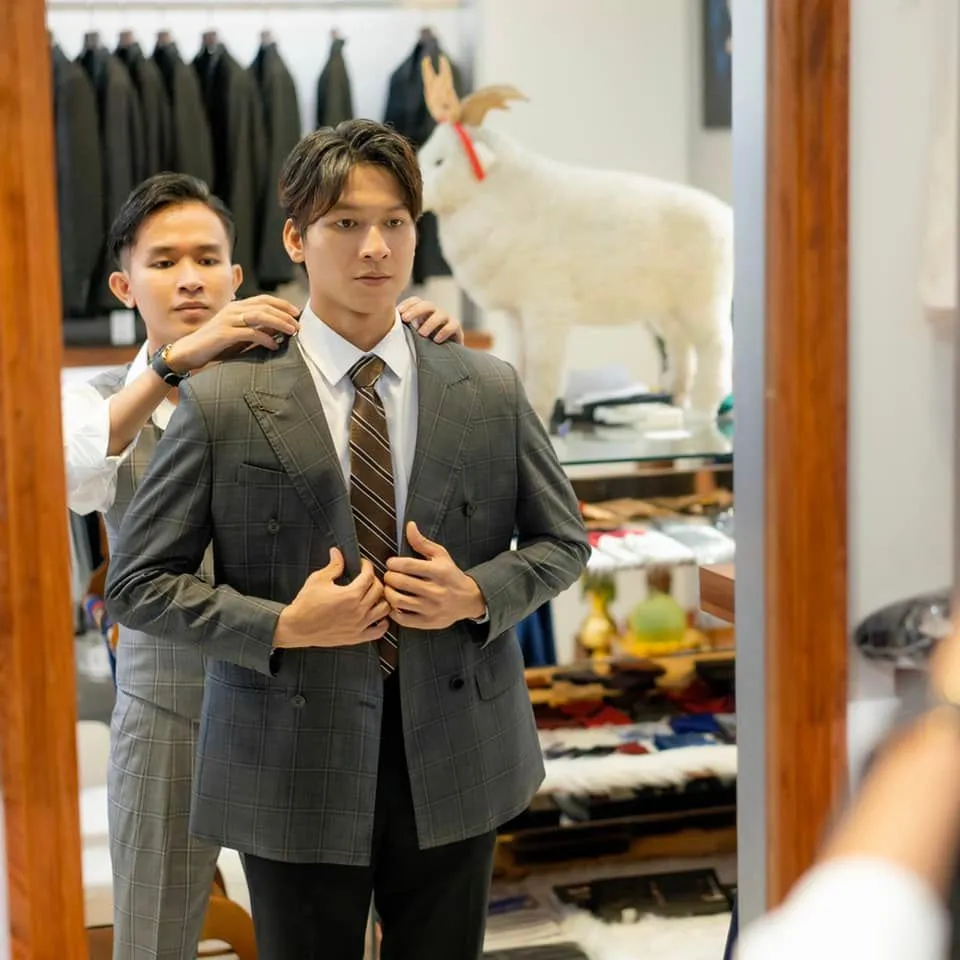
Six builds that should go made-to-measure
- Broad shoulders, small waist. Common among people who lift weights or play sport. A jacket that fits the shoulders is baggy at the waist, and one that fits the waist is tight at the shoulders. Taking in the waist too much on a ready-made jacket throws the pockets and side seams out of line.
- A stomach larger than the chest. Choose the size by the stomach and the shoulders and chest are baggy. Choose by the chest and the button pulls into an X-shaped crease.
- Uneven or clearly sloping shoulders. The jacket shows diagonal creases running from the neck to the armhole, on one side if the shoulders are uneven, on both if they slope. The shoulder is the hardest place to alter on a jacket off the rack, and only a little adjustment is possible.
- Shorter than the standard size. The jacket is too long, the pockets sit low, and the legs look shorter. A ready-made jacket can be shortened very little because it would reach the pocket positions.
- Tall and slim. The sleeves and body are short of length; going up a size for length makes the chest and waist loose.
- A slightly rounded back or an arched chest-forward stance. The front and back hems differ in length and the back vent gapes. Ready-made patterns are drafted for someone standing straight.
Beyond build, there is one more reason: you wear a blazer three or more days a week. A jacket that fits is less tiring on the shoulders through the day, and you can choose a durable cloth suited to that frequency.
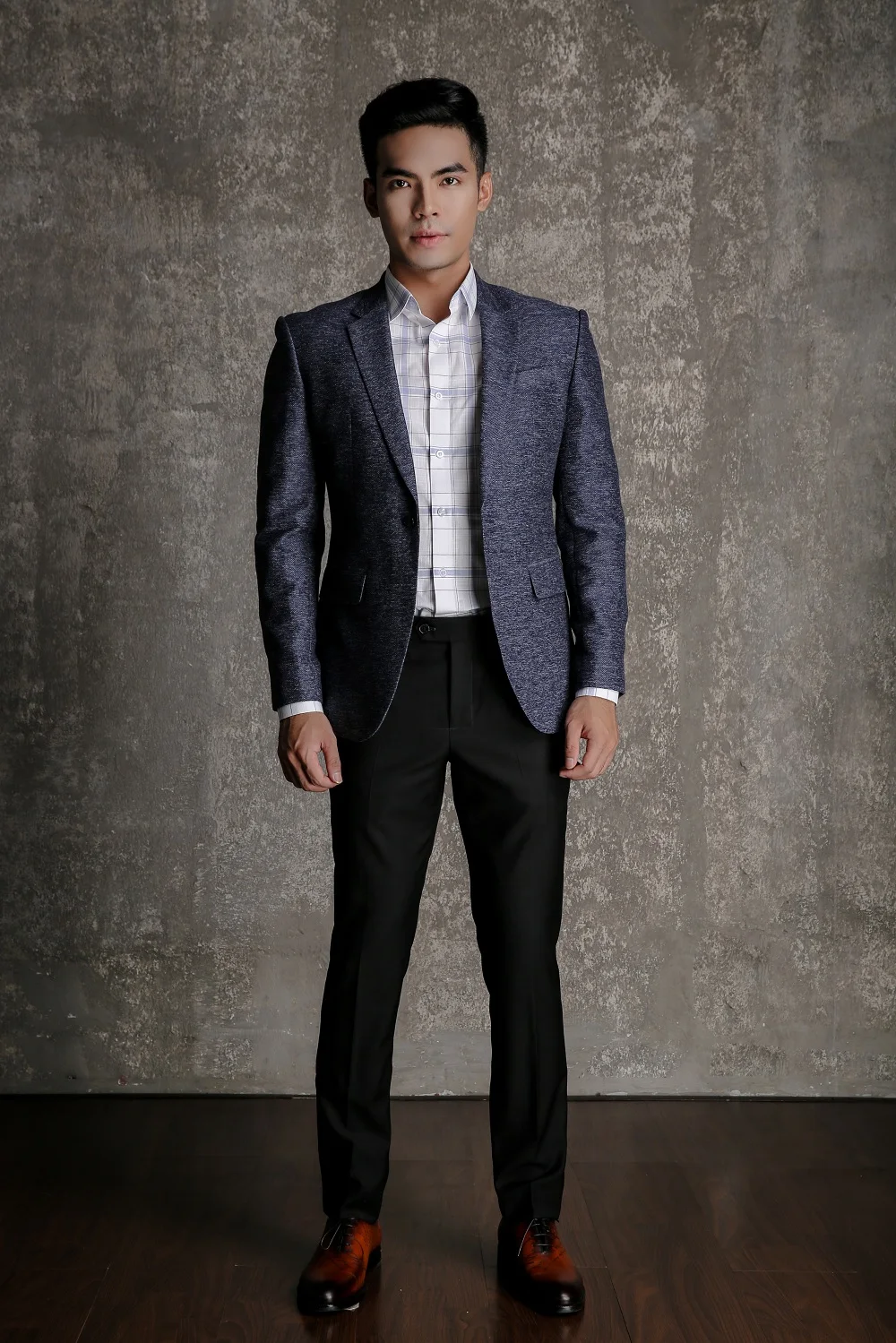
Style SN-272: a navy single-button blazer, the kind of jacket worth having made first because it goes with many trousers.
Choose ready-to-wear when
- You pass all four of the tests above.
- You need to wear it today or tomorrow.
- It is a fashion blazer in a seasonal colour that you plan to wear for a year or two.
- You wear a blazer a few times a year and want to keep the budget low.
If you go this way, the cost of alterations should be counted into the price of the jacket. Mon Amie's price list for alterations to garments bought elsewhere: adjusting the body, sleeves or shoulders VND 300,000; resizing a jacket VND 800,000. For the shoulders in particular, the VND 300,000 covers a small adjustment; it does not turn a jacket that is wide at the shoulders into one that fits.
Choose made-to-measure when
- You fall into one of the six builds above.
- You wear a blazer three or more days a week.
- You need a colour, cloth or weight that isn't on the rack, for example a thin, breathable cloth for sunny weather.
- You have bought off the rack several times and each time needed alterations in many places, and the price of the jacket plus the alterations has come close to the price of having one made.
The article on how a made-to-measure suit differs from a ready-made one in 6 points shows the differences you can see when wearing one, if you want to understand it in more depth.
The tailor's advice: try off the rack first; if the shoulders are wrong, have one made
Mon Amie suggests trying the ready-made jacket first. If the shoulders fit and only the sleeves or waist are off, buy it and have it altered. If the shoulders are wrong, or you fall into one of the six builds above, made-to-measure is better value than any amount of alteration.
For your first made-to-measure blazer, choose navy or grey, and choose the cloth grade by the number of days you will wear it. Separate Kevinlli jackets, excluding 8% VAT:
| You wear the blazer | Suggested cloth grade | Kevinlli separate jacket price |
|---|---|---|
| A few times a year, for occasions | 40–50% wool | VND 3.6 – 4.95 million |
| Work, 1–2 days a week | 50–60% wool | VND 4.35 – 5.6 million |
| 3 or more days a week | 60–70% wool | VND 5.6 – 6.35 million |
The final figure is confirmed by the stylist after measuring and choosing the cloth. Other cloth ranges are on the price list and the cloth library.
Frequently asked questions
How does a blazer differ from the jacket of a suit?
A blazer is a jacket worn on its own, usually with a textured cloth, buttons in a different colour or metal, and worn with trousers in a different colour. The jacket of a suit standing alone often looks as if it is missing its trousers, because its smooth plain cloth was made to go with trousers of the same cloth.
Is buying a ready-made blazer online all right?
Only if you already know your size at that particular brand. If not, take the jacket that fits best at the shoulders from your wardrobe, measure across the shoulders and the length, and compare with the seller's size chart. If the shoulders are off by more than about 1 cm, skip it, because that is the hardest place to alter.
I'm losing weight. Should I buy off the rack or have one made?
If your weight is changing fast, make few pieces or wait until it settles before having anything made. In the meantime, a ready-made blazer that fits at the shoulders is a reasonable stopgap.
Does an expensive ready-made blazer fit better than a cheap one?
A higher price usually buys better cloth and stitching, but the pattern still follows the standard size. If your shoulders don't match the standard size, an expensive jacket will be off in exactly the same place as a cheap one.
Shoulders decide first, price comes after
Try the ready-made jacket and look at the shoulder seam: if it fits, buy it and alter it; if it is wrong, have one made. If you want a stylist to look at which group your build belongs to before you decide, book an appointment at a showroom, and wear the blazer you use most so the stylist can see it.