
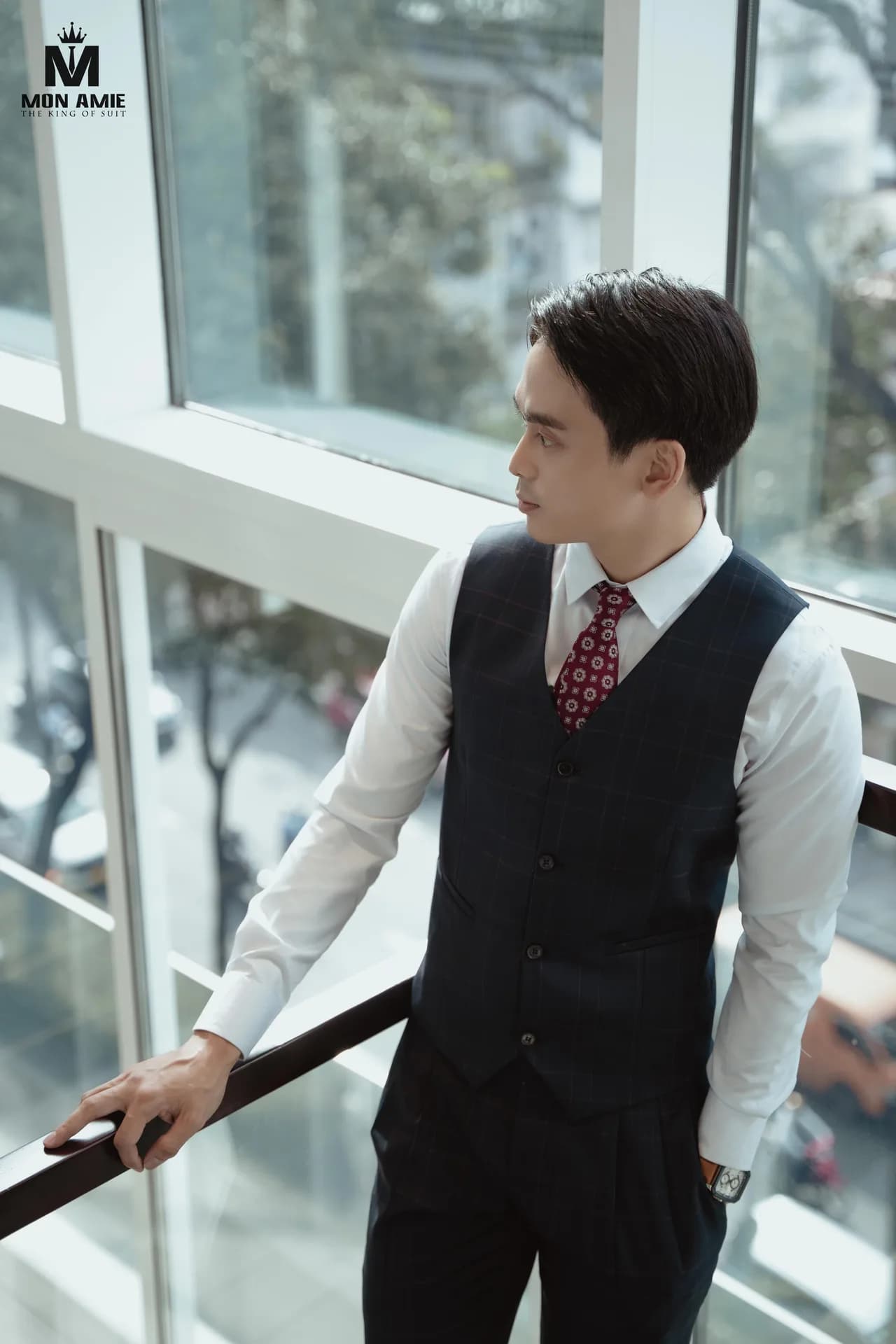
Turn the waistcoat over and look at the inside. Most of us look only at the front: is the colour nice, are the buttons bright? But a master tailor does the opposite, because the back and the inside tell the truth about a waistcoat. A waistcoat hugs the torso with no jacket to shield it, so every flaw in cutting and sewing shows. That is why, to tell a luxury men's waistcoat from an ordinary one, you only need to know the seven details below.
The short answer
A luxury men's waistcoat differs from an ordinary one in seven details: a sturdy, flat cinch strap; a soft back lining in a matching tone; sharp welt pockets with firm bar tacks; a balanced point; securely shanked buttons; a flat chest interfacing that does not bubble; and a moderately high, neatly bound armhole. Check by turning it to the inside, feeling it, pulling gently and sitting down.
Why is the waistcoat the garment that reveals quality most readily?
A waistcoat hugs the torso, with no spare cloth to hide the seams. As for the back, its inside shows the moment you take off your jacket. So a carelessly made waistcoat leaves traces everywhere: twisted binding, crooked buttons, X-shaped creases, wrinkled lining. That is also why two waistcoats of the same colour and price look alike at a glance but feel completely different once worn.
Seven details that set a luxury men's waistcoat apart
1. The cinch strap at the back
This is the waist adjuster at the back of the waistcoat (cinch back), usually with a metal buckle. A luxury waistcoat has a strap that is flat, of moderate width, with a buckle that slides smoothly, and a seam joining it to the lining that is firm and matches the lining cloth. An ordinary waistcoat uses a thin strap of elastic or plastic, the buckle sticks and the strap twists easily. A firm strap lets you adjust the waistcoat when your weight changes without it losing its shape.
2. The back lining
The lining of a good waistcoat's back uses a soft lining cloth such as satin or cupro, with a gentle sheen, in the same tone as the suit, with flat, even seams. An ordinary waistcoat uses a thin lining, harsh in sheen, wrinkled, with frayed edges. If you plan to wear the waistcoat on its own, consider a back in the same cloth as the front, exactly as analysed in men's office waistcoats.
3. Welt pockets
The welt pockets of a luxury waistcoat are sharp, straight cuts with firm bar tacks (reinforcing stitching, rectangular or horizontal) at both ends, and the mouth of the pocket lies flat without gaping. A waistcoat with two pockets may also carry a small watch pocket above. An ordinary waistcoat often uses fake pockets (stitched outlines), patch pockets, or pocket mouths that are crooked and split after a few uses.
4. The point
The point is the pointed tip at the bottom centre. A luxury waistcoat has a point that is balanced, with a smooth curve and symmetrical on both sides, with the edge lying flat and not curling up. An ordinary waistcoat has a lopsided point or a cut-off bottom and curling edges, which make the waistcoat look short and less refined.
5. Buttons and buttonholes
The buttons of a luxury waistcoat are usually horn, metal or cloth-covered, with a pleasing weight, even and in a straight line, with a shank high enough for the button to sit comfortably on the cloth rather than pulling it tight. The buttonholes are neat, closely stitched and do not come undone. Thin plastic buttons and stamped buttonholes with loose thread are signs of an ordinary waistcoat.
6. Chest interfacing
A luxury waistcoat has a soft, springy chest interfacing, which keeps the front flat, without bubbling, and holds its shape all day. Squeeze the chest area lightly: if you feel a separate soft layer of padding, it is good interfacing. Look from the side under light: if the cloth ripples or puffs out, that is poor fusible interfacing. An ordinary waistcoat is thinly fused and, after a few wears, creases and bunches at the lapel or neckline.
7. Armhole and binding
The armhole of a luxury waistcoat is cut moderately high and close, letting the arm move without pulling the whole waistcoat up. The binding at the neckline and armhole is neat, the binding cloth does not roll, and no loose thread shows. An armhole that is too low exposes the side and the shirt, while twisted binding shows hurried sewing.
| Detail | Luxury waistcoat | Ordinary waistcoat |
|---|---|---|
| Cinch strap | Flat, buckle slides smoothly | Thin, sticks, twists easily |
| Back lining | Soft satin or cupro, same tone | Thin lining, harsh sheen, wrinkles |
| Welt pockets | Sharp, straight, firm bar tacks | Fake, patch or crooked pockets |
| Point | Balanced, symmetrical | Lopsided, cut off, curling edge |
| Buttons | Firm, weighty, shanked | Thin plastic, loose thread |
| Chest interfacing | Flat, springy | Puffy, creased |
| Armhole | Moderately high, neat binding | Low, twisted binding |
Checking for yourself before you buy or order
You don't need to be a tailor to check; you only need six steps:
- Turn it to the inside, and look at the back lining, the seams and the cinch strap.
- Pull the seams gently at the back and armholes; if they give slightly, the sewing is poor.
- Feel the cloth: good wool is soft, springy and recovers its shape quickly when squeezed lightly.
- Fasten every button in front of the mirror, stand straight and look for an X-shaped crease or a front that rides up.
- Sit down and raise your arms to check the armholes and the fit.
- Look from the side under light to spot a puffy chest interfacing or rippled cloth.
Fabric and cut: the two remaining deciders
The seven details above belong to “how it is made”. “What it is made of” is the cloth. A luxury waistcoat usually uses wool or a wool blend with an even surface, not falsely shiny, with good springiness. When made to measure, a waistcoat cut from the same bolt as the suit will match in tone completely, which a separately bought waistcoat struggles to achieve. You can look at cloth samples in the fabric library and compare ranges in the price list to choose the right level.
The cut matters too: see men's waistcoat styles: 10 cuts to choose a style that suits your figure, and men's waistcoat sizes to measure the waist correctly.
Tips from Mon Amie's master tailors
- A fit at the waist matters more than any other detail. However good the waistcoat, if it is loose at the waist or tight over the belly, it is spoiled. Put the measurements first.
- Make it with the suit, from the same bolt of cloth. That keeps the colour tone uniform, even when you wear the waistcoat on its own.
- Say clearly how you intend to wear it. If you plan to wear it on its own, ask for a back in the same cloth; if you wear it under a jacket, a soft back lining is enough.
- Trust your hands. Feeling, pulling and squeezing is the quickest way to tell a good waistcoat from a careless one, better than any label.
- To learn about cost and process, read the price of a made-to-measure men's waistcoat and how a men's waistcoat is made.
At Mon Amie, the bespoke made-to-measure service takes more than 30 measurements, includes a baste fitting and adjusts until the fit is right. That is the foundation for a luxury waistcoat that truly fits its wearer.
Frequently asked questions
How does a men's waistcoat differ from a suit jacket?
A waistcoat has no sleeves and its collar usually has no lapels (or small ones); it is worn under a suit jacket or on its own. A suit jacket is an outer garment with sleeves and large lapels. Together, the two from the same suit make a three-piece suit.
What is a men's waistcoat and trousers set?
It is the general term for a waistcoat and trousers in the same cloth, which can be worn without a jacket. Because they share fabric and tone, they look like a complete set when worn.
What is a men's waistcoat lining?
“Lining” is the inner layer of the waistcoat, usually at the back. A good lining uses a soft cloth such as satin or cupro, in a matching tone, with flat seams. A poor lining is thin, harsh in sheen and wrinkles easily.
Should you buy a ready-to-wear or made-to-measure waistcoat?
Ready-to-wear is convenient and quick, but hard to fit at the waist and in length. Made-to-measure fits your figure, uses the same cloth as the suit and lets you choose each detail such as the lining, buttons and strap. If you have an unusual figure or want a truly luxurious waistcoat, made-to-measure is the option to consider.
Closing thoughts
Telling a luxury waistcoat apart needs no special sense, only knowing which seven details to look at and daring to turn the inside out. When you would like to hold each of those details in your hands on a real waistcoat, we invite you to book an appointment and visit a showroom, where a master tailor will point out every seam.