

Frequent presenters face a particular problem: the suit is not judged at handshake distance but from the back row, through a projector wash, and on camera. The usual suit-buying criteria need adjusting.
The short answer
A presenter's suit should meet three criteria: a color that contrasts well with the stage backdrop (deep navy and charcoal are safest — avoid pure black under strong lights), a fit with room at the shoulders and armholes so you can gesture and hold a microphone naturally, and wrinkle-resistant cloth — because you usually sit waiting for quite a while before going on. Only then think about accents like the tie or pocket square.
The suit as seen from the back row
At 10–20 meters, the audience cannot see stitching or fabric quality — they see blocks of color and silhouette. So:
- A clear color block. Deep navy or charcoal forms a crisp silhouette against most backdrops. Avoid colors too close to the backdrop itself (deep navy in front of a dark blue screen simply melts into it).
- Contrast within the outfit. A white or light blue shirt against a dark suit draws clean lines at distance — which is why navy with a white shirt endures on every stage.
- Beware fine patterns. Tight checks or fine stripes can shimmer (moiré) on camera — if the talk is being filmed, plain cloth or a subtle texture is the wise choice.

The fit must keep up with your body language
Presenting is movement: gesturing, turning to point at slides, walking the stage. When trying a suit, perform exactly those motions in front of the mirror. Three checks:
- Raise both arms to shoulder height — if the whole jacket body lifts with them, the armholes are too low or too tight.
- Button up and walk — if the button pulls into an X-shaped crease, the jacket is too tight, and it is very visible from a distance.
- Stand side-on to the mirror — jacket length and shoulder line define your silhouette from the audience's angle.
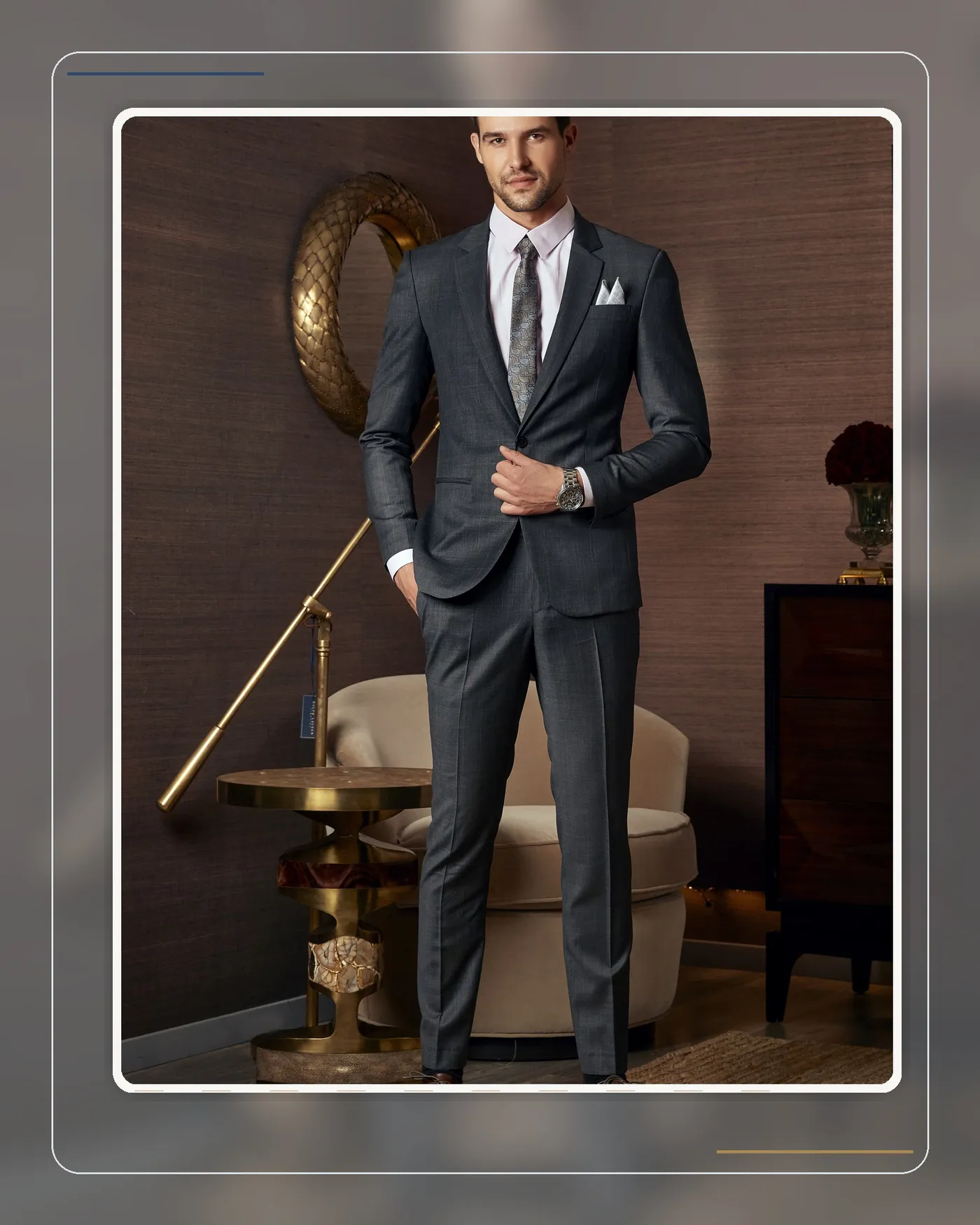
Common mistakes
- Choosing a suit that is too fashionable and too tight: fine for standing still in photos, restrictive when gesturing — and the audience senses the stiffness instantly.
- Wearing pure black under stage lights — black swallows detail and reads flat and heavy on recorded footage.
- Skipping a check under lights and on camera before a major event — colors and fabrics can look completely different on screen.
A word from Mon Amie's artisans
For clients who spend time on stage, Mon Amie eases the armholes slightly and builds a softer shoulder so the arms swing freely without the jacket shifting. We favor wool twill or hopsack with good recovery — sit in the front row for an hour, stand up, and the jacket is still smooth. We also suggest keeping two dedicated "stage" suits: with a busy speaking calendar, you never have to wear an unpressed suit to the most-watched spot in the room.

Frequently asked questions
What is the safest suit color for presenting? Deep navy: it holds a crisp silhouette against most backdrops, films well, and flatters every skin tone; charcoal is a strong alternative.
Should you wear a three-piece suit when presenting? Yes, for formal events — the waistcoat keeps you sharp if you remove the jacket under hot lights; for casual seminars a two-piece is enough.
How do you keep a suit unwrinkled while waiting to go on? Choose wool with good recovery, hang the jacket during long waits, and only button up right before stepping on stage.
Conclusion
A presenter's suit has to look right at three distances: the back row, the camera lens, and the handshake afterwards. Strong contrast, a fit that keeps up with your gestures, cloth that holds its shape — those three beat any fashion detail.
If you would like a stage-ready suit cut to your own body language, book an appointment with Mon Amie or read about the tailoring process.