
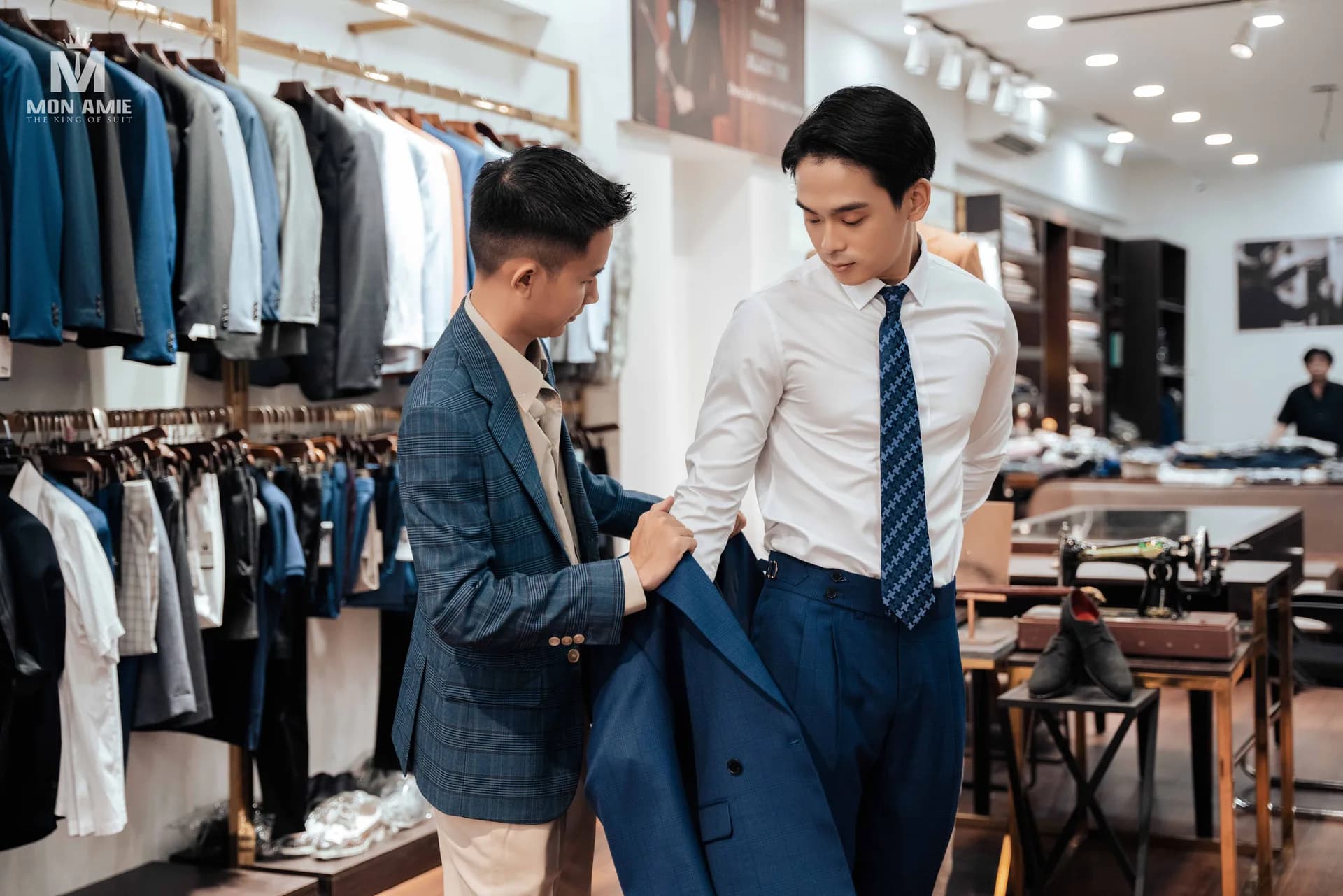
Stand in front of a mirror, button your jacket, let your arms hang, then look straight ahead. In just 30 seconds you can answer the question of how a suit should fit without a tailor standing beside you. This article is the 10-point set of questions that Mon Amie's master tailors use when customers try on a jacket, rewritten so you can check at home or right in the store.
The short answer
A suit fits when the shoulder seam sits at the tip of your shoulder bone, the collar hugs the shirt collar, buttoning shows no X-shaped crease, the front panels lie flat, the sleeves end at the wrist and the trouser hem touches the shoe with one light break. The shoulders are the one thing that cannot be altered, so check them first.
How should a suit fit: 10 points to check in the mirror
Put on an ordinary shirt and the shoes you will actually wear, then go through these 10 points in turn.
1. Shoulder line
The shoulder seam must sit exactly at the tip of the shoulder bone. If it sticks out past the bone, the jacket droops off the shoulder; if it falls inside, the jacket pulls tight and wrinkles around the armpit. This is the most important point, because the shoulder is tied to the collar and the lapel, and altering the shoulder means almost rebuilding the whole jacket.
2. Jacket collar
The jacket collar must sit snug against the shirt collar and not stand away at the back of the neck. If there is a crescent-shaped gap, the jacket is loose in the shoulders or the body of the jacket does not match your posture.
3. Chest and button
Fasten the top button (on a two-button jacket) and let your arms hang straight. If you see an X-shaped crease around the button, the jacket is tight across the chest. If the front bulges out like wings, the jacket is loose. You should be able to slide a flat palm between the jacket and your chest, and no more than that.
4. Waist and front panels
The two front panels should close flat, neither flaring out to the sides nor overlapping. A jacket that fits at the waist follows the body gently, but does not turn into a vase shape pinched in the middle.
5. Back of the jacket
Look sideways in the mirror. A horizontal crease across the back means the jacket is tight across the shoulders or back. Vertical folds hanging down from the collar mean the jacket is loose. A good jacket back is flat, follows the spine and has no wrinkles.
6. Jacket length
The hem should cover the seat, ending around the knuckle of your thumb when you let your arms hang down. A jacket that is too short makes the legs look short, and one that is too long makes you look shorter.
7. Sleeves and shirt cuffs
The jacket sleeve should stop at the wrist bone, showing about 1 to 1.5 cm of the shirt cuff. Covering the shirt entirely or swallowing half the hand are both signs that the sleeve is too long. This can be altered, but it takes a tailor.
8. Trousers: waist, seat, crotch
Trousers fit when you can fasten the button without sucking in your stomach, you can slide a finger into the waistband and still find room, and the seat does not pull in horizontal creases. The crotch should neither hang too low nor be pulled tight.
9. Trouser hem and shoes
The hem touches the top of the shoe and forms one light fold at the front (called a half break), or just touches the shoe with no fold (no break) for a clean look. Trousers piling up in many folds are too long; trousers that show the socks are too short.
10. Movement
Finally, move: raise your arms to shoulder height, sit down, shake hands, hug a friend, turn as if you were driving. A suit that fits lets you do all of that without tugging at the collar or popping a button.

What can be altered, what cannot
Telling these two groups apart helps you choose the right jacket and not waste money on alterations.
| Check point | Alterable? | Note |
|---|---|---|
| Shoulders | Almost never | Choose the jacket by the shoulders first |
| Jacket collar | Limited | Depends on the shoulders and back |
| Chest | Limited | Can be let out only very slightly |
| Waist | Yes | Taken in or let out by a few cm |
| Sleeve length | Yes | Altered at the cuff edge |
| Jacket length | Limited | Mostly shortening |
| Trouser hem | Yes | The easiest; measure while wearing shoes |
| Trouser waist | Yes | Taken in or let out within limits |
A quick rule to remember: shoulders, chest and collar must be right from the start; waist, sleeves and hem can be adjusted later. A jacket that fits at the shoulders but is a little loose around the stomach can be fixed by a tailor in minutes. A jacket that fits the stomach but is wrong at the shoulders cannot be rescued by anyone.
How to check at home in 5 minutes
You need nothing except a full-length mirror and a phone. Put on the suit with the shirt and shoes you will wear, then follow this order:
- Stand straight, facing forward, and compare against points 1 to 4: shoulders, collar, chest, waist.
- Turn sideways, then turn your back. Ask someone close to take a photo of your back, or use a second mirror. The back of the jacket is the place we rarely see but other people see first.
- Walk a few steps, sit down, stand up. Point 10 only shows itself when the body moves.
- Take a full-length photo. A photo is flatter than a mirror and gives you an objective view, especially of the jacket length and the trouser hem.
If how a suit should fit is still a question mark after those four steps, do not hesitate to bring the jacket to a tailor. In just a few minutes they will point out what can be altered and what should be swapped.
Wearing a suit correctly: a few details often forgotten
- Buttoning. On a two-button jacket, fasten only the top button and leave the bottom one open. On a one-button jacket, fasten that button. When seated, unbutton so the jacket does not crease.
- Pockets. Do not stuff your phone or wallet into the jacket pockets. Full pockets make the front bulge and lose the waistline.
- Shirt. The shirt collar should show about 1 cm above the jacket collar. A shirt that is too loose makes the jacket collar warp.
- Shoe and belt colour. Matching tones for the two is the basic rule.
If you are choosing a size before buying, the chart in the article men's suit size chart by height and weight is a good starting point; then come back to the 10 points above to settle it.
Tips from Mon Amie's master tailors
A master tailor has one habit: look at the shoulders first, and the hem last. The reason is simple: the shoulder is the only place that is hard to fix, while the trouser hem is the easiest. When a customer hesitates between two jackets, we always advise choosing the one with the right shoulders, even if the stomach is a little loose. Only when the shoulders are settled do we discuss the remaining details.
The next point is not to try on a jacket in a hurry. A jacket that looks right the first time you stand in it may reveal problems after you sit, raise your arms or walk a few steps. Take 5 minutes to move in front of the mirror. You should also try it on with exactly the kind of shirt and shoes you will wear, because the thickness of the shirt changes both the collar and the sleeves.
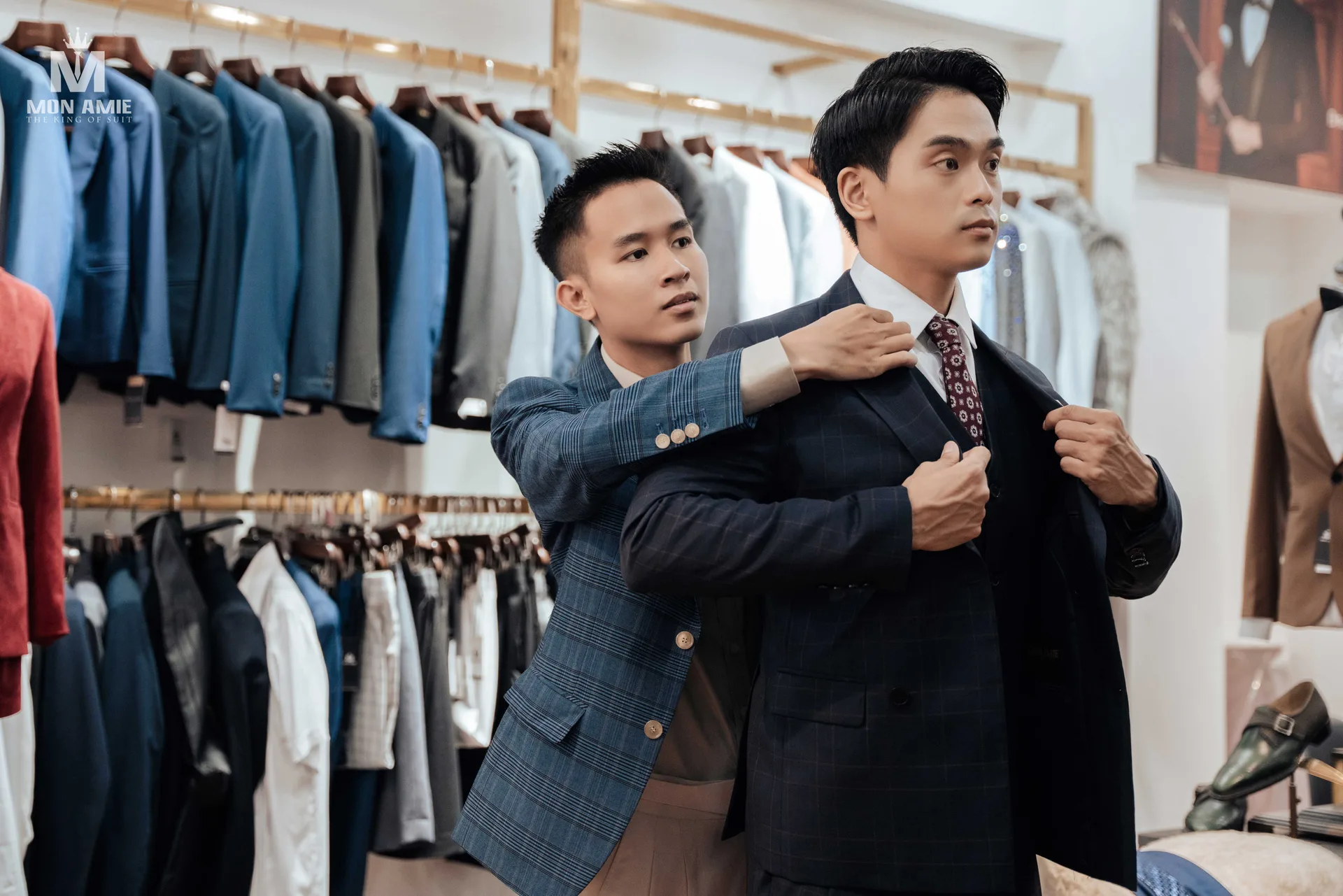
Frequently asked questions
How should a suit fit for someone wearing one for the first time?
A beginner should start from the three points that are easiest to recognise: the shoulder seam sits exactly at the tip of the shoulder bone, buttoning shows no X-shaped crease, and the sleeves stop at the wrist. If those three pass, a tailor can adjust the rest.
What does a standard suit fit mean?
A standard fit means the jacket sits right at the shoulders, hugs the collar, buttons without creasing, the sleeves stop at the wrist and the trouser hem touches the shoe with one light break. In short, the suit does not pull, does not sag and does not cover up what you mean to show off.
How should a suit fit for a man with a larger stomach?
Choose the jacket by the shoulders and chest, and let the tailor let out the waist if needed. A jacket that fits the shoulders and whose front lies flat when buttoned is enough. Avoid a jacket that is too tight in an attempt to hide the stomach, because the tension creases around the button will make the stomach stand out more.
What is the difference between wearing the right size and wearing a suit that fits?
The right size is the size on the label. A suit that fits is right for your own body: shoulders, back, waist. Two people in the same size 50 may still need two different jacket cuts, which is why made-to-measure gives a better fit.
Do you need to try on a suit with shoes?
Yes, especially for trousers. The hem length must be set while you are wearing the exact shoes you plan to wear. Thick or thin soles can shift the hem by a whole centimetre.
An invitation from Mon Amie
If you want a suit that passes all 10 points from the start, the Bespoke made-to-measure service takes more than 30 measurements and carries out baste fittings until the fit is right. You can view the made-to-measure process or book a measurement appointment to be checked in person. To learn what a good suit looks like on the inside, read the article how to recognise a premium men's suit through 10 tailoring details.