
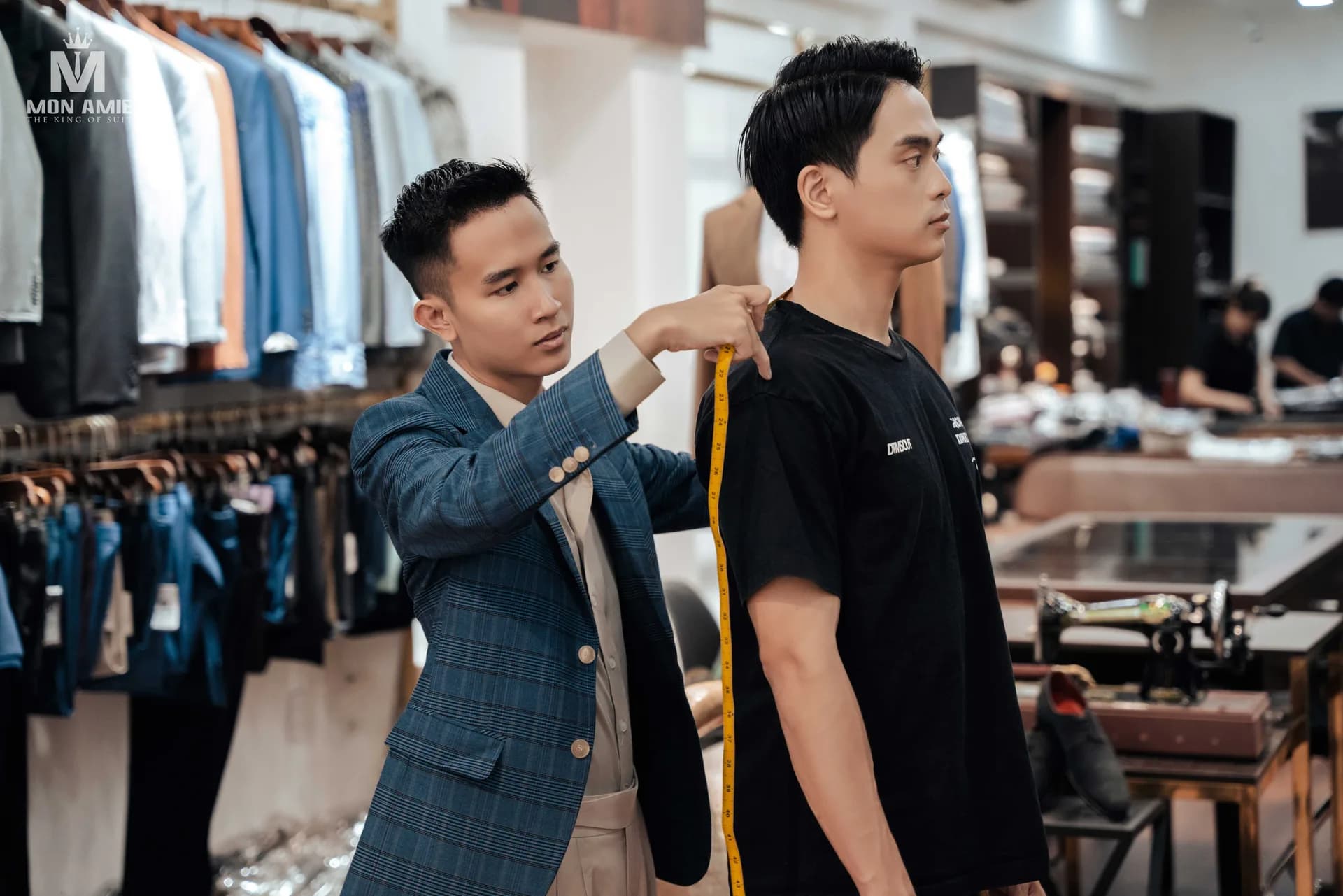
About 1.70 m tall and 68 kg: what suit size do you take? It is one of the first questions customers ask us when they walk into a showroom. Look it up in the men's suit size chart below and you will land on size 50 (L). But if you stop there, you may take home a jacket that fits at the belly yet falls short at the shoulders, because height and weight are only guesswork. What truly decides the size is the chest and the shoulders.
Quick answer
Suit size is decided by chest circumference and shoulder width; height and weight only give a rough estimate. A man 1.65–1.75 m tall and 60–72 kg usually wears size 48–50 (M–L). To be sure, measure your chest and halve it to get the size number, then try the jacket on and let the shoulders be the referee.
Men's suit size chart by height and weight
Suits in Vietnam are usually labelled in two systems: letter sizes (S, M, L, XL) and European number sizes (46, 48, 50, 52…). There is a very easy rule of thumb: the European size number equals half the chest circumference in cm. Size 48 means a chest of about 96 cm; size 50 is about 100 cm.
| Letter size | Number size (EU) | Chest | Reference height | Reference weight |
|---|---|---|---|---|
| XS | 44 | 88 cm | 1.55 – 1.62 m | 48 – 54 kg |
| S | 46 | 92 cm | 1.60 – 1.66 m | 54 – 60 kg |
| M | 48 | 96 cm | 1.64 – 1.70 m | 60 – 66 kg |
| L | 50 | 100 cm | 1.68 – 1.74 m | 66 – 73 kg |
| XL | 52 | 104 cm | 1.71 – 1.77 m | 72 – 80 kg |
| XXL | 54 | 108 cm | 1.74 – 1.80 m | 79 – 87 kg |
| 3XL | 56 | 112 cm | 1.76 – 1.83 m | 86 – 95 kg |
This is a commonly used reference chart for ready-to-wear suits, calculated for a balanced build; it is not a final measurement. You will notice that the ranges overlap: a man 1.70 m tall and 66 kg sits exactly on the border between sizes 48 and 50. At that border, don't guess; pick up the tape measure.
Trousers follow a different logic: by waist, not by jacket size. One inch is 2.54 cm, so the quick conversion chart is as follows.
| Waist (cm) | 74 | 76 | 79 | 81 | 84 | 86 | 91 |
|---|---|---|---|---|---|---|---|
| Trouser size (inch) | 29 | 30 | 31 | 32 | 33 | 34 | 36 |
How to find your suit size correctly in 4 steps
- Measure your chest. Wrap the tape around the fullest part of your chest, under the armpits, with the tape lying flat across the back. Wear a thin shirt, breathe normally, and don't pull the tape tight. Halve the measurement to get the European number size.
- Measure your shoulders. Measure from one shoulder tip to the other, passing over the nape of the neck at the back. Ask someone else to measure for you, because measuring yourself is almost always off.
- Measure your sleeve length. From the shoulder tip down to the wrist, with your arm hanging straight. The jacket sleeve ends at the wrist bone, showing about 1 to 1.5 cm of shirt cuff.
- Measure your waist and hips to choose trousers. Take the jacket size from the chest and the trouser size from the waist. It is perfectly normal for these two sizes to differ.
If your chest and your height point to two different sizes, go by the chest. Height only tells you whether the jacket should be a little longer or a little shorter.

Why shoulders decide suit size
In a suit jacket, almost everything can be adjusted: the waist taken in, the sleeves shortened, the trouser hems raised. The shoulders cannot. The shoulder is bound up with the shoulder pad, the collar and the lapel; altering the shoulder means taking apart nearly half the jacket, which is laborious and rarely returns to the original shape.
When trying a jacket on, check three signs:
- The shoulder seam sits exactly at the tip of the shoulder bone. If it sticks out, the jacket droops at the shoulder; if it falls inside, the jacket pulls tight and wrinkles around the armpit.
- Fasten one button and let your arms hang naturally: the front panels should lie flat. An X-shaped crease around the button is a sign of a tight chest.
- The jacket collar hugs the shirt collar, without gaping away at the back of the neck.
A jacket that fits at the shoulders but is a little loose at the belly can be adjusted by the tailor in a few minutes. A jacket that fits the belly but is wrong at the shoulders cannot be saved by anyone.
Three typical Vietnamese body types: how to find your size?
The three examples below are common illustrative situations, not specific customers.
Build 1: 1.65 m, 56 kg, small shoulders. The chart gives size 46 (S). Shorter men with small shoulders very often choose size 48 “for comfort”, and the result is a shoulder line that drops onto the upper arm and sleeves that swallow half the hand. Stay with size 46 and choose a jacket length that just covers the seat, no longer.
Build 2: 1.72 m, 78 kg, a protruding belly. Height and weight both point to size 52 (XL), but if your actual chest is only 98 cm, the shoulders of a size 52 will be too much. This is the hardest build to fit in a ready-to-wear suit, because a ready-made suit has a preset difference between chest and waist (called the drop), and a man with a belly struggles to fit both. How to handle it: choose by the shoulders and ask the tailor to let out the waist, or go made-to-measure so the pattern is cut specifically for the belly.
Build 3: 1.78 m, 70 kg, broad shoulders, tall and lean. Height suggests size 54 to 56, while weight suggests size 50. The two signals contradict each other, so you have to measure: a 98 cm chest gives size 49, which means choosing 50, and you should take the long cut so the jacket covers your height properly. Many brands offer short, regular and long cuts ready-made; ask clearly before trying on.
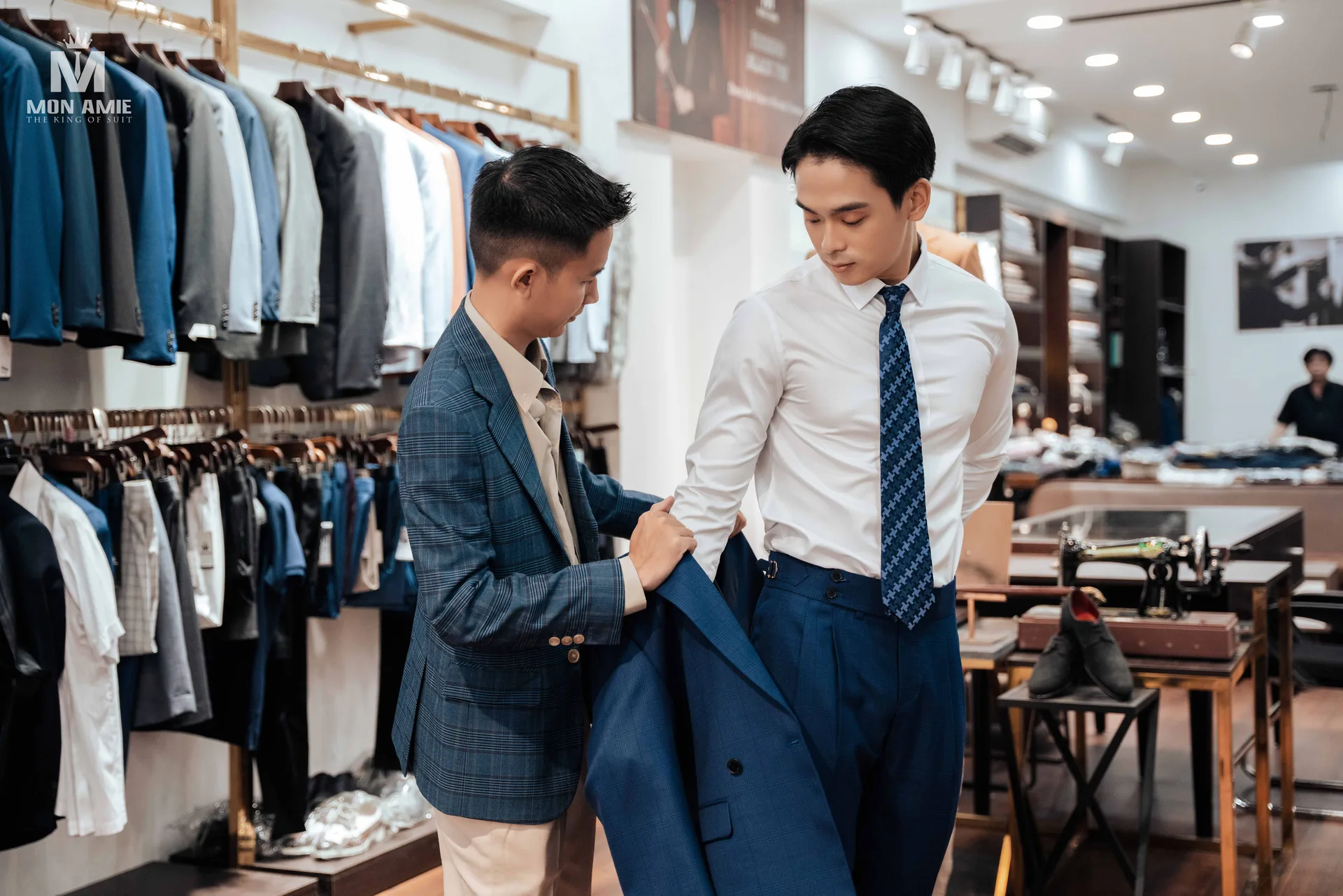
When the size chart is no longer enough: why many men choose made-to-measure
Every men's suit size chart has to sort people into a few groups. And no one is a group: the two shoulders usually differ slightly, some backs are straight and some are slightly rounded, and the belly and chest follow nobody's proportions. With made-to-measure, those details are recorded as numbers.
With the Bespoke tailoring service, the artisan takes more than 30 measurements and keeps them for life, so on your next order you do not need to be measured from scratch. If you live far away or your schedule is full, online made-to-measure lets you book a video call, with step-by-step guidance on measuring or using your saved measurements. And if you only need a quick purchase, the size chart above is still a good starting point.
Common mistakes when choosing suit size
- Going up a size for comfort. A baggy jacket makes the wearer look wider and less tidy. Roomy enough means being able to slide a flat hand between the jacket and the shirt once it is buttoned.
- Taking shirt or T-shirt size as the standard. Each is measured differently, so sizes cannot be copied across. To look up shirt size, see the article what weight is a men's size L shirt for.
- Measuring over thick clothing or pulling the tape tight. A chest measurement a few centimetres short is enough to throw off a whole size.
- Using old measurements. Gain or lose a few kilos and your waist and chest have already changed, so re-measure before ordering.
Tip from Mon Amie's master tailors: choose the jacket by the shoulders first, then ask the tailor to take in the waist and adjust the sleeves. This order is the reverse of how many people do it, but it is the only order you will never regret.
Frequently asked questions
What are suit sizes M and L in numbers?
By the chart above: S is 46, M is 48, L is 50, XL is 52 and XXL is 54. Each maker may differ by one size, so measuring the chest and halving it remains the surest method.
What suit size for 1.70 m and 70 kg?
The chart gives size 50 (L), meaning a chest of about 100 cm. If your actual chest measures only 96 to 97 cm, try size 48 as well and let the shoulders decide.
Are jacket size and trouser size the same?
No. The jacket follows the chest and shoulders; the trousers follow the waist and hips. A ready-to-wear suit pairs two sizes in advance, so men with a broad chest and small waist, or with a belly, often have to alter the trousers. A made-to-measure suit is cut from your own measurements, so it is not bound in that way.
Should I choose a suit one size bigger to be comfortable?
No. A suit that is too big makes the shoulders droop and the body of the jacket wrinkle, and it looks less professional. You only need enough room for a shirt underneath and for comfortable arm movement.
How should heavier or slimmer men read a suit size chart?
The method is the same: measure the chest, measure the shoulders, and choose by real measurements rather than weight. The difference lies in the cut and in the chest-to-waist drop; the article suits for heavier men: 8 principles for choosing the cut goes deeper into this.
Closing thoughts
A men's suit size chart gives you only a starting point; the tape measure and the mirror have the final say. If you would rather not guess, you can book a fitting at a showroom, or look at the made-to-measure price list first. Mon Amie's hotline and Zalo is 0888.111.118.