
“I'm already wearing an XL and the button over my belly is still about to pop.” Customers have said this to master tailors more than once. And they often go on: “But if I go up another size, the shoulders are too wide and the sleeves too long.” They are right, and that is the root of how a big man should wear a dress shirt: the problem isn't a missing size, it is that mass-produced shirts aren't cut for a body with small shoulders and a full belly.
The short answer
A big man should choose a dress shirt that fits rather than one that is loose: a straight or semi-fit cut, fabric of medium weight that holds its shape, plain colours or small vertical stripes, a collar that matches the neck, and a hem that falls past the middle of the seat. The most important thing is that the waist has enough room for the buttons not to pop, while the shoulders and collar remain snug.
Why the stomach button pops, and why buying a bigger size doesn't solve it
Ready-to-wear shirts are cut to average proportions: neck, shoulders, chest and belly come as one set. A man with a fuller belly often has different proportions: shoulders or neck at an M or L, but a waist already at XL or XXL. Buy to fit the belly and the shoulders are wide, the sleeves long and the collar loose. Buy to fit the shoulders and the belly strains, and the stomach button pulls into a diamond-shaped gap.
There is one cause people often forget: sitting. This doesn't happen only to you, but to anyone whose waist is fuller than their chest. When you sit, the belly gathers upward and bulges, so the button at the fullest point takes the most strain. That is why a shirt for a fuller figure has to be cut with both standing and sitting in mind.
The cut: fitted, not loose
The first rule: don't choose a baggy shirt to “hide” the belly. Extra cloth only makes the body of the shirt bigger and adds a heavy feeling. The cut to choose is:
- Straight or semi-fit: a straight body, or one lightly darted at the waist; not tight, not billowing.
- Snug shoulders: the shoulder seam sits exactly at the shoulder point. With the shoulders right, the whole shirt holds its shape, even if the belly is full.
- Sleeves that fit: not reaching the back of the hand, not tight around the arm.
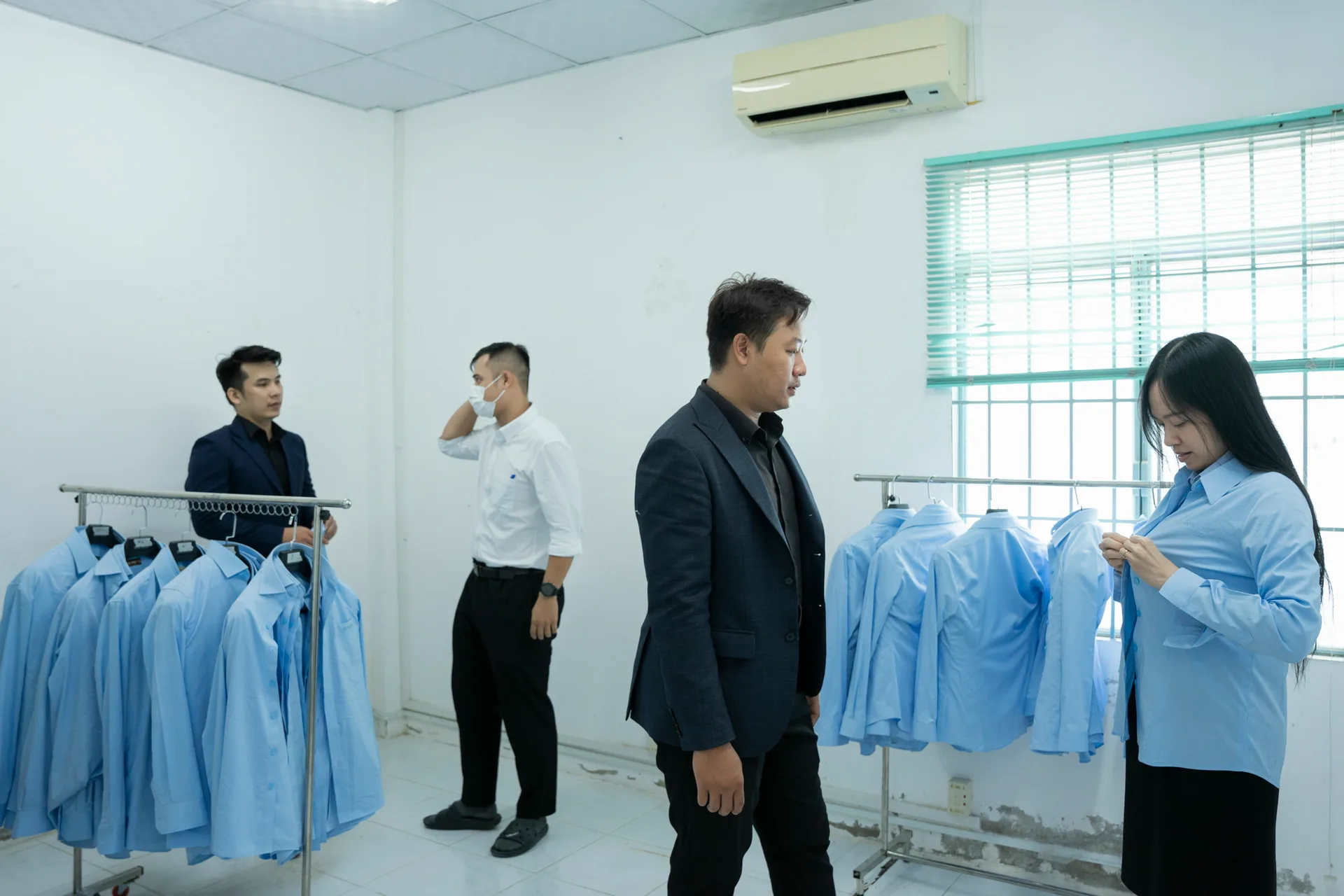
- A button at the right point on the belly: in made-to-measure, the tailor can place a button exactly at the fullest point of the belly to reduce gaping. This is a detail that ready-to-wear shirts struggle to offer.
The collar: a small detail that shapes the face
Bigger men often have a fuller neck, so a collar that is too tight chokes, while one that is too loose looks sloppy. A good collar fit lets one finger slip between the neck and the collar when it is fully buttoned.
- Choose: a semi-spread collar (a medium spread), or a classic collar with medium-length points. They draw the eye downward and make the neck area look more open.
- Avoid: a collar too high for a short neck, an oversized button-down collar, a small round collar.
Choose a moderate collar width of about 7–8 cm, which suits most men with a fuller build.
Fabric: medium weight, holds its shape, doesn't cling
Fabric decides whether the shirt “hugs” the belly or hangs straight:
- Choose: medium-weight cotton poplin, cotton twill, or blends with some body. They drape straight and don't follow the curves.
- Avoid: cloth that is too thin, shiny cloth, stretch cloth that clings. Thin fabric sticks to the belly, and shiny fabric reflects light and makes the torso look bigger.
For a white dress shirt for a big man, opaque fabric is a must. Thin white shows the edge of the undershirt and the folds of the belly. Master tailors often recommend ivory or light blue if pure white doesn't suit your skin.
Colour and pattern
| Choose | Avoid |
|---|---|
| Plain colours: opaque white, light blue, light grey, navy | Horizontal stripes, large checks |
| Small, fine vertical stripes | Large printed patterns, bold motifs |
| Dark tones on the body, light at the collar | Loud colours, neon |
| Small, dense patterns that blend into the background | Two contrasting colours cutting across the belly |
Small vertical stripes create a line that leads the eye from top to bottom, making the body look longer and slimmer. But vertical stripes should be fine and evenly spaced; wide stripes tend to curve around the belly.
Hem length and how to tuck in
This is the part many people skip.
- Untucked: the hem should reach about the middle of the seat, straight or only very slightly curved. A hem that is too short shows the belly when you bend, and one that is too long makes you look shorter.
- Tucked in: choose high-rise trousers, at the navel or slightly above, so the belly doesn't hang over the waistband. Use a medium-width belt with a neat buckle. You can add shirt stays so the tails don't pull out when you bend or sit.
- High-rise trousers with light pleats: they keep the whole line of the shirt tidy without it sliding down below the belly.
Common mistakes
- Wearing an oversized shirt to hide the belly. A baggy shirt makes you look bigger.
- Wearing a shirt that is too tight. Strained buttons pull into gaps, and you can see the undershirt.
- Choosing horizontal stripes or large checks. The curve of the belly distorts the pattern.
- Leaving the hem too short. Each time you bend or raise an arm, the hem rides up.
- A big chest pocket plus a pen and a phone. It strains the chest and makes the shirt look untidy.
Tips from Mon Amie's master tailors
When a client asks how a big man should wear a dress shirt for everyday work, the master tailor always measures the waist twice: once standing, once sitting. The difference between the two is exactly the amount of room to add so the buttons never have to “carry the load”. That is also why, for fuller figures, made-to-measure usually gives far better results than hunting for a large size. If you are thinking about a blazer once you have a shirt that fits, see men's blazers for bigger men.

Frequently asked questions
What style of men's dress shirt suits a man with a belly?
Choose a straight or semi-fit cut, fabric that holds its shape and a hem past the middle of the seat. Avoid shirts that are skin-tight and those that are too loose. If you can, go made-to-measure so the waist is accounted for separately while the shoulders and collar stay snug.
Where can bigger men buy dress shirts that fit?
Ready-to-wear large sizes tend to expand evenly in every direction, so the shoulders and sleeves are often off. Made-to-measure is the surest way, because the tailor cuts to each of your measurements. You can book a measuring appointment at a showroom or use the online made-to-measure service if you live far away.
Does a white dress shirt suit a big man?
Yes, if the cloth is opaque and the cut fits. Avoid thin, shiny white cloth, which shows the edge of the undershirt and the folds of the belly. Ivory or light blue is a gentler choice if pure white feels a little harsh.
Should a large-size dress shirt be tucked in or left out?
Both work. Tucking in is neat if you wear high-rise trousers and the tails are long enough not to pull out. Untucked suits you when the hem reaches the middle of the seat and the body of the shirt isn't too loose. What matters most is that the shirt fits at the shoulders.
In closing
How should a big man wear a dress shirt? The shortest answer is to wear the shirt cut for your actual body, rather than trying to hide your body. When the shoulders are snug, the collar fits and the belly has enough room, you will look neater without losing a single kilo. If you want a shirt made to your real build, Mon Amie's bespoke tailoring service takes more than 30 measurements and stores them for life, so next time you only need to choose the cloth.