
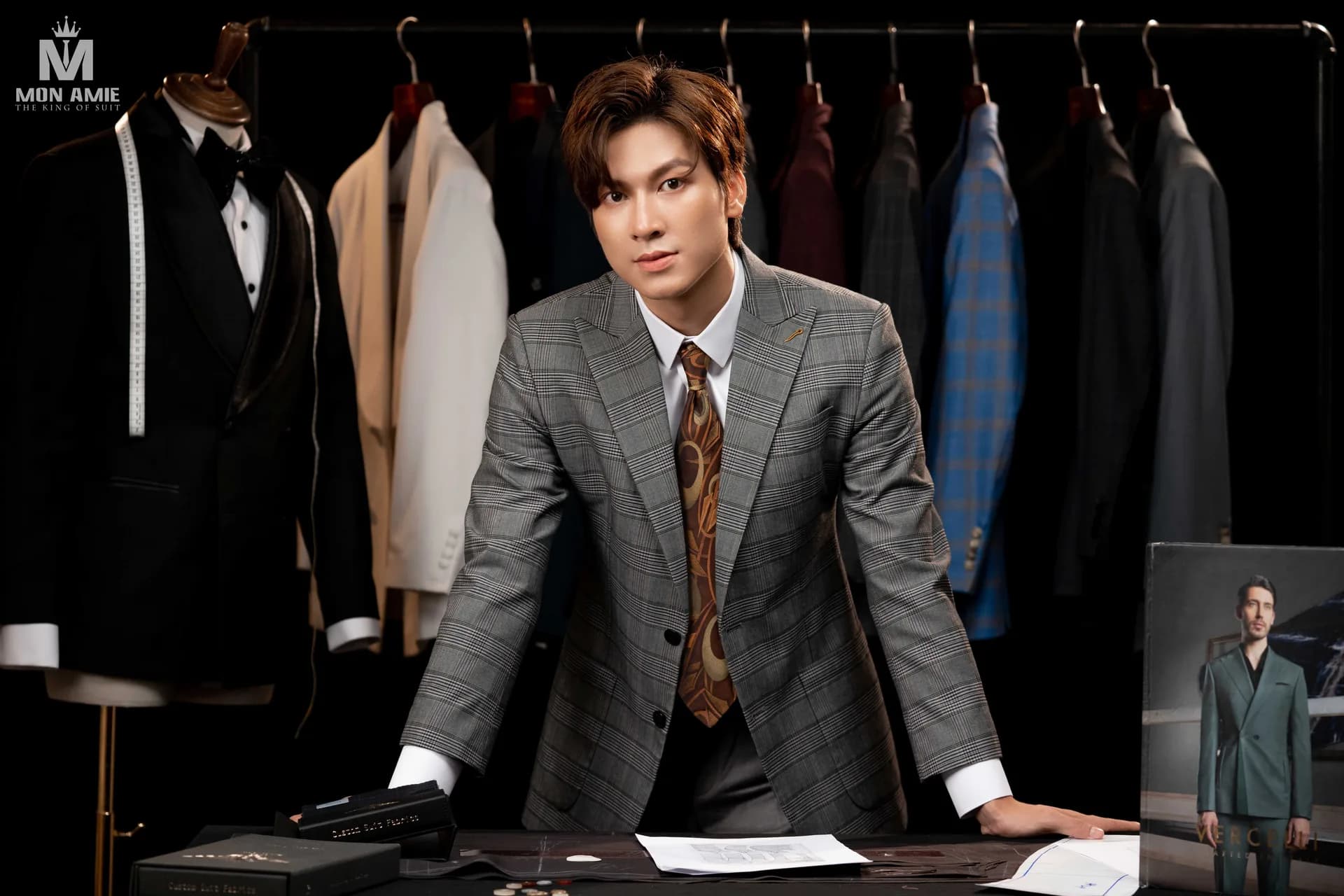
A master tailor needs about three seconds to look at a blazer on a heavier client and know where it will fail: right at the middle button. That spot takes the most strain, and when the jacket is not roomy enough at the belly, the cloth pulls into an X-shaped crease that is very hard to look at. So when you choose a men's blazer for big men, the first question is not "what colour?" but "does this jacket leave enough room for the middle button to breathe?"
Quick answer
Choose a blazer with perfectly fitting shoulders, single-breasted, with a skirt long enough to cover the seat, straight flap pockets, plain cloth that drapes evenly and a dark colour such as navy, charcoal or moss green. Avoid double-breasted, large checks and thick, stiff cloth. The middle button must fasten without pulling an X-crease: that is the most important test.
Why a blazer worn solo shows the belly more than a suit
On the same body, a suit usually looks trimmer than a separate blazer. There are three reasons:
- Matching trousers create an unbroken vertical line. A suit carries the eye from the shoulder to the trouser hem. A blazer worn with trousers in a different colour cuts the body across at the waist.
- A blazer is usually shorter and more lightly structured. A short skirt shows the belly and hips, and light construction lets the jacket follow the curves.
- The middle button takes concentrated strain. If the jacket lacks room at the belly, an X-crease appears immediately.
Once you understand this, you will see that the solution is not buying a bigger jacket but getting the small details underneath right.
Shoulders: choose them before anything else
The shoulder is the point from which the whole jacket hangs. When the shoulder line matches your own shoulder, the entire body of the jacket drapes correctly. A drooping shoulder makes the torso look larger; a tight shoulder pulls the jacket up and out of line. For a heavier build, a lightly padded shoulder balances the proportions between shoulders and belly and gives a more even silhouette, but do not pad too much, or it becomes a "square shoulder" that exaggerates the whole upper body.
If you have to choose between a jacket that fits the belly but is loose at the shoulders, or one that fits the shoulders but is slightly tight at the belly, choose the shoulders and ask the tailor to adjust the belly. Shoulders cannot be altered; the belly can be let out.
Length, number of buttons and vents
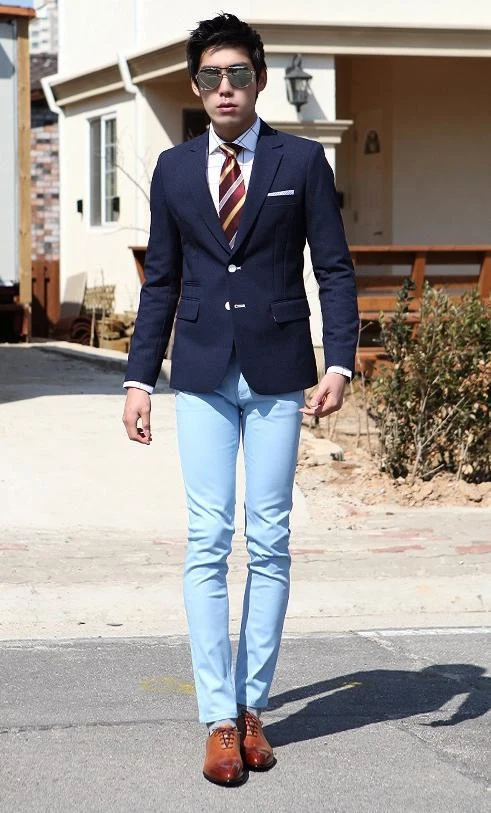
- Length: the skirt should cover the seat, reaching about your knuckle when you let your arms hang straight. A short blazer exposes the belly; one that is too long makes you look shorter.
- Number of buttons: single-breasted, two buttons or one. Double-breasted adds bulk across the chest and belly.
- Button position: a fastening button at or just above the natural waist draws the V longer, so the torso looks slimmer.
- Lapels: a medium-width notch lapel. Lapels that are too wide make the upper body fuller; lapels that are too narrow throw it off balance.
- Rear vents: two side vents are neater than a single centre vent, because a centre vent tends to flare open when the belly is full.
- Waist suppression: light, not tight. Too much suppression makes the jacket cling to the belly.
Pockets: fewer details, the cleaner the better
Pockets over the belly are the detail most likely to make a jacket look biggest. Choose:
- Straight flap pockets or jetted pockets. Flat and discreet, they add no bulk.
- Avoid large patch pockets, especially two big ones sitting right on the belly.
- Don't stuff the pockets. A phone or wallet makes the hips bulge further.
Cloth and colour: plain, drapey, dark
| Choose | Avoid |
|---|---|
| Plain wool or a fine small weave, evenly woven | Thick, stiff cloth that creates bulk |
| Soft-draping cloth that does not cling | Shiny cloth, stretch cloth that clings to the body |
| Navy, charcoal, deep moss green, chocolate brown | Large checks, horizontal stripes |
| Small, discreet patterns | Loud colours, large prints |
Dark colours absorb light, so the torso looks slimmer. But dark does not only mean black. Navy and charcoal are both easier to pair and more refined than solid black when a blazer is worn separately in the daytime.
Plus-size men's blazers: sizing and made-to-measure
For those searching online for a plus-size men's blazer jacket or a big-size blazer, the common problem is that large sizes grow evenly in every direction: one size up at the belly means one size up at the shoulders and sleeves too. The result is a jacket that fits the belly but is loose at the shoulders.
A practical tip is to choose by the shoulders first, then ask the tailor whether the belly can be let out. But the surest way is still made-to-measure, where shoulders, chest and belly are calculated separately. Mon Amie takes more than 30 measurements on the bespoke line, so the blazer fits the body far better than hunting for a larger size. For how to read a size chart, see the article on how to choose a men's blazer size.
How to style a men's blazer for big men for a slimmer look
- Dark blazer, pale shirt: creates a vertical V from the collar to the button.
- High-waisted trousers, in the same tone as the blazer or darker, keep the vertical line unbroken.
- A shirt that fits, not a loose one. You can read how heavier men should wear dress shirts to choose a shirt that works.
- Dark lace-up leather shoes or loafers, not shoes that are too white or too chunky.
- Skip the tie, or choose a tie in the same tone as the shirt, so the eye is not cut across the chest.
If you are still torn between a blazer and a full suit, remember a simple rule: for formal occasions choose a full suit, for relaxed occasions choose a blazer.
Common mistakes
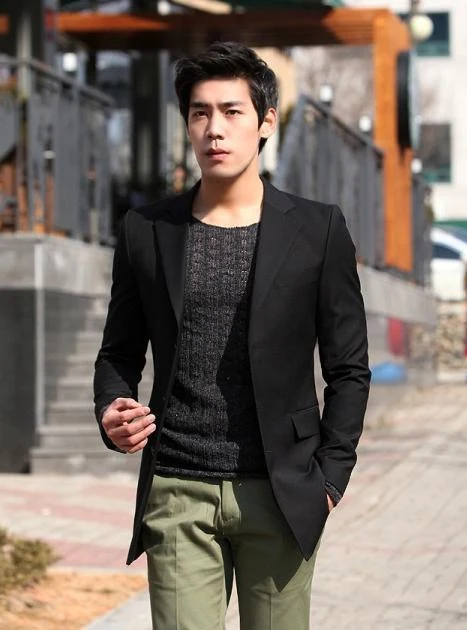
- Choosing a blazer that is too loose to "hide" the belly. Excess cloth makes the body look bigger.
- Choosing a blazer that is too short for fashion. A short skirt brings the belly into plain view.
- Double-breasted. It adds thickness at the chest and belly.
- Large checks or horizontal stripes. The pattern is distorted by the body's curves.
- Fastening every button when sitting. The jacket strains and an X-crease sets in.
A tip from Mon Amie's master tailor
The master tailor always tells clients to try a blazer in three positions: standing, sitting and raising an arm. If you try it only standing, every jacket looks fine. Sit down with the button fastened, then stand up: if the middle button does not pull an X-crease and the shoulders are not pushed up, that jacket passes. And if you have found a blazer you like but the middle button is slightly tight, don't give up on it. Ask the tailor to let out the body seam; sometimes just a few centimetres is enough.
Frequently asked questions
What colour blazer should a heavier man choose?
Navy, charcoal, deep moss green or chocolate brown. They slim the frame and are easy to pair. Lighter colours can still be worn if the jacket fits at the shoulders and the cloth drapes well, but they need more care.
Where can I buy a plus-size men's blazer that fits?
Ready-to-wear in large sizes usually grows evenly, so it is easy to end up loose at the shoulders. Made-to-measure is the surest route, because the tailor calculates the shoulders, chest and belly separately. You can book a measuring appointment so a stylist can advise you specifically.
Should a big-size blazer be double-breasted?
Usually not. Double-breasted makes the chest and belly look thicker. A single-breasted blazer with two buttons or one makes a longer, slimmer V.
Can a plus-size men's blazer jacket be worn in Ho Chi Minh City in hot weather?
Yes, if you choose lightweight wool or a linen blend, half-lined or unlined. If you spend the whole day in an air-conditioned room, you can use a slightly heavier cloth so the jacket drapes well.
Closing thoughts
Choosing a men's blazer for big men really comes down to choosing the right shoulders, the right length and enough room at the middle button. When these three are right, the blazer does the work for you: trim, polished and comfortable all day. If you want a blazer measured to your body, see the bespoke tailoring service and the price list at Mon Amie.