
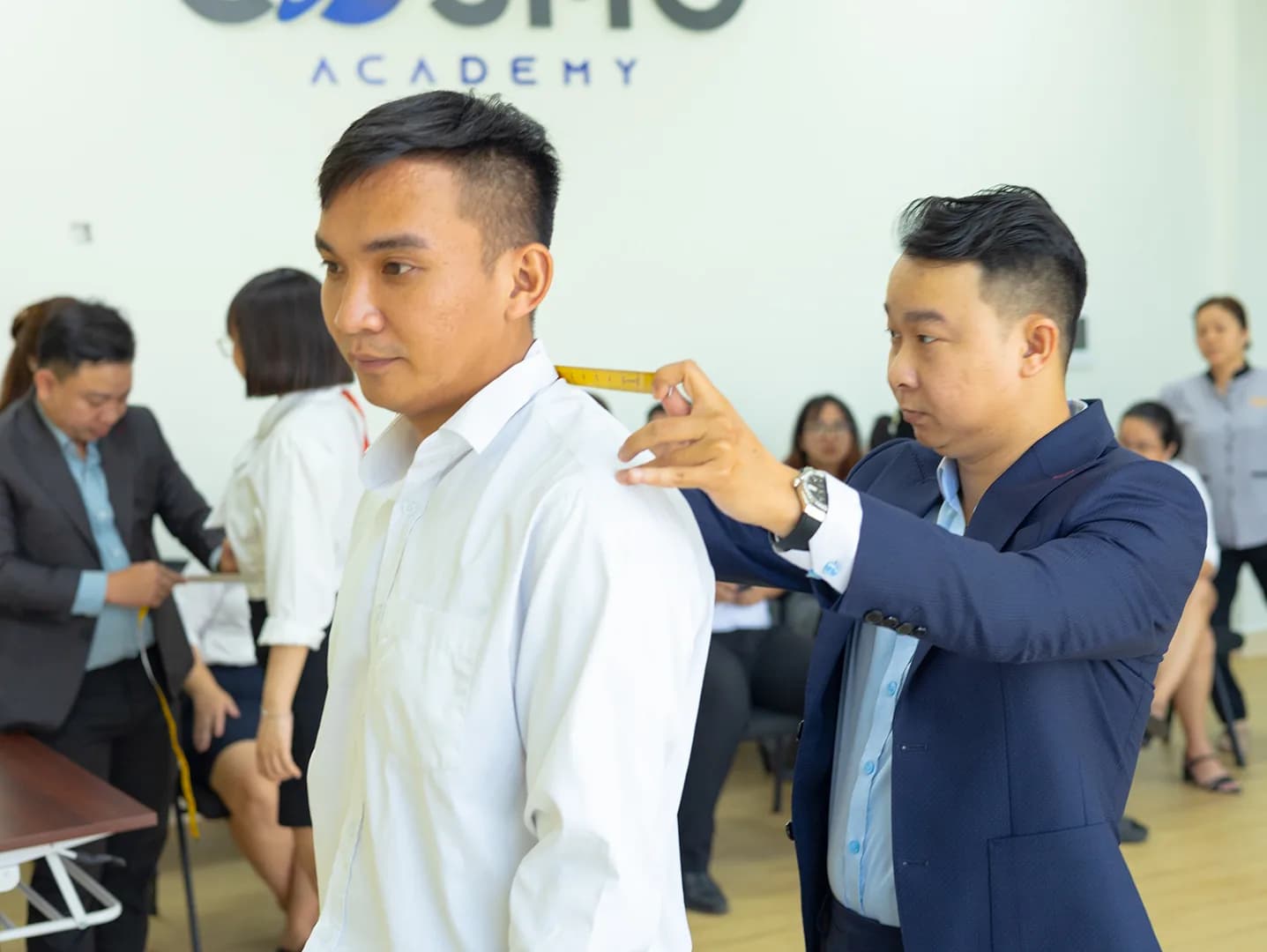
One client held up his phone, pointed at a photo and asked quietly: “This jacket has no collar. Will it look like a staff uniform at work?” Mon Amie hears that question often, and it is hard to argue with. A collarless suit jacket is easy to make look good, but just as easy to turn into a uniform because of three details: the neckline, the fabric and the garment worn underneath.
The short answer
A collarless men's suit jacket drops the lapels and the folded collar, leaving only a round neckline, a V-neck or a band collar. To avoid the uniform look, choose a textured fabric in a muted colour, wear it as a separate with trousers in a different tone, and put a T-shirt or a thin knit underneath instead of a stiff-collared shirt.
What is a collarless suit jacket?
A regular suit jacket has two parts around the neck: the lapel (the flap that folds down over the chest) and the collar (the part that hugs the back of the neck). A collarless jacket, or lapel-free jacket, drops both. What remains is a clean neckline, and that neckline decides the character of the jacket.
In practice there are three common variants:
- Round neck, no lapels: the jacket sits close around the neck with a small gap, a little like a cardigan but with structure. This is the most fashion-forward style and also the easiest to get wrong.
- V-neck, no lapels: a moderately deep V that lengthens the upper body. Safer, and flattering on many body types.
- Mandarin collar: a low standing band, buttoned closed or left open. It looks serious, and if you choose the wrong fabric it can easily recall a technician's or service uniform.
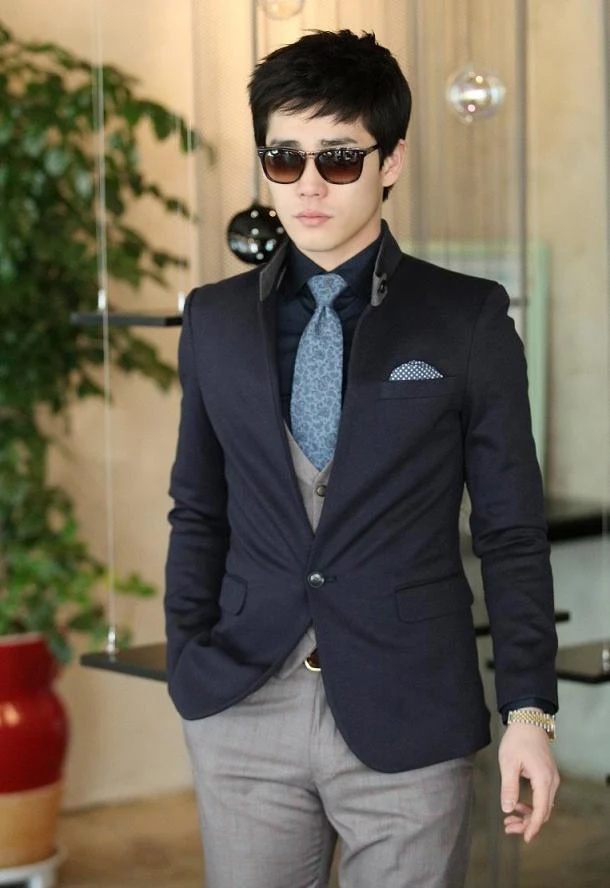
Who suits the lapel-free style?
With no lapels to frame the face, the neckline has to do that job. A few quick rules:
- Long neck, balanced shoulders, slim face: suits most styles. A round neck and a mandarin collar both look very neat.
- Short neck, round face: choose a V-neck without lapels. A tall mandarin collar can “swallow” the neck and make you look hunched.
- Fuller build: choose a straight cut, fabric with good drape and dark colours, and avoid stiff, puffy cloth. A moderately deep V makes the upper body look longer.
- Slim build: a snug round neck works, but the shoulders must match your measurements exactly, because there are no lapels to “hide” a shoulder that is too wide.
Shoulders cannot be altered. On a lapel-free jacket, even a slightly off shoulder shows at once, so choose the jacket by its shoulders first.
Choosing fabric and structure
This is the part that decides between “fashionable” and “uniform”. Uniforms usually follow one formula: flat, plain cloth, the same colour from jacket to trousers, buttoned all the way up. To break out of that formula, change the fabric.
Fabrics to choose
- Wool with visible texture, such as twill, hopsack, or wool with a tonal check. Cloth with depth in its surface looks less “flat”.
- Fine tweed or lightly textured weaves for cooler months.
- Linen-wool or linen-cotton blends for Ho Chi Minh City weather: lighter to wear, yet still holding their shape.
- Thick, substantial knit if you want a genuine cardigan feel.
Fabrics to avoid: shiny, flat, thin polyester. It makes a lapel-free jacket look like a service uniform.
Structure: because there are no lapels or collar to hold the shape, the chest and neckline must be built firmly enough for the edges to lie flat and not flare outward. With too little canvas the jacket sags; with too much it looks like a workwear jacket. This is where the master tailor looks at your body and decides, so it is hard to follow a general formula.
Colours should lean towards muted tones: grey, charcoal, moss green, coffee brown, navy with a grey cast. Plain dark blue is the easiest to read as a uniform.
What to wear underneath: T-shirt, thin knit or shirt?
An open neckline calls for a neat, good-looking layer beneath. A few good options:
- A substantial cotton T-shirt, plain crew neck. White, black or grey. It must be perfectly flat, with no lettering and no stretched-out neck.
- A thin crew-neck knit or fine polo-neck. Suits cool seasons and chilly air-conditioned rooms.
- A band-collar shirt in the same tone as the jacket, or one shade lighter. A band collar under a band collar is a matched pairing, and very clean.
- A fine-knit polo. For relaxed settings; skip it for formal events.
Two things to avoid: a stiff turndown-collar shirt poking up above the neckline (it looks cluttered, as if you put on the wrong layer) and a tie (with no lapels the tie has nothing to rest against and looks as if it is floating).
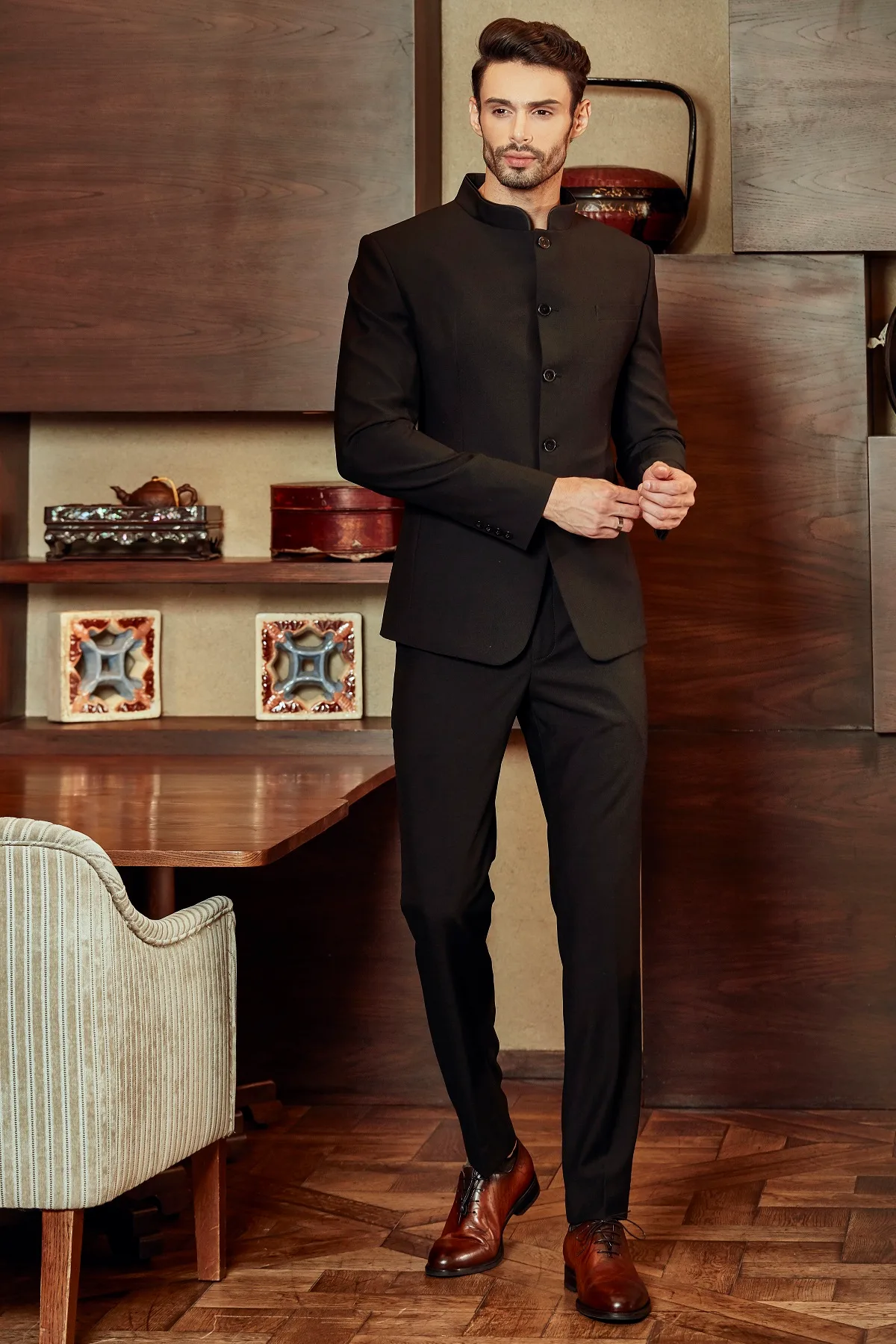
Which occasions suit it, and which do not?
| Occasion | Can you wear a collarless suit jacket? | Suggestion |
|---|---|---|
| Creative office, tech company | Very suitable | V-neck or round neck, textured wool, plain T-shirt underneath |
| Weekend party, café, meeting friends | Very suitable | Wear it as a separate, with suede shoes or leather sneakers |
| Launch event, exhibition | Suitable | Choose muted colours, add a pocket square or a standout watch |
| Meeting traditional partners, banking, law | Worth thinking twice | Use a jacket with lapels, since clients are used to that image |
| Interview at a large company | Better avoided | Stick to a standard lapelled jacket, preferably navy or grey |
| Wedding, formal event | Not recommended | Use a suit or tuxedo with lapels |
If you do not yet have a proper business suit, make a lapelled one first, then add a lapel-free jacket as a second piece for a change of pace.
Common mistakes and tips from Mon Amie's master tailors
- Matching from jacket to trousers. A lapel-free jacket in the same colour as the trousers is the uniform formula. Change the trouser tone: a grey jacket with navy trousers, a brown jacket with beige trousers.
- Buttoning every button. Undo the top button and let the V open up.
- Cloth that hangs like a cloak. The jacket needs structure at the shoulders and chest, otherwise it looks like a dressing gown.
- Ignoring small details. Horn or wooden buttons, patch pockets and a pocket square in a contrasting corner give the jacket its “own voice”.
- Choosing a size from what is on the rack. A lapel-free jacket demands a perfect fit at the shoulders and armholes. Made-to-measure, with the shoulders, armholes and sleeve length cut exactly to your measurements, is the surest way.
One small tip: when trying on the jacket, raise both arms to chest level. If the neckline is pulled along and exposes your neck or the layer underneath, the jacket does not yet fit through the shoulders.
And when it really is a uniform?
For many businesses, the band collar is chosen because it looks serious and uniform across the whole team. The aim is then different: the whole organisation dresses alike, but each person still has to fit properly. For uniform suit jackets, Mon Amie measures each member individually and does not apply generic sizes; for T-shirt, polo and shirt uniforms in large quantities, Mon Amie works through the website maydongphuc.vn. If you are in charge of uniforms for your company, the page on suit-jacket uniforms for businesses explains how it works.
Frequently asked questions
Is a collarless suit jacket the same as a collarless blazer?
Almost. A suit jacket usually means the tailored piece that belongs to a suit, while a blazer is a jacket that can be worn on its own. A collarless blazer is therefore usually worn as a separate and feels more relaxed. If you need broader ways to pair it, the article on choosing a men's blazer will help, and if you are torn between lapel-free and lapelled, the article on wide or standard suit lapels gives you a clear yardstick.
Can a lapel-free jacket be worn to work?
Yes, if your office is not too strict. Creative companies, consultancies, restaurants and hotels all accept it. For banking, law, or meetings with foreign partners, a jacket with lapels is still the safer choice.
What trousers go with a collarless blazer?
Tailored trousers in a different tone from the jacket, such as navy with a grey jacket, or beige with a brown one. Chinos or straight-leg trousers are worth trying. Avoid ripped jeans or trousers that are too tight.
How is a lapel-free jacket different from a cardigan?
A lapel-free jacket is structured at the shoulders and chest, made in a substantial cloth, with pockets and proper suit-jacket stitching. A cardigan is a soft knit with no structure, and it usually holds its shape less well. A lapel-free jacket is more serious than a cardigan but still softer than a jacket with lapels.
Final thoughts
A collarless suit jacket is not for men who are shy of suits, but for men who are already used to them and want something new. If you would like to see the cut, the fabric and the styling on yourself, you can book a fitting at one of our 5 showrooms, or preview the blazer and suit collection first. A stylist will show you which neckline suits your shoulders and neck.